10 things to See and Do in Havana

Plaza de Armas
This is where Havana was founded, originally the governmental and ceremonial center of the city, where military exercises and parades were held. Today, you’ll see lots of book sellers, a shady park and the Hotel Ambros Mundos, where Hemingway lived for a while. The stately 18th-century Palacio de los Capitanes Generales, which now houses the Havana Museum, forms one side of the square and Castillo de la Real Fuerza fortress is nearby.

Plaza de Armas

Plaza de Armas

Continue reading

Growing Up in Cuba, An Interview with Tania Vazquez Paldi, Part 6

To read previous parts of this interview, click below:
Part 1
Part 2
Part 3
Part 4
Part 5

In our last post, Tania was telling us about her work as a tour guide in Cuba in the 1990s. After the fall of the Soviet Union, Cuba had to adjust to the loss of significant economic aid. The development of leisure tourism was one plan to make up for the loss and the country invested in tourist infrastructure and services and allowed foreign hotels to come in.

Tania: After ten years getting to know the tour operators, the ministers etc., Melia decided to create this office in Havana. They were in the beach resort, in Varadero before, but when they moved to Havana because they had so many hotels that they needed to be in the city and they needed a corporate office to do the sales and marketing, rather than the contractors. They needed a team, a bigger team and they decided to hire guides. Why tour guides? Because it’s easy for a tour guide to sell a country because you know your country and its history and everything and you know the industry and the tour operators. You sell first the destination, then the product. So, they called different guides and 2 out of 50 were approved.

Kyna: And you were one.

Tania: I was qualified for the British and English-speaking market and my colleague, Frank, he speaks German and English, so we could share different markets. So, out of 50, 2 were approved. I was lucky. They were so in need of marketing, I started to work in September and in October I was already in Glasgow and all over the UK traveling.

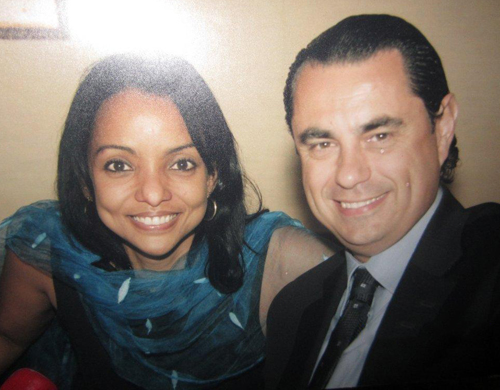
London, 2006 - Tania and a Melia Hotels executive at a gala dinner to announce the novelties of the Melia Hotels in Cuba to UK tour operators and press.

London, 2006 – Tania and a Melia Hotels executive at a gala dinner to announce the novelties of the Melia Hotels in Cuba to UK tour operators and press.

Kyna: Was this the first time you had been out of Cuba?

Tania: No, the first time was in the Bahamas, but it was like being in Cuba, it’s very close. That was 1993, when I was a tour guide.

Kyna: You started traveling to Europe in 2000…

Tania: 2003

Kyna: How was that?

Tania: It was an adventure. Traveling is an adventure every time you go out. But for me it was okay because I developed the skill of traveling when I was a tour guide. Even in traveling your own country, you know, you get a plane, you check into a hotel, you have to find your way, you have to ask and be social, so you get all those skills once you’re a tour guide.

Kyna: Plus you had been working with people from these countries.

Tania: Exactly, it was the best experience. I have no issue, anywhere I go. Even if I don’t speak the language, I always find my way. You cannot imagine how many times I got lost in London, sometimes with the telephone battery dead and people helping me, giving me their phones to call. Everywhere I go, I always get lost and I ask people. People help you. It’s fun. As long as you respect people and they respect you back. In 2003, when I started to travel I realized I always had the dream of being a tourist instead of a tour guide, and now I am a tourist.

Kyna: How does the Cuban government chose people who will be traveling outside of the country. They want to pick people who are a low risk for defection. You had small children at home…

Tania: You go through a background check but there is always a risk. I have friends and colleagues who decided to defect. Most of them did not have kids. I had several opportunities but I didn’t. Not because of my kids because in the end you can file a claim and get them out. I didn’t do it because the company put trust in me. Morally I couldn’t do it. Some people understand that, some do not. I had a good life. Not all the Cubans that live here or abroad defected. Some, like me, they married or came to live with their family. Sometimes, when I speak with Cubans who defected, they are very negative about Cuba and assume I agree. I understand maybe they had bad experiences but my experience was not bad. It’s not black and white. You have to be pragmatic. I know there are bad things about Cuba but there are good things too. I have met a lot of Cubans abroad, some are doing well, some not so well, but most of them would like to be back in Cuba. I’m sure when it changes, many will be back.

This concludes my first interview with Tania. We plan to sit down again over coffee and treats, probably after the holidays, so stay tuned. I have a list of things I want to talk about, including religion and the black-market in Cuba. If there’s anything in particular you’d like me to ask Tania, please let me know.

www.yallatours.com

Growing Up in Cuba, An Interview with Tania Vazquez Paldi, Part 3

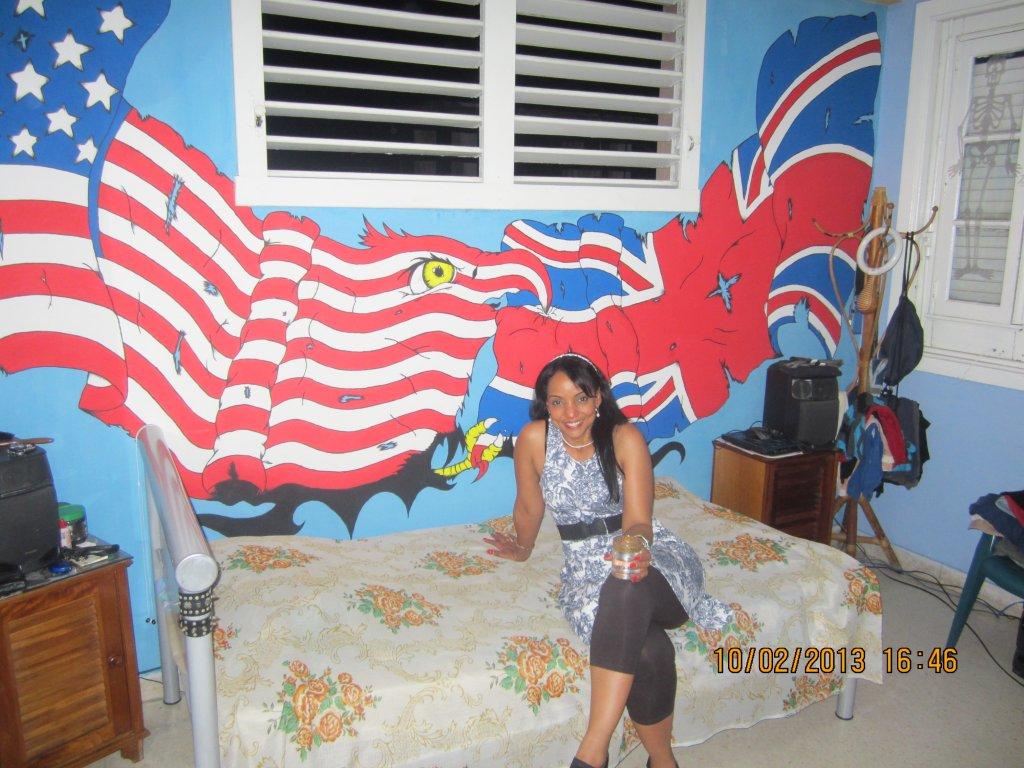
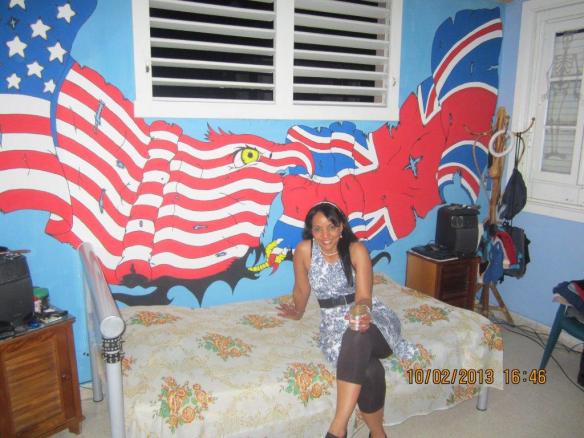
Tania at her house in Havana, with a mural painted by her son.

Tania at her house in Havana, with a mural painted by her son.

Here’s another installment of my interview with Tania Vazquez Paldi about her life in Cuba. In this part, we’re discussing housing.

Tania moved from Havana, Cuba to Portland, Oregon about two years ago.
For a short bio of Tania and the first part of our conversation click.
For part 2, click.

Tania: Housing was another Revolution.There were a lot of people, in the countryside mainly, that didn’t have houses. Farmers were moving from place to place because they didn’t own the land. That was one thing that happened in favor of the population. The farmers were given the land and people living in the city, like my parents, they were given housing. Those that helped or fought, they got better housing. So my father, as part of the army, he could get a nice apartment in a nice area.

Kyna: Before the Revolution were they renting?

Tania: Yes, my father, because he’s from the countryside, he was living in a humble house in the countryside.

Kyna: After the Revolution, tenant farmers were given land by the government?

Tania: Yes, land was taken from the land owners and foreign companies in the Agrarian Reform and transferred to the farmers who were already living on the land and working it. They then paid the government to own the land, according to their income and with no interest. Farmers were also subsidized to buy seed and equipment and they had to sell a certain portion of their crops to the government. Today it is the same but with Raul’s reforms, farmers can also sell to hotels and private restaurants. Although, when I was just in Cuba in October, the manager at the Iberostar Hotel in Trinidad told me that the farmers are charging foreign hotels 7-times the normal rate.

Kyna: Is that because  sales to private companies are heavily taxed?

Tania: I’m not sure, probably so.

Kyna: Can they sell their land?

Tania: Now they can sell it but not before last year.

Kyna: So, farmers became land owners.

Tania: Yes, the same in the city. I was able to pay off my mother’s house, the one given to my father after the Revolution. They divorced and my father was granted another apartment and he, of course, left the house to us. Later, we swapped that 2-bedroom apartment for a 3-bedroom apartment, with some money for the exchange. We lost the location, though we were in the same center, not as nice a neighborhood as where we used to live, but we got a bigger place.

Kyna: Was that complicated, changing apartments like that?

Tania: It was not but you had to hide from the housing department the fact that you were getting some money in the exchange. You go there; you sign the papers; you do everything legal. Swapping is legal. They call it in Spanish “permutas.” It’s swapping from place to place. You were not allowed to buy.

Kyna: Would you put in a request to change?

Tania: In radio and magazines you can read announcements for swapping. You were allowed to trade exactly, but no money involved. There are certain areas, parks and neighborhoods, were people go who want to swap houses or apartments, kind of a network.

Kyna: You ended up getting some money in the swap because your place was more valuable?

Tania: Yes, the location.

Kyna: Did you have to pay the government to facilitate the swap?

Tania: A very tiny fee, for paperwork.

Kyna: And you had to hide that you got money in the trade?

Tania: yes

Kyna: But it’s standard to exchange money, just not official?

Tania: Yes but some people just do furniture, stuff like that, some kind of hook. That still happens, even with the sales.

Kyna: and your father was given another place…

Tania: Because he was committed to the Revolution and to the government,  so he was rewarded that way. It was not as good as the one he was given the first time but it was in a good area.
Growing Up in Cuba, An Interview with Tania Vazquez Paldi, Part 2

Here’s another installment of my interview with Tania Vazquez Paldi about her life in Cuba. Tania moved from Havana, Cuba to Portland, Oregon about two years ago. For a short bio of Tania and the first part of our conversation, click here.

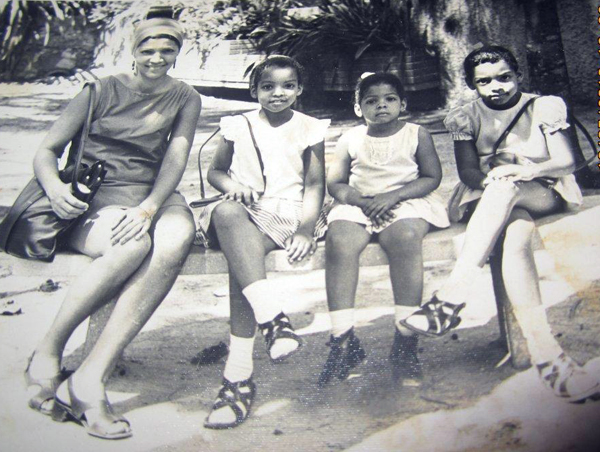
Tania, with mom and sisters, mid-1970s, Cuba

Tania, with mom and sisters, mid-1970s, Cuba

Kyna: Was there any public education before the Revolution?

Tania: There was, primary education and high school, but after that it was a matter of how wealthy you were. And precisely my grandmother on my father’s side, she’s from Guantanamo, a very remote area, that province, which is a very poor area. My grandmother from my mother’s side, she had a better living because her father had a farm with cattle and they ate very well. She’s also from the countryside in Guantanamo but she could get a better education. She became a tailor and she bought a house downtown, in the city of Guantanamo. She had a better living than my other grandmother.

Kyna: She had these things before she married?

Tania: Yes. Then she had four daughters, which are my mom and my aunties, and she could afford, before the Revolution, to buy clothing for her daughters and to feed them properly and to educate them. My mom, before the Revolution, was studying medicine in college.

Kyna: To be a doctor?

Tania: Yes.

Kyna: And she left when she got pregnant?

Tania: Yes, she got overwhelmed and then my sister came. She had only the help of my grandmother, and she was working too. She couldn’t afford more help, so she had to stop studying. But when the Revolution first came, she was studying but she stopped to go to the countryside to teach the farmers. She told me very interesting stories. She even had to sleep in a stable sometimes, with the animals because they were so poor, the family she was teaching, that they didn’t have a place for her.

Kyna: She would go and stay with a particular family?

Tania: Yes

Kyna: She would stay there for a few months?

Tania: Yes

Kyna: A family would get their own private tutor, basically?

Tania: Yes. The Literacy Campaign was so important. There was so much illiteracy that any student who could read or write could join the campaign and go and help.

Kyna: Was it voluntary?

Tania: It was voluntary.

Kyna: Were they paid?

Tania: No, it was voluntary, they were not paid. During the heat of the Revolution, you know, everyone wanted to help because they wanted this to succeed and there was no money. Everything was from scratch. They changed the currency. Many people lost a lot of money because they had money in the bank and they could only take out a certain amount and the rest was frozen. Then the embargo against Cuba started. So, Cuba had to start from nothing. Everything was voluntary, at the beginning.

Tune in next time for more of our conversation.

The winner of this week’s drawing is Linda of South Suburban Travel Professionals in the greater Chicago area. Congratulations Linda!

Saint Joan of the Worms

“Worms?  You brought worms?”

We were on a motor coach on a busy street In Havana, on a legal ministry trip to deliver lotions, soaps and medical supplies to the Cuban people, and this was the question as we gathered some of our supplies for a stop at one of the churches.

“I thought that was something you brought home with you,” said another traveler.

Laughs.

“Not real worms,” said Joan, the worm carrier.  “Fake ones.  For bait.”

Our trip through Cuba took us to a number of stops, but finally the right stop for the delivery of the worms took place not far from the Cuban home of Ernest Hemingway, the famous American author of The Old Man and the Sea.  Hemingway lived in Cuba from the 1930’s to just after the Cuban Revolution of 1959.  There he wrote and he drank and he was known as “Papa Hemingway.”

Not far from Finca Vigía or Lookout Farm, there is a bust of Hemingway  on a pillar near the sea. The motor coach stopped and while some of us – okay, only me – sat and relaxed in the heat of the sun, others, including Joan, walked to a nearby pier where children and men were fishing. That is where she delivered her worms.

I can only imagine the sight. A bus full  of Yanquis arrive from nowhere and deliver what might be the first rubber worms ever in Cuba to an unsuspecting village crowd one afternoon and then disappear forever. It might go down in Cuban legend and lore, especially if those worms catch some big fish.

And with every legend there is a hero or a heroine, and that would be our own St. Joan of the Worms. 

Saint Joan may get her own bust right next to “Papa Hemingway.”

ricardo
Guest blogger Rich Davis is the Ya’lla Tours Midwest regional sales manager.
He just returned from escorting a group in Cuba. Check out his previous posts RevisitingTrinidad de Cuba and The Old Man and His Pee.

The Old Man and His Pee

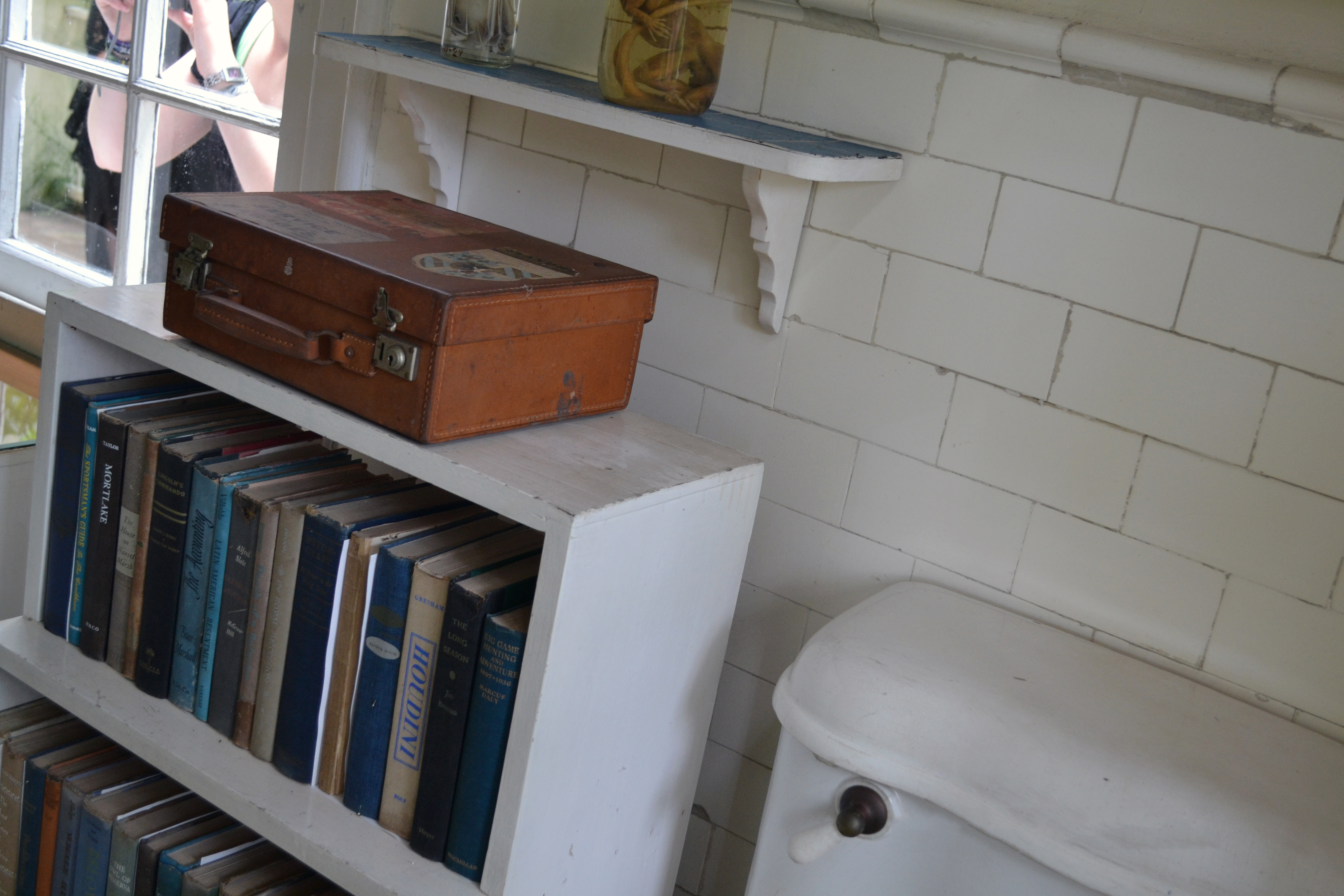
Hemingway's bathroom, Finca Vigia, Cuba

Hemingway’s bathroom, Finca Vigia, Cuba

Most all of us do it: we read while on the throne. Today that reading can be done with an iPad or the old-fashioned way, on paper.

While visiting Ernest Hemingway’s home on a legal trip to Cuba I became curious as to what the most famous American author of the 20th Century might have read while going potty.

Hemingway lived in Cuba from the 1930’s to 1960, when he left due to the Cuban Revolution of 1959.  He had a beautiful home just outside Havana called Finca Vigía or “Lookout Farm.” When Hemingway left Cuba the government took possession of his home. After his death in 1961, his widow was allowed to come back and take some personal things back with her, but the house remains as Hemingway left it, lined with books and trophies of his big game hunting days in Africa, and, of course, his reading material in the bano.

Hemingway and Cuba have quite a history together. Hemingway wrote a number of his famous novels there, including The Old Man and the Sea, which was based on a local fisherman. So intertwined with Cuba is Hemingway, that many people when visiting go to some of his favorite haunts, including his home and the El Floridita Bar, where the Daiquiri was invented.

We were on a legal trip to Cuba, whose purpose was to deliver much-needed goods to the Cuban people, such as soaps and lotions and medical supplies, but I had a chance to see what Hemingway read while pooping, so I examined the bookshelf next to the commode. You can only view it from the outside, as with all the rooms in the house, and I craned my neck to take a look at some of the volumes.  A few stood out.

One book was on the adventures of big game hunting and one other that caught my eye was a biography of Houdini.

Houdini was of course the famous escape artist of the early 20th Century, and I couldn’t help but wonder if, for all his bravado, whether Hemingway suffered from constipation and if he was reading about different escape methods that might have included ingested food.

The next time I go to Cuba, I will search out the el supremo story of what the most famous person in Cuba reads on his throne.

Fidel?

ricardo
Guest blogger Rich Davis is the Ya’lla Tours Midwest regional sales manager.
He just returned from escorting a group in Cuba. Check out his previous post written from Trinidad.

My heart is always with Cuba

Image

I didn’t know I would be having a love affair with Cuba, back in 2003,  when I first visited.  In fact, I didn’t know what to expect.  I had been to most of the Caribbean islands, but until Ya’lla Tours became a Travel Service Provider to Cuba, I had not given the island much thought. To me, it was just another rock in the sea, though a big one: Cuba is the seventh largest inhabited island in the world. Continue reading

The Best Paladares in Cuba

A paladar is a privately owned and operated restaurant in Cuba. Although they have been around since the 1990s (and illegally so before that), paladares are having a bit of a surge right now. That’s an understatement, really, they’re going gangbusters, popping up all over the place in Havana and Trinidad and even in some smaller cities, like Cienfuegos. Since new economic reforms introduced in late 2010, the paladares have a lot more freedom around what they can serve and the number of diners they can seat. Continue reading