NAME THAT COUNTRY! Episode 2

The answer to the last episode (Episode 1) is: ISRAEL.
Site 1 – Acko, ancient Acre
Site 2 – Caesarea Maritima, built by Herod the Great
Site 3 – Caesarea Philippi, built by Herod’s son Philip II

Now for this episode –

All the clues in this post refer to one Ya’lla Tours destination: Bahrain, Cuba, Egypt, Greece, Israel, Jordan, Morocco, Oman, Turkey, or United Arab Emirates.

We’ll show you images of popular tourist sites in our mystery country, along with descriptions of those sites. Continue reading

NAME THAT COUNTRY! Episode 1

NAME THAT COUNTRY!

All of the clues in this post refer to one Ya’lla Tours destination: Bahrain, Cuba, Egypt, Greece, Israel, Jordan, Morocco, Oman, Turkey, or United Arab Emirates.

We’ll show you images of popular tourist sites in our mystery country, along with  descriptions of those sites. Continue reading

Gay-Friendly Cuba

Is Cuba “gay-friendly?”

That is a question that has been asked of many destinations, and certainly of some Caribbean island destinations in recent years, and the good news is that Cuba is gay-friendly, to a fairly high degree.

According to Ronen Paldi, President of Ya’lla Tours USA, “Today, with Raul being in the closet and his daughter heading the ‘Gay Coalition’ (she is out of the closet), Cuba is gay friendly.” Ya’lla Tours has been a US Treasury Licensed Travel Service Provider to Cuba since 2002, and has sent thousands of people to Cuba.

How are gay visitors and natives treated in Cuba? Paldi goes on to say that gay visitors experience the same Cuba as everybody else. Cuba is a huge attraction for those who are interested in religion, culture, arts and social interaction with the Cuban people. Cubans who are gay are not persecuted like they were under Fidel’s power, according to Paldi.

Further, Cuba does have a gay social scene. “There are clubs that gay people feel more comfortable going to, and we recommend those clubs as a matter of course,” said Paldi.

While same-sex relationships might not be celebrated in Cuba (public displays of affection are not encouraged), they are fairly well tolerated, and people are free to be themselves.

Paldi reminds potential visitors to Cuba that travel to Cuba is restricted, and US Citizens and foreign nationals living in the United States, must comply with the law in any travel to Cuba.

Rich Davis, Ya'lla Tours USA Sales Manager, Midwest Region

Rich Davis, Ya’lla Tours USA Sales Manager, Midwest Region

Guest blogger Rich Davis is the Ya’lla Tours USA sales manager in the Midwest region. He’s based in Chicago.

Farewell 2013, Ya’lla 2014!

Grand Mosque, Abu Dhabi, United Arab Emirates

Grand Mosque, Abu Dhabi, United Arab Emirates

2013 was an eventful year at Ya’lla Tours USA.

To begin with, it was our 20th anniversary. In 1993 Ronen Paldi, Israeli native, landed in Portland, Oregon and opened Ya’lla Tours USA. He based the company philosophy and operations on the practical experience he gained as a tour guide for over 10 years in Israel and Egypt, on the ground day-to-day with travelers.

Our really big news in 2013 was the introduction of not 1 but 4 new countries to our repertoire – the UAE, Oman, Qatar and Bahrain. Our tag line “specialists to the exotic Mediterranean” no longer covers it. These were our first new destinations in over 10 years. Clients often nudged us to cover Italy, Spain and France because they combine nicely with our existing countries (Israel, Jordan, Egypt, Morocco, Greece,Turkey). However, there are already many well-established, quality tour operators to Italy, Spain and France and the world really doesn’t need another one. Ronen’s excellent business sense told him that there was not room in that market for us and chose to stay focused on our product line in the Middle East/Eastern Mediterranean (plus Cuba, which is another thing altogether). The Arabian Peninsula, on the other hand, is a relatively untapped market for American travelers and it fits well culturally and geographically with our other countries, while also bringing something new.

Perhaps what sealed the deal was that our dear Jordanian friends Gaby and Reem operate a travel services company in Dubai. They were our ground operator in Jordan back in the 1990s. So, although the destinations are new, we have friends we trust advising us and taking care of our clients. They know us, how we operate, what we expect and we know they will deliver. I think it was meant to be. In addition to Gaby and Reem, the director of our office in Egypt is very familiar with the area, having visited there many times. His input was essential as we began to select hotels and compose itineraries.

Ronen and Tania went to the Arabian Peninsula for the first time in June. When they returned we had a meeting in Portland with all of our sales reps from around the country, something we hadn’t done in three years. It was fun to have everyone in the same room together and exciting to be learning about new places.

In early December Ronen returned to the Arabian Peninsula with our entire sales team, Teri McCulloh, our general manager, our videographer and 18 travel agency owners and managers. Some of us stayed behind to hold down the fort… My colleagues went to the Arabian Peninsula and all they brought me was 1,000+ pictures… (and that’s enough!)

Speaking of colleagues, we got a new one, just as the year was drawing to a close – Michael Walsh, our new sales manager in California and Colorado. Welcome Michael!

Finally, my 2013 babies, our pretty new web site and this blog, both of which will benefit from those 1,000+ photos mentioned above.

In 2014 we’ll continue to deepen our knowledge of the Arabian Peninsula; Egypt, Greece, Israel, Jordan, Morocco, Turkey and Cuba too, and share what we know with you. Thanks for reading.

We wish you a healthy, peaceful and prosperous 2014.

Stocking-Stuffers for Your Travelers

My picks for stocking-sized travel gifts from TravelSmith.com:

All suitcases look alike, especially after emerging from a 12-hour flight into a strange airport with thousands of other disoriented people. These bright tags from TravelSmith stand out against all that circling black so you’ll spot your bag in time to lift it off the carousel on the first pass and be on your way to a hot shower and soft bed.

Bright luggage tags with your initial.

Bright bag tags with your initial.

Are you planning a trip to Egypt? Cuba? Morocco? Jordan? Dubai? …
Two words: personal fan. Yes, blowing your face with a tiny fan on a lanyard is less than dignified. Believe me, you won’t care. Dry heat or not, when it’s 120F in the shade, dignity is your last concern. Cool off and enjoy the sites. Even Hades is no match for the intrepid traveler armed with a tiny yet powerful fan on a lanyard.

personal fan

personal fan

Once I rode in a motor coach from Tiberias, Israel on the Sea of Galilee, below sea level, up about 5,000 feet into the Golan Heights on a very windy road. Throughout the ride, it took all my powers of concentration to hold my lunch down, but I did. Just behind me, a woman and her seatmate were not so lucky. The lunch of one ended up in the lap of the other. Pity none of us were wearing PSI bands.

PSI bands to combat motion sickness

PSI bands to combat motion sickness

Ever cry and stomp your feet like a frustrated toddler in the Musée D’Orsay? I have. Standing mere inches from Renoir, Cézanne, Manet, Van Gogh, there was no joy; jet lag sucked it away. I would have given anything to go back to my hotel and sleep but my mean travel companion wouldn’t let me (you know who you are). He insisted we stay up all day our first day in Paris, to acclimate to the time change. I purposely lost him at one point, found a vacant corner and just leaned into it. If I thought I could get away with it, I would have been horizontal on a bench. I hated the masterworks of French Impressionism for standing between me and sweet, sweet sleep. I hated the splendid, converted train station that is the museum. I hated the happy, time-adjusted people all around me.

This was many years ago, either before jet lag remedies existed or before I knew about them. Now, jet lag is just unnecessary. These No-Jet-Lag tablets work.

No Jet Lag pills

No Jet Lag pills

Smell pretty across the globe with these leak-free, TSA-approved, travel atomizers.

pocket atomizer

pocket atomizer

Merry Christmas!

www.yallatours.com

Growing Up in Cuba, An Interview with Tania Vazquez Paldi, Part 6

To read previous parts of this interview, click below:
Part 1
Part 2
Part 3
Part 4
Part 5

In our last post, Tania was telling us about her work as a tour guide in Cuba in the 1990s. After the fall of the Soviet Union, Cuba had to adjust to the loss of significant economic aid. The development of leisure tourism was one plan to make up for the loss and the country invested in tourist infrastructure and services and allowed foreign hotels to come in.

Tania: After ten years getting to know the tour operators, the ministers etc., Melia decided to create this office in Havana. They were in the beach resort, in Varadero before, but when they moved to Havana because they had so many hotels that they needed to be in the city and they needed a corporate office to do the sales and marketing, rather than the contractors. They needed a team, a bigger team and they decided to hire guides. Why tour guides? Because it’s easy for a tour guide to sell a country because you know your country and its history and everything and you know the industry and the tour operators. You sell first the destination, then the product. So, they called different guides and 2 out of 50 were approved.

Kyna: And you were one.

Tania: I was qualified for the British and English-speaking market and my colleague, Frank, he speaks German and English, so we could share different markets. So, out of 50, 2 were approved. I was lucky. They were so in need of marketing, I started to work in September and in October I was already in Glasgow and all over the UK traveling.

London, 2006 - Tania and a Melia Hotels executive at a gala dinner to announce the novelties of the Melia Hotels in Cuba to UK tour operators and press.

London, 2006 – Tania and a Melia Hotels executive at a gala dinner to announce the novelties of the Melia Hotels in Cuba to UK tour operators and press.

Kyna: Was this the first time you had been out of Cuba?

Tania: No, the first time was in the Bahamas, but it was like being in Cuba, it’s very close. That was 1993, when I was a tour guide.

Kyna: You started traveling to Europe in 2000…

Tania: 2003

Kyna: How was that?

Tania: It was an adventure. Traveling is an adventure every time you go out. But for me it was okay because I developed the skill of traveling when I was a tour guide. Even in traveling your own country, you know, you get a plane, you check into a hotel, you have to find your way, you have to ask and be social, so you get all those skills once you’re a tour guide.

Kyna: Plus you had been working with people from these countries.

Tania: Exactly, it was the best experience. I have no issue, anywhere I go. Even if I don’t speak the language, I always find my way. You cannot imagine how many times I got lost in London, sometimes with the telephone battery dead and people helping me, giving me their phones to call. Everywhere I go, I always get lost and I ask people. People help you. It’s fun. As long as you respect people and they respect you back. In 2003, when I started to travel I realized I always had the dream of being a tourist instead of a tour guide, and now I am a tourist.

Kyna: How does the Cuban government chose people who will be traveling outside of the country. They want to pick people who are a low risk for defection. You had small children at home…

Tania: You go through a background check but there is always a risk. I have friends and colleagues who decided to defect. Most of them did not have kids. I had several opportunities but I didn’t. Not because of my kids because in the end you can file a claim and get them out. I didn’t do it because the company put trust in me. Morally I couldn’t do it. Some people understand that, some do not. I had a good life. Not all the Cubans that live here or abroad defected. Some, like me, they married or came to live with their family. Sometimes, when I speak with Cubans who defected, they are very negative about Cuba and assume I agree. I understand maybe they had bad experiences but my experience was not bad. It’s not black and white. You have to be pragmatic. I know there are bad things about Cuba but there are good things too. I have met a lot of Cubans abroad, some are doing well, some not so well, but most of them would like to be back in Cuba. I’m sure when it changes, many will be back.

This concludes my first interview with Tania. We plan to sit down again over coffee and treats, probably after the holidays, so stay tuned. I have a list of things I want to talk about, including religion and the black-market in Cuba. If there’s anything in particular you’d like me to ask Tania, please let me know.

www.yallatours.com

Growing Up in Cuba, An Interview with Tania Vazquez Paldi, Part 5

To read previous parts of this interview, click below:
Part 1
Part 2
Part 3
Part 4

When we left off, we were discussing how Tania got her start in the tourism industry in Cuba. After studying English at university, she had hoped to work in a hotel but was told she was over qualified. Then she got a call from the Cuban tourism company Cubanacan to work as a tour guide.

Kyna: When was this, what year?

Tania: That was in 1991.

Kyna: So, that was right after Russia was out of there, really hard times.

Tania: Exactly and that was the beginning of real Western tourism. What we had before were political groups, students that came for political or social reasons.

Kyna: You mean from Communist countries?

Tania: And from America too, kind of like People to People.

Kyna: But not vacation tourism?

Tania: No. Socio-politic, they used to call it, socio-politic groups.

They used to meet Communist Party members and stuff like that. That was the type of tourism that we had.The real tourism really broke out after 1991, after the collapse of the Soviet Union. I worked with the first FITs and groups coming from the UK with Thompson Holidays, the first tour operator to do flights directly to Varadero, to the beach resorts.

Kyna: Were they building beach resorts?

Tania: Oh yes. Melia came into the picture in 1990. In 1990 they built Sol Palmeras, in 1991 Melia Las Americas and several other hotels, they were building infrastructure very strategically to develop tourism. Then came Super Clubs, Iberostar and different hotel chains.

Kyna: What about existing hotels, from before the Revolution?

Tania: They were owned and managed by the government. Later they were commercialized. There was a lot of competition.

So, my work as a tour guide gave me the opportunity to get experience in the industry, to deal with the tour operators, to get to know the resorts, the different sites.

www.yallatours.com


Growing Up in Cuba, An Interview with Tania Vazquez Paldi, Part 4

Here’s another installment of my interview with Tania Vazquez Paldi about her life in Cuba. In this part, we’re discussing Tania’s work in the travel industry in Cuba.

Tania moved from Havana, Cuba to Portland, Oregon about two years ago.
For a short bio of Tania and the first part of our conversation click.
For part 2, click.
For part 3, click.

Kyna: How did you get into the position that allowed you to travel outside of Cuba extensively?

Tania: When I started at college, I did a Bachelor of Arts in languages and literature. I was supposed to be, after I graduated, a translator or a teacher of English Literature. But I didn’t want that. I wanted to be in the tourist industry always.

Kyna: Did you chose your degree of study or where you placed?

Tania: You had three choices, it depends on your scripts and your curriculum.

Kyna: Your aptitude… so, they track you and they decide what you’re good at and give you three choices.

Tania: They interview you as well. My choices were journalism, architecture and then translation.

Kyna: Journalism and architecture were very competitive?

Tania: Very competitive, very demanding

Kyna: For journalism, I would think you would have to be really committed to the party, to be a card-carrying Communist.

Tania: Correct, and I was no part of any political organization what-so-ever, though I had to behave.

Kyna: Do you think, because your father was so loyal to the Revolution, that helped you in any way?

Tania: If it did. I don’t know. They always do a background check on you and I’m sure it came out and it was a positive thing in my favor but they never tell you. And, I always behaved. I was not involved in any issues or trouble or social movements. I was a standard student. So I was approved and I was happy it happened. I really liked what I was studying; I really liked all these subjects – history, art, literature, languages. I did attempt to leave the university because I wanted to become a stewardess. My father, smartly, told me, “Don’t; finish what you started and whatever you want to become after that, that’s fine, but you have to finish.” I was so upset but now I understand why he was so right. So I finished and then became a tour guide. That was another accident that happened that was for good. I wanted to work in a hotel but because I was over qualified, they didn’t accept me. I was so disappointed and I was crying one day and my mother came with a telegram and said, “They called you from Cubanacan,” that still exists, “and they are looking for tour guides and they want to interview you.” So I stopped crying and then I went to this agency. They were just starting to create this group of guides because that was the beginning of tourism, Western tourism.

Kyna: When was this, what year?

Tania: That was in 1991.

In Wednesday’s post we’ll continue with Tania’s experiences as a tour guide.

Growing Up in Cuba, An Interview with Tania Vazquez Paldi, Part 3

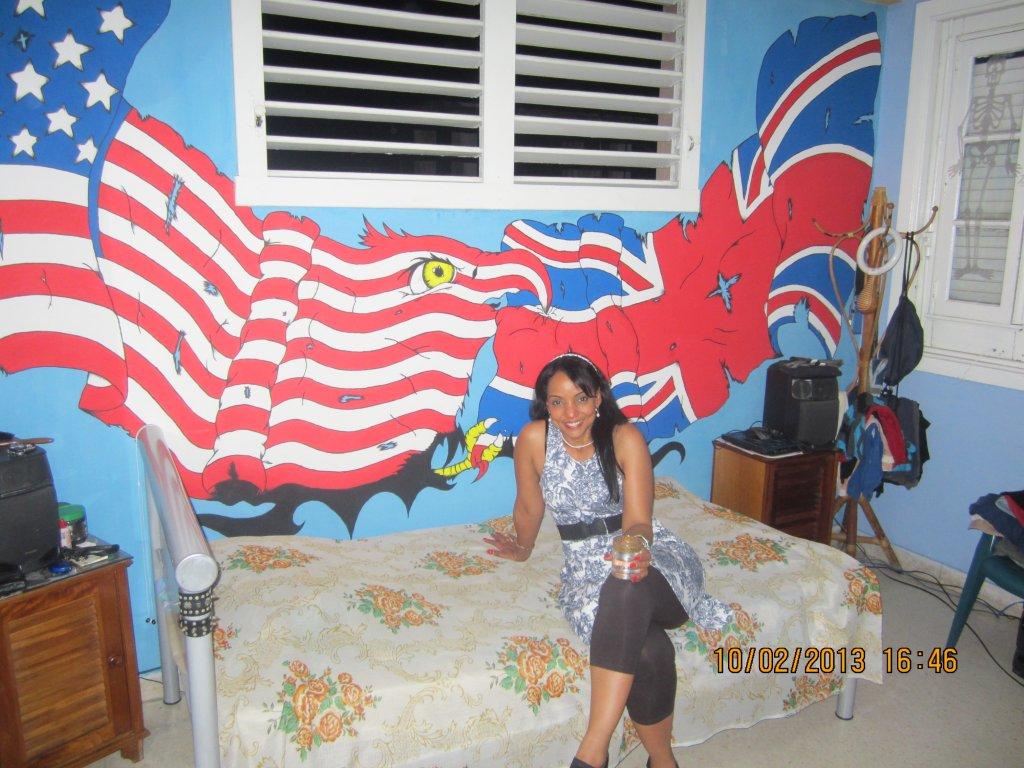
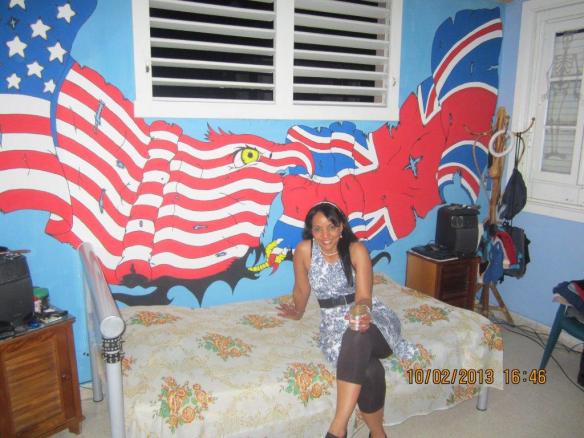
Tania at her house in Havana, with a mural painted by her son.

Tania at her house in Havana, with a mural painted by her son.

Here’s another installment of my interview with Tania Vazquez Paldi about her life in Cuba. In this part, we’re discussing housing.

Tania moved from Havana, Cuba to Portland, Oregon about two years ago.
For a short bio of Tania and the first part of our conversation click.
For part 2, click.

Tania: Housing was another Revolution.There were a lot of people, in the countryside mainly, that didn’t have houses. Farmers were moving from place to place because they didn’t own the land. That was one thing that happened in favor of the population. The farmers were given the land and people living in the city, like my parents, they were given housing. Those that helped or fought, they got better housing. So my father, as part of the army, he could get a nice apartment in a nice area.

Kyna: Before the Revolution were they renting?

Tania: Yes, my father, because he’s from the countryside, he was living in a humble house in the countryside.

Kyna: After the Revolution, tenant farmers were given land by the government?

Tania: Yes, land was taken from the land owners and foreign companies in the Agrarian Reform and transferred to the farmers who were already living on the land and working it. They then paid the government to own the land, according to their income and with no interest. Farmers were also subsidized to buy seed and equipment and they had to sell a certain portion of their crops to the government. Today it is the same but with Raul’s reforms, farmers can also sell to hotels and private restaurants. Although, when I was just in Cuba in October, the manager at the Iberostar Hotel in Trinidad told me that the farmers are charging foreign hotels 7-times the normal rate.

Kyna: Is that because  sales to private companies are heavily taxed?

Tania: I’m not sure, probably so.

Kyna: Can they sell their land?

Tania: Now they can sell it but not before last year.

Kyna: So, farmers became land owners.

Tania: Yes, the same in the city. I was able to pay off my mother’s house, the one given to my father after the Revolution. They divorced and my father was granted another apartment and he, of course, left the house to us. Later, we swapped that 2-bedroom apartment for a 3-bedroom apartment, with some money for the exchange. We lost the location, though we were in the same center, not as nice a neighborhood as where we used to live, but we got a bigger place.

Kyna: Was that complicated, changing apartments like that?

Tania: It was not but you had to hide from the housing department the fact that you were getting some money in the exchange. You go there; you sign the papers; you do everything legal. Swapping is legal. They call it in Spanish “permutas.” It’s swapping from place to place. You were not allowed to buy.

Kyna: Would you put in a request to change?

Tania: In radio and magazines you can read announcements for swapping. You were allowed to trade exactly, but no money involved. There are certain areas, parks and neighborhoods, were people go who want to swap houses or apartments, kind of a network.

Kyna: You ended up getting some money in the swap because your place was more valuable?

Tania: Yes, the location.

Kyna: Did you have to pay the government to facilitate the swap?

Tania: A very tiny fee, for paperwork.

Kyna: And you had to hide that you got money in the trade?

Tania: yes

Kyna: But it’s standard to exchange money, just not official?

Tania: Yes but some people just do furniture, stuff like that, some kind of hook. That still happens, even with the sales.

Kyna: and your father was given another place…

Tania: Because he was committed to the Revolution and to the government,  so he was rewarded that way. It was not as good as the one he was given the first time but it was in a good area.
Growing Up in Cuba, An Interview with Tania Vazquez Paldi, Part 2

Here’s another installment of my interview with Tania Vazquez Paldi about her life in Cuba. Tania moved from Havana, Cuba to Portland, Oregon about two years ago. For a short bio of Tania and the first part of our conversation, click here.

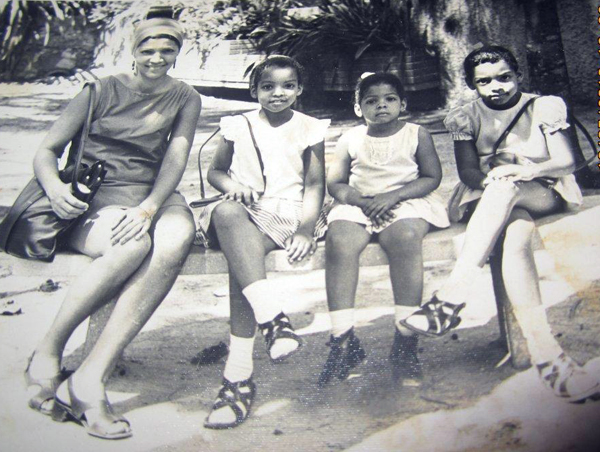
Tania, with mom and sisters, mid-1970s, Cuba

Tania, with mom and sisters, mid-1970s, Cuba

Kyna: Was there any public education before the Revolution?

Tania: There was, primary education and high school, but after that it was a matter of how wealthy you were. And precisely my grandmother on my father’s side, she’s from Guantanamo, a very remote area, that province, which is a very poor area. My grandmother from my mother’s side, she had a better living because her father had a farm with cattle and they ate very well. She’s also from the countryside in Guantanamo but she could get a better education. She became a tailor and she bought a house downtown, in the city of Guantanamo. She had a better living than my other grandmother.

Kyna: She had these things before she married?

Tania: Yes. Then she had four daughters, which are my mom and my aunties, and she could afford, before the Revolution, to buy clothing for her daughters and to feed them properly and to educate them. My mom, before the Revolution, was studying medicine in college.

Kyna: To be a doctor?

Tania: Yes.

Kyna: And she left when she got pregnant?

Tania: Yes, she got overwhelmed and then my sister came. She had only the help of my grandmother, and she was working too. She couldn’t afford more help, so she had to stop studying. But when the Revolution first came, she was studying but she stopped to go to the countryside to teach the farmers. She told me very interesting stories. She even had to sleep in a stable sometimes, with the animals because they were so poor, the family she was teaching, that they didn’t have a place for her.

Kyna: She would go and stay with a particular family?

Tania: Yes

Kyna: She would stay there for a few months?

Tania: Yes

Kyna: A family would get their own private tutor, basically?

Tania: Yes. The Literacy Campaign was so important. There was so much illiteracy that any student who could read or write could join the campaign and go and help.

Kyna: Was it voluntary?

Tania: It was voluntary.

Kyna: Were they paid?

Tania: No, it was voluntary, they were not paid. During the heat of the Revolution, you know, everyone wanted to help because they wanted this to succeed and there was no money. Everything was from scratch. They changed the currency. Many people lost a lot of money because they had money in the bank and they could only take out a certain amount and the rest was frozen. Then the embargo against Cuba started. So, Cuba had to start from nothing. Everything was voluntary, at the beginning.

Tune in next time for more of our conversation.

The winner of this week’s drawing is Linda of South Suburban Travel Professionals in the greater Chicago area. Congratulations Linda!