Happy Friday! Please enjoy a few images of some of the world’s great buildings:

Burj Khalifa, Dubai
The Burj Khalifa in Dubai is the world’s tallest building. Click to read more about this building. Continue reading
Happy Friday! Please enjoy a few images of some of the world’s great buildings:
Burj Khalifa, Dubai
The Burj Khalifa in Dubai is the world’s tallest building. Click to read more about this building. Continue reading
We boarded our Greek Island cruise at around 10am at Athens’ Piraeus port. We’re traveling on a four-day cruise on the Louis Cruise Lines on the Olympia ship. Ports of call will be Mykonos, Kusadasi (Turkey), Patmos, Rhodes, Crete and Santorini. Continue reading

Temple of Octavia, Corinth, Greece
The ancient site of Corinth is about an hour drive west of Athens on the isthmus that connects mainland Greece to the Peloponnese. There has been significant development there since the 8th century BCE. With ports on the Corinthian Gulf and the Saronic Gulf, Corinth controlled a great deal of trade and was very wealthy and powerful, especially in the Classical period, when the city was known for decadence. The flamboyant Corinthian Order (column) originated in Corinth and is a good reflection of the city’s character at its peak.
Ancient attempts to dig a canal through the isthmus failed but after the first try in the 7th-century BCE, a paved ramp was built so ships could be moved overland, to avoid sailing around the Peloponnese. In the late 19th century the canal was finally built, 4 miles long and only 70 feet across, too narrow for most modern seafaring traffic.
Many visitors to Corinth are interested in its biblical significance. Paul the Evangelist established a church there and visited several times. Two of his letters to the congregation in Corinth are part of the Christian Bible – 1st & 2nd Corinthians. Among the ruins are a 6th-century BCE Temple of Apollo, one of the oldest surviving Greek temples, a Roman Temple of Octavia, the Roman agora, and the Bema, a public square where Paul was judged after some of the locals complained about his preaching.

Cape Sounion, Greece
Less than an hour drive southeast of Athens is Cape Sounion, a windswept promontory jutting out into the Aegean Sea. A magnificent 5th-century BCE Temple of Poseidon commands the end of the cape. It’s a dramatic and evocative place, well worth the pretty drive from Athens along the Saronic Gulf.

Hydra island, Greece
With Saronic Islands day trips from Athens you visit three islands – Hydra, Poros and Aegina. If you’re short on time and really want to see more than one island in an organized, semi-escorted way, this is a good way to do it. On the other hand, you spend a lot more time traveling between islands and boarding and disembarking than you do on the islands. Personally, I’d rather have time to linger and soak up one place, and Hydra would be that place. Hydrofoils depart several times a day from Athens’ Pireaus port during the tourist season (March/April-October). The one-way trip takes about 1 ½ hours. The island is idyllic, with the pretty, whitewashed town tucked between amphitheater hills and the harbor, cobbled roads and no motorized traffic – the perfect recipe for lazy poking around and a long harbor-view lunch.
So many Greek islands, so little time… Cyclades, Dodecanese, Sporades, Ionian…literally hundreds of islands, thousands if you count the uninhabited ones, and why not count them? They’re there, they’re islands, they deserve to be recognized. However, in order to stay relevant, we’ll stick to the inhabited ones, and then narrow it way down to a few that possess just the right combination of scenery, personality, infrastructure and accessibility.
We’ll take one in this post – Santorini
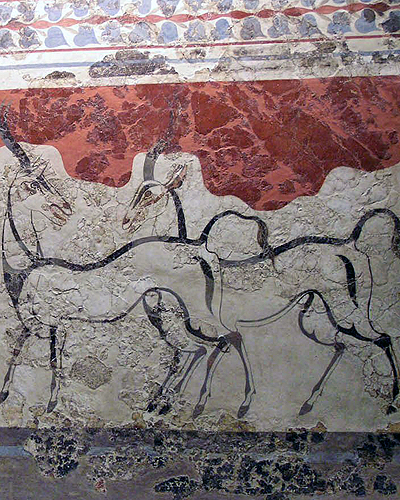
While I’m sure most islands have some drama in their past; on that front, I venture none can compete with Santorini. The island as we know it is the caldera of a volcano which erupted in one of the largest explosions ever known on this planet around 1600 BCE. Ash and debris shot 25 miles into the stratosphere and the massive tsunami that followed brought immediate destruction, as well as prolonged environmental devastation that lead to the extinction of the powerful Minoan civilization.
The Minoans were centered in Crete but their influence was widespread and they had colonies on a number of Aegean islands. Akrotiri on Santorini was a Minoan settlement that was preserved in volcanic ash, much like Pompeii. No human remains have been found, so it would seem the inhabitants got out in time. What remains is evidence of a very wealthy, sophisticated city. A powerful city that sank into the ocean in a single day, hmmm, does that sound familiar? Could it be Atlantis? Some think so, scholars even. Visit Akrotiri and decide for yourself.
Despite an explosive history, Santorini is a very peaceful place, and thanks to its explosive history, Santorini is extraordinary to look at. Santorini is all about the views. You sit on your hotel terrace and look at the view, you eat your meals looking at the view. When walking around, you really must try to stop looking at the view and watch where you’re going because there are some pretty steep drops.

Most habitation is perched on the caldera rim, a sheer 1,000 feet over the sea. Fira is the main town, with the most happening. Oia is a little out of the way, quieter and more romantic. Imerovigli is closer to Fira but quiet and sits higher than either Fira or Oia, so claims superior views. Really, the views are good everywhere, as long as there’s nothing in the way.
Most (if not all) Greek island cruises stop in Santorini for a few hours. In season (April/May-October) there are frequent flights and ferries from Athens.
The Greece travel season of 2014 is fast upon us. Here, we offer some enticing images to mark the occasion.
ATHENS
Read about Athens here and here and here.

Evzones guards, Parliament building, Athens, Greece
DELPHI
Read about Delphi here.
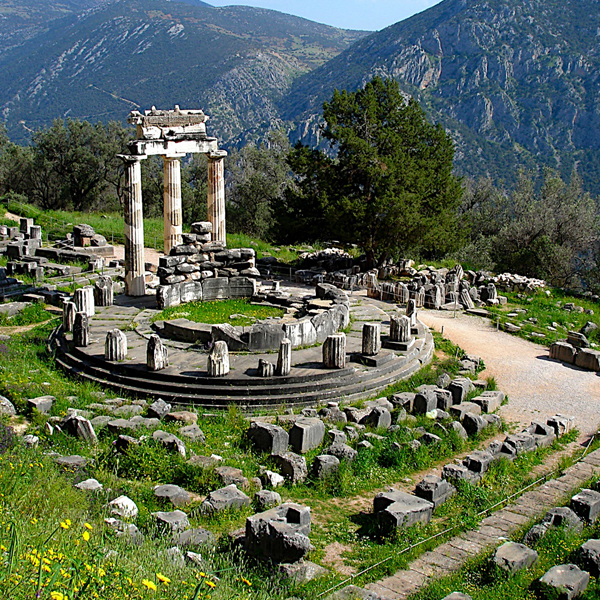
Delphi, Greece
METEORA
Read about Meteora here.
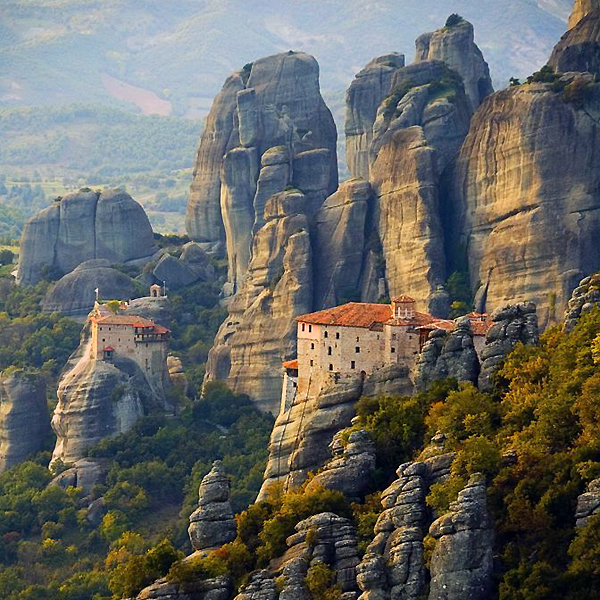
Meteora, Greece
NAPFLION
Read about Napflion here.

Nafplion, Greece
MYCENAE
Read about Mycenae here and here.
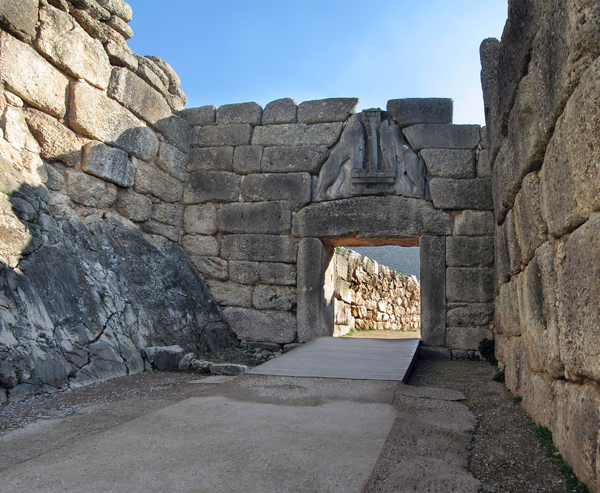
Lions Gate, Mycenae, Greece
PATMOS
Read about Patmos here.
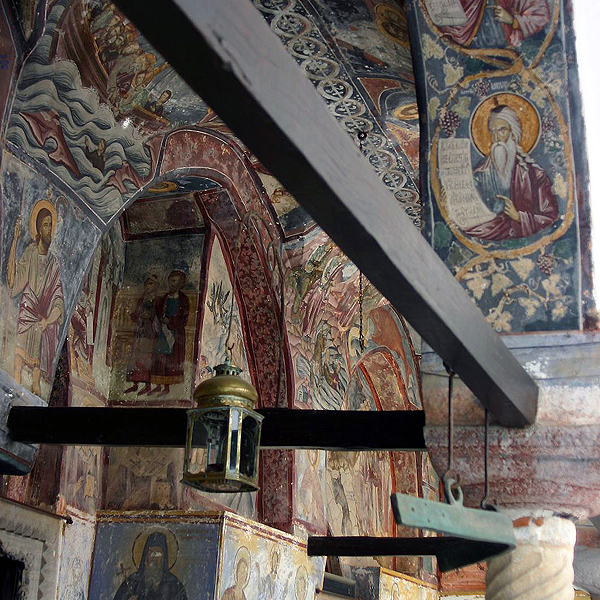
St. John Monastery, Patmos, Greece
SANTORINI
Read about Santorini here.
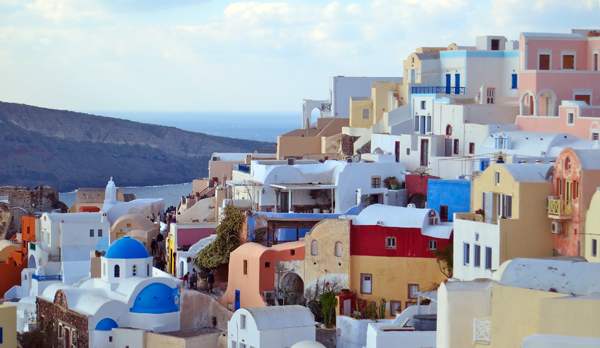
Santorini, Greece
CRETE
Read about Crete here.
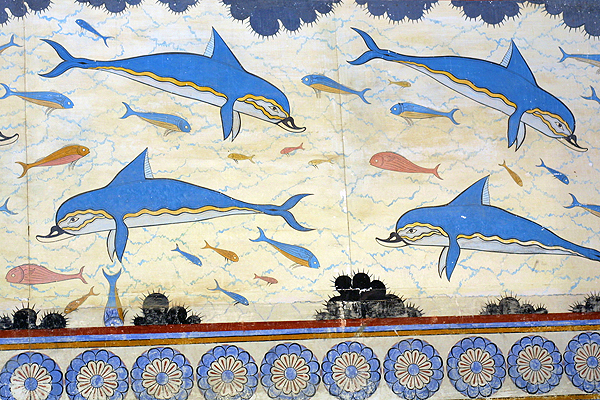
Knossos, Crete, Greece
See tours to Greece here.
Patmos is a Greek island off the western coast of Turkey. It’s especially important for Christians as the place where the Book of Revelation was written. The author refers to himself as John and there are varying opinions as to whether he and the author of the Gospel of John (the “beloved disciple” of Jesus) were one in the same.
In any case, John of Patmos was an exile or refugee on the island during the Christian persecutions by the Roman emperor Domitian near the end of 1st century. If he was the disciple of Jesus, he would have been in his 90s. The story goes that John took shelter from the heat of the day in a cave and there encountered Jesus in the form of an angel, who dictated a message to each of seven Christian communities in Asia Minor (western Turkey). Then John was transported to heaven and the throne of God, where he received an apocalyptic message that has deeply affected Western culture, religious and secular.
Whether read as prophecy or allegory, the imagery is vivid and terrifying. John is shown the radiant throne of God encircled by a rainbow and emitting thunder and lightning. Jesus stands before the throne in the form of a slaughtered lamb and he shows John the 4 Horsemen of the Apocalypse. Then John sees a sign in heaven – a pregnant woman clothed in the sun and a tremendous red dragon waiting to take her child. As soon as the child is born, he is taken to heaven and his mother escapes to the forest. The enraged dragon is thrown out of heaven to earth, where he calls upon 2 beasts to assist him in a battle against heaven. In heaven, 7 angels pour 7 bowls full of God’s wrath onto the earth to torment the faithless there. Jesus leads an army of angels against the dragon and his angels and the ungodly humans. The forces of heaven prevail and vultures devour all the ungodly dead. The dragon is thrown into Hell. All the dead rise to be judged by Jesus, who throws the evil-doers into Hell and welcomes the good to eternity in Heaven. That’s the short version. Until recently, I had never read the full text. Actually, I still haven’t read it. I listened to a mesmerizing audio recording by Max McLean.
Getting to Patmos is not easy. For groups, we usually charter a private boat from Kusadasi, Turkey, but that’s expensive for couples and small parties. Most Aegean cruises include a port stop at Patmos, see the cruise tours on our website. Ferries from Piraeus take 7-8 hours. It may be possible to fly from Athens to Samos and ferry to Patmos from there.
 The Ya'lla Blog