NAME THAT COUNTRY

Local musicians and dancers entertain tourists at this desert camp in the Sharqiya Sands (aka Wahiba Sands after a resident tribe). The golden dunes of Sharqiya Sands are located between the cities of Muscat and Sur in our mystery country. This Arabian Peninsula country is modern and prosperous, with a down-to-earth appeal that contrasts sharply with its glitzy neighbor to the west. The country’s considerable natural endowments include long, unspoiled coast lines on the Arabian Sea, Arabian/Persian Gulf and the eponymous gulf, Shangri-La valleys and rugged wadis tucked into the grand Al Hajar Mountains off the northern coast, expansive desert and an annual, mist-induced pop-up jungle in the southern mountains.

Can you name that country? 
See below for answers.


Continue reading →

Turkish Folktales: The Contest & The Candle

Across the Muslim world, stories and anecdotes attributed to or about Nasreddin Hodja are as much a part of the collective consciousness as the Grimm’s Fairy Tales in Europe and North America.

Nasreddin was probably a real man who lived in Turkey in the 13th century. Some sources say he was born in Turkey, others that he moved there from Iran. In any case, it seems agreed that he lived and worked as a judge and teacher in or near the city of Konya in central Turkey. He is known for his sly wit, appreciation of the absurd, optimism and genial nature. The honorific Hodja refers to a wise teacher.

With a respectful good riddance to the historically harsh winter much of the US has endured this year, here’s a winter tale from Nasreddin Hodja.

One very cold winter night, Nasreddin Hodja and twelve of his neighbors were enjoying good company in the village teahouse. As they sipped their hot tea, the men took turns voicing their astonishment at the severe weather, each striving to outdo the last in the extent of their suffering. Nasreddin Hodja listened without comment to the tales of winter woe. When all eyes turned to him for his contribution on the topic, Nasreddin made a dismissive gesture and said, “My friends, what a bunch of whiners you are. Is it cold outside? I hadn’t noticed. In fact, this morning I remarked to my wife what a refreshing day it was, and left my coat at home.”

Nasreddin’s boastful contradiction was no surprise to his companions. He rarely let any statement go unchallenged. Life in the teahouse was never dull. “I find this weather so mild, I’m sure I could stay out in it all night long with no coat at all,” he said. “Let’s see about that,” replied one of the friends. “If you can spend the entire night outside without a coat, or any means of warmth beyond your own hot air, each of us will host you for dinner. If you cannot, you will host all of us.” It was a deal.

For the next eight hours, the village men watched from their windows as Nasreddin paced around the town square stomping his feet, blowing on his hands and hugging himself against the bitter night. His wife also kept watch and left a candle burning in the window as a sign of her support. When the faint sun finally peeped over the horizon, Nasreddin went inside, feeling tired but triumphant, and not a little numb.

Later that day, when all the men were gathered in the teahouse, Nasreddin asked who would be the first to invite him for dinner. Altogether they responded, “It is you who owe us dinner!” “How do you figure that?” he said. “I know you saw me outside all night.” “Oh, we saw you outside; this is true. But we also saw the candle burning in your window. Surely that provided you some warmth.” Nasreddin’s expression told his friends what he thought of their implausible argument, but he agreed to feed them dinner anyway.

A few days later Nasreddin welcomed his friends to his home. As dinner was not yet ready, he made them comfortable in the sitting room and they chatted about the weather and politics and local gossip, just as they did whenever and wherever they gathered. After more than an hour, they were getting pretty hungry and asked Nasreddin if he meant to feed them anytime soon. Rising from his chair, he asked them to join him in the kitchen to check the progress of their dinner.

In the kitchen, they found a cast iron pot filled with rice, chicken and vegetables hanging from a beam over a burning candle. “What are you thinking?” they exclaimed. “This small candle will never provide enough heat to cook a pot full of food!” “Huh,” said Nasreddin, cocking his head and knitting his brow in mock wonderment. “You say this candle, mere inches from the pot, is not hot enough to cook the food, but the very same candle was hot enough to warm me all the way across the square?” The friends had no rebuttal and all repaired in good humor to the teahouse for some food that had been thoroughly cooked on a blazing fire.
NAME THAT COUNTRY

 The tannery pictured above operates in the same way it has done for 1,000 years. It’s located in the heart of the old town in one of our mystery country’s most visited cities. Visitors can look out over the tannery from the upper floors of surrounding leather shops. Hides are cured in cow urine, lime and pigeon poop and then dunked in vats of natural dye. A sprig of mint held at your nose will take the edge off the powerful smell.

Can you name that country? What about the site?
See below for answers.

Continue reading →

Mighty Aphrodisias

tetrapylon, Aphrodisias

tetrapylon, Aphrodisias

The site of Aphrodisias in south-central Anatolia (Asian Turkey) was a major cult center of the regional version of Aphrodite, the Greek goddess of love and fertility. Around the 3rd century BCE, Aphrodite was merged with the local Great Mother goddess of fertility, worshipped here in the lush Dandalas River Valley for more than 5,000 years before the Greek pantheon settled in. Continue reading →

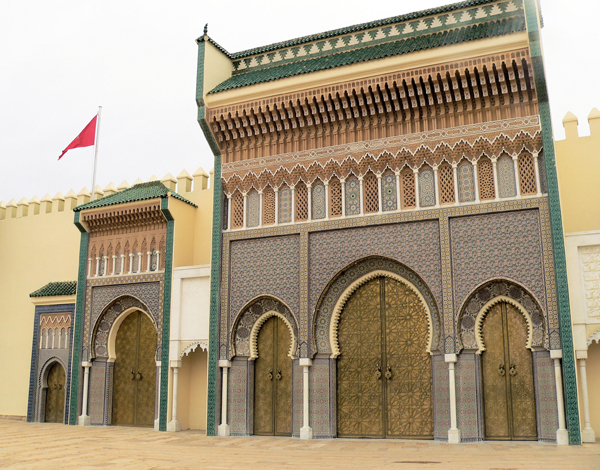
Gates of Fez

Founded in the 8th century, Fez is the intellectual, cultural and spiritual center of Morocco. The Medina, or Old City, is one of the best preserved medieval cities anywhere. Today, the pungent, labyrinthine Medina pulses with daily life much as it has for over 1,000 years. The Medina consists of the larger and older Fes el Bali, parts of which date to the 9th century, and Fes Jdid, which originated in the 13th century. Fes el Bali is a UNESCO World Heritage Site. Some of the most interesting sites in the Medina are the many gates that pierce the ancient city walls. Here are just a few: Continue reading →

Aegina Island, Greece

The island of Aegina is just 16 miles from Athens in the Saronic Gulf. Ferries travel regularly from Piraeus and take about an hour and 15 minutes.

With ancient ruins, idyllic fishing villages and lots of beaches, the island makes a good day-trip from Athens.

Sites of interest include:

Temple of Aphaia

The 5th century BCE Doric Temple of Aphaia (Afea), a local goddess of fertility, is a beautiful monument in its own right, but it’s especially interesting because it is built on the site of a Mycenean Mother Goddess sanctuary, which dates to at least the 13th century BCE.

Kolona archaeological site

Kolona archaeological site

Near the Aegina harbor, the Kolona archaeological site is easily recognized by its  lone column, all that stands of a Temple of Apollo, which was destroyed by Christians in the 4th century. The site was continuously inhabited for two thousand years from about 3000BCE and sporadically thereafter. There are remains (mostly rubble) of a theater, a stadium, numerous temples, civic buildings, a synagogue, tombs and a port. If you’re an archaeology nerd, you’ll love exploring this place. If not, it may try your patience. The lovely views should satisfy anyone. The Archaeological Museum helps make sense of this very complex site and documents the history of other parts of the island as well.

Paleochora

Paleochora

Paleachora (which means Old Town) was the site of the island’s capital for a thousand years (9th-19th centuries CE). Remains consist mostly of Byzantine churches, 38 of them, to be precise. Scattered across a steep hillside, the churches are connected by footpaths and range in condition from newly restored to quite decayed. Nearby, the very beautiful, 20th century Agios Nektarios church honors a saint who died in 1920 and is a popular pilgrimage site.

Perdika village

Perdika village

Perdika is a sweet fishing village, with cafes and bars facing the small harbor and Moni Island beyond. It’s a popular place for fish lunch. Across from the harbor is the Camera Obscura, built in 2003 for the Light & Image Exhibition. A 360-degree image of the surrounding landscape is projected, upside down, on the inner walls of the cylindrical building though small holes in the walls.

The coast road is dotted with equally quaint villages.

And now a plug for Animal Protection Aegina Agistri, just because. It’s an animal welfare charity and founding member of the Panhellenic Animal Welfare Federation that shelters dogs and cats, vaccinates, neuters and finds homes for hundreds of animals annually. Check out their FB page!


NAME THAT COUNTRY

Shakshuka has roots in North Africa but is practically the national dish of our Middle Eastern mystery country. This country is a cultural melting pot, with Eastern and Central European, Mediterranean, North African, and Middle Eastern culinary influences (not to mention Balkan, Ethiopian, Yemini, North American, Iberian…)

There are many variations on Shakshuka, but basically it is a stewy mix of peppers and tomatoes in which eggs are poached. Eaten with good, crusty bread, it’s nutritionally balanced, with complex flavor that manages to be intense and mellow at the same time. Click here for a recipe.

This mystery country is increasingly known as a food and wine destination. See our Culinary Tour for a glimpse of the possibilities.


Can you name that country? 
See below for answers.


Continue reading →