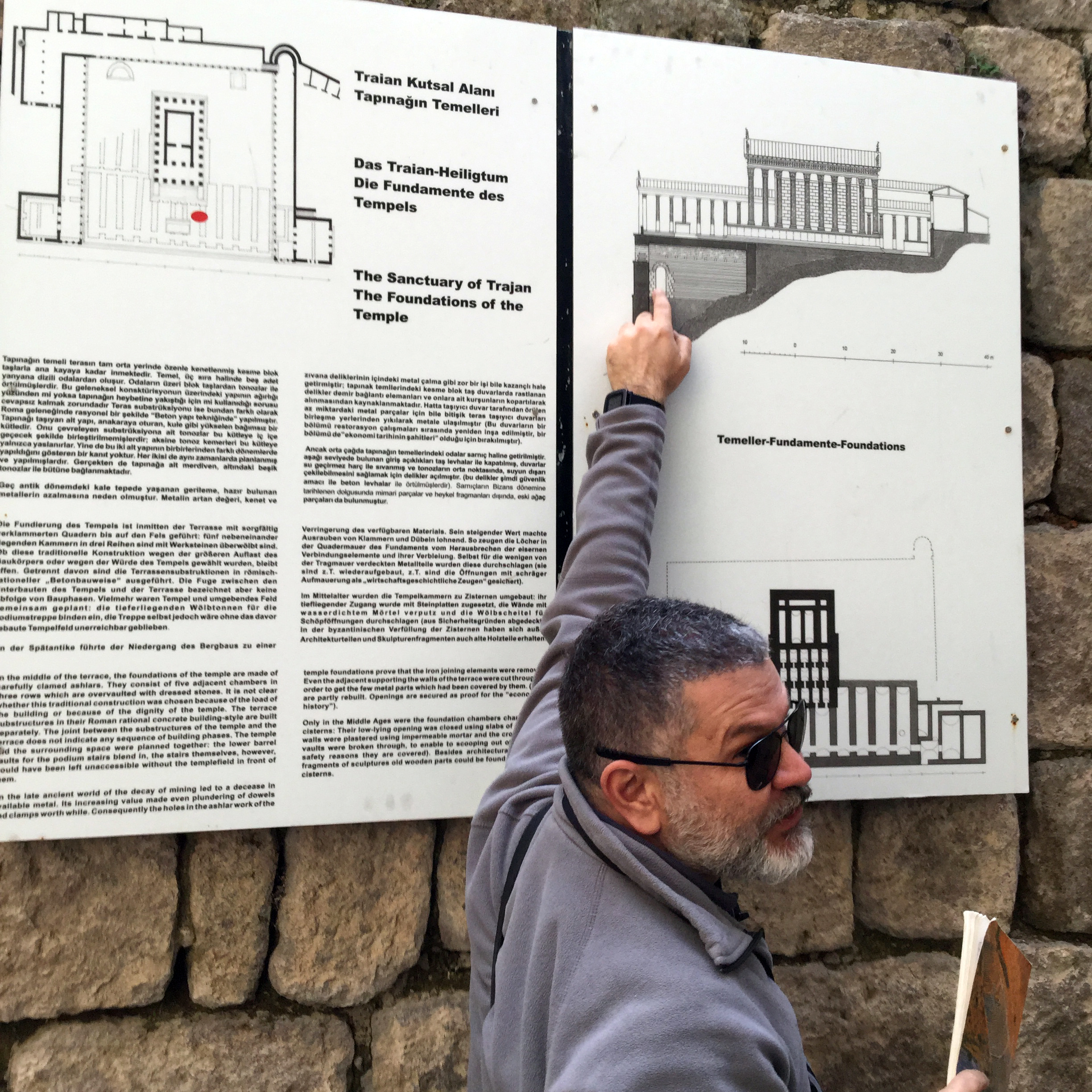
Pergamum in Turkey

Temple of Trajan, Pergamum, Turkey

Temple of Trajan, Pergamum, Turkey

Pergamum is an ancient Greco-Roman city in western Turkey, about 15 miles from the Aegean coast, 60 miles from Izmir, the closest airport, 110 miles from Ephesus, and about 320 miles from Istanbul. The modern town on the site is Bergama.

Continue reading

The Underground Cities of Cappadocia

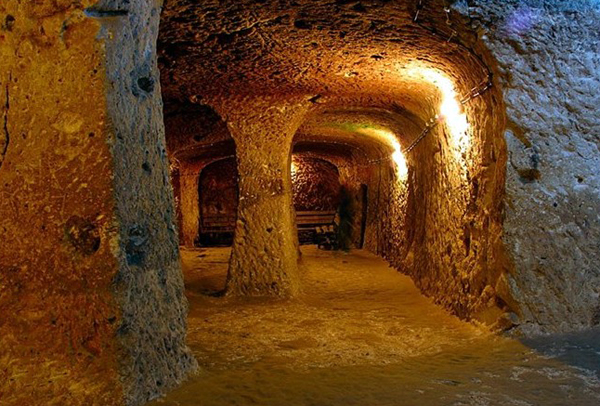
Derinkuyu underground city, Cappadocia, Turkey

Derinkuyu underground city, Cappadocia, Turkey

There are 40 some underground cities in the Nesehir and Kayseri provinces of Cappadocia in central Turkey. Some estimates put the number into the hundreds, while others count around 40. My guess is the discrepancy lies in how one defines “city.”
For our purposes, and those of the average tourist, 40 is more than enough. Most are not open to the public anyway, so we’ll focus on two that are: Derinkuyu and Kaymakli.

Extending down 200 feet with 8 levels, Derinkuyu is the deeper of the two cities but Kaymakli has more sprawl. They are connected to each other by tunnels, as are many of the other underground cities.

The cities possibly originated in Hittite times, around 1200 BCE, but were certainly, significantly expanded over the centuries, especially during Roman persecution of Christians in the 2nd and 3rd centuries and again in the 7th century, with the Arab invasions. Really, this part of the world was a superhighway for invaders, and the inhabitants had reason to hide on a regular basis. They got very good at it.

The underground cities were set up to shelter as many as 20,000 for long-term living and include sleeping quarters, kitchens, storehouses, churches, stables and even a winery. Ventilation shafts doubled as wells. Passageways allowed single file movement only, so intruders could be easily picked off one at a time. Giant boulders served as rolling doors that could only be removed from the inside. The doors had small holes in the center, just the size and height to spear the unwelcome in the gut, or thereabouts. For quick and easy access, most above-ground homes had openings to the underground right inside or very near the houses.

For most visitors, it’s enough to see one of the two cities. Each takes about an hour to tour. There’s very little signage, so a guide is highly recommended. Passageways are narrow but allow people of average height to get through with minimal stooping. Lighting is good, but if you’re claustrophobic, you might want to stick to the plentiful and thoroughly satisfying above-ground attractions of Cappadocia.

To get to Cappadocia, there are daily flights from Istanbul to Kayseri, in the heart of the region. Ankara is about a 3-hour drive. Istanbul is about a 10-hour drive. The more comprehensive tours of the western half of Turkey will do a semi-circle from Ankara, through Cappadocia, down to the coast and on to Istanbul.

See my last post Cappadocia Above and Below for descriptions of other things to see in Cappadocia.

Click to see our tours that include underground visits in Cappadocia.

NAME THAT CITY

This city literally bridges Europe and Asia, East and West. It’s known for its dramatic setting, spilling down rolling hills to water’s edge, the skyline punctuated with monumental Byzantine and Ottoman buildings. In amongst the hills and monuments, in everyday lanes of shops and homes, the people of this city dwell peacefully alongside many thousands of stray cats. The cats of any given neighborhood are loved and cared for collectively. Walking the streets, you’ll see plenty of cats, as well as water and food dishes and baskets and boxes made cozy with blankets. Cats wander freely in and out of businesses and residences, curl up on benches, snooze in shop windows, and approach passersby for pats and scratches. An old story tells that a cat saved the Prophet Muhammad from a snake, so cat fancy has deep roots in this Muslim city.

These cats are becoming famous far beyond their city. They have had their own Facebook page for years and now there is a beautiful documentary about the cats, the people who care for them and the stunning city they share.


Can you name that city? 
See below for answers.

Continue reading

Street Food in Turkey – Kumpir

my homemade kumpir, topped with bulgar pilaf, pickled, spicy green beans, olives, roasted red and yellow peppers, tabbouleh salad, and tahini drizzle

my homemade kumpir, topped with bulgar pilaf, pickled, spicy green beans, olives, roasted red and yellow peppers, tabbouleh salad, and tahini drizzle

One of Turkey’s favorite street foods is kumpir, what we in the U.S. would call a loaded baked potato, dressed up a la carte, with a kaleidoscope of toppings selected according to the taste, adventuresome nature, aesthetic and upper arm strength of the imminent consumer. The combinations are endless. Some common toppings are corn, peas, hot peppers, sweet peppers, chopped greens, pickled vegetables, kisir (bulgar salad, aka Turkish tabbouleh), chopped hotdogs, mushrooms, olives, chick peas, carrots, yogurt, mayonnaise, ketchup… really, anything goes. At a typical kumpir stand, baked potatoes are split in the middle and the steaming, fluffy innards are roughly mashed with a dollop each of butter and Kaşar cheese. Then they’re yours to top with the flavors, colors and textures of your choosing. Kumpir stands are found all over Istanbul, and around the country, but the Bosphorus-front Ortaköy neighborhood in Istanbul is practically synonymous with kumpir.

Kumpir with a view in Ortakoy

Kumpir with a view in Ortakoy


TURKISH EXTRAVAGANZA – 9 Days of WOW! Part 2

Many thanks to our guest blogger Adrienne Lee! Adrienne and Robert Lee traveled on our travel agent fam trip February/March 2017. Click to read Part 1 of Adrienne’s post

Library of Celsus, Ephesus

Library of Celsus, Ephesus

HISTORICAL SITES

We expected to visit sites like the Blue Mosque, Hagia Sofia and Grand Bazaar – and all were amazing. But they were only the beginning…Each of the historical sites/ruins revealed layer upon layer of civilizations past, complete with massive theaters, towering columns and even latrines. It really felt like we were walking back in history. Since none of them were very crowded we were treated to what felt like private tours. That was definitely the case at Alexandria Troas, where the site was opened up just for us; talk about VIP treatment! Robert and I had visited Ephesus in 2011 (with throngs of other tourists), so we knew what to expect. But on this visit we could see how much more of the ancient city had been excavated.

Many of the sites had added wooden walkways and they made it easier to get around – much easier than crossing uneven and sometimes rugged terrain.

CUSTOMER SERVICE

The customer service was top notch throughout the trip, beginning with the Turkish Airline flight attendants. The staff at each of the hotels went out of their way to make our stays enjoyable. Our luggage was even transported from the bus to our rooms at each one. The attentive service at each restaurant was quite notable. It was helpful that everyone we met spoke English, especially since we spoke very little Turkish. Merhaba, gunaydn and tesekur ederim were about the extent of our vocabulary – and I’m sure that our pronunciation was atrocious. But we never had a problem with communication.

YA’LLA TOURS

This trip was our introduction to the company and we were very impressed. Every detail of the trip had been planned and well thought out. The coordination was like clockwork.   We were never left waiting or wondering what to do – and there were lots of moving parts; buses, in-country flights, ferry rides, funicular, tractor-pulled trams….each one was on time. The trip kept building and each day was better than the last. Every day offered something that surpassed the day before…building up to the pièce de résistance – Dinner at the Ciragan Palace.

There were even several extra special treats like candy at the Marmara Hotel, the gift/wine basket at the Hilton, the yacht cruise on the Bosporus, the special gift on our last day.

The travel documents were detailed and even included historical information, packing tips and Turkish vocabulary.

The Saturday seminar was very informative. When we saw that there was going to be a mandatory daylong seminar, we expected it to be a typical seminar – long and boring. On the contrary, it was filled with many insights and valuable information. It also stimulated our thought processes with regard to marketing Turkey, Israel, Cuba and our own business.

Due to recent events, many people are apprehensive about visiting Turkey right now. Even our friends and associates questioned our decision to go. However, not once did we experience anything that made us feel unsafe or in danger. The presence of security personnel and metal detectors added a measure of security. We’re aware that many American travelers are fearful, and we are committed to dispelling those fears.

Turkey is a rich travel destination and we look forward to returning and sending clients to the region. We have seen quite a bit of the world and have taken many familiarization trips, but this was by far the best trip ever.

Adrienne and Robert Lee at Aphrodisias, March 2017
Adrienne and Robert Lee at Aphrodisias, March 2017
TURKISH EXTRAVAGANZA – 9 Days of WOW! Part 1

Adrienne and Robert Lee at Aphrodisias, March 2017

Adrienne and Robert Lee at Aphrodisias, March 2017

My husband and I just returned from this familiarization trip to Turkey and we can’t say enough about how much we enjoyed it. We’d visited Istanbul briefly during a pre-cruise stop in 2011, when we’d only had 3 hours to pay short visits to the Blue Mosque and Hagia Sofia. That whirlwind tour whetted our appetites and we knew we wanted to return to experience more of that vibrant city. We discovered the Ya’lla Tours opportunity on a Sunday in mid-December. I immediately sent an email to the Ya’lla information email address to check availability, assuming that I wouldn’t receive a response until the next business day. To my surprise, I received a response from Ronen Paldi within the hour (I had no idea that he was the company owner), explaining that there was space available and that confirmation would be dependent on the submission of certain documents. I submitted the requisite documents later that afternoon and we received confirmation within 24 hours. I was immediately impressed by the quick response.

I could use so many superlatives to describe the trip – awesome, incredible, wonderful, marvelous, and memorable – but the word that came to mind most often was WOW and that was from the first day to the last. We were “wowed” by:

HOTELS

I’ll admit that I’m a luxury travel sort of gal, so I was especially pleased with the quality and location of each of the hotels. I was impressed from the evening that we checked into the Marmara, to the morning we checked out of the Hilton.
The rooms were spacious and well equipped. The views of the Bosporus and Aegean Sea made each sunrise and sunset very special. The inability to adjust the temperature in most of the rooms below 75 degrees was a bit of a challenge, but we managed to offset that by opening the window to let in the cool sea air.
The least impressive of the 4 hotels was the Charisma. It was a bit “long in the tooth” – its simple décor, and plentiful (but mediocre) food gave it the ambiance of a college dormitory. But that was offset by our breathtaking view of the Aegean Sea…another WOW.

The opportunities to do site reviews of other hotels gave us good options for making recommendations to our clients. I especially enjoyed the old world charm of the Para Palace.

FOOD

Turkish cuisine is world-renowned so we expected it to be very good. But it surpassed every expectation that we had. From fine dining establishments to small countryside eateries all were exquisite. Each dish featured the freshest ingredients. Many were organic and some even locally sourced. Everything was prepared to perfection.
Even those who had dietary restrictions were accommodated. For instance, we do not eat red meat but that did not create a problem. Every meal offered a delicious choice of fish or chicken. The servings were plentiful and often artfully presented. Most of the dinners included wine and beer. All of the hotels offered plentiful breakfast buffets with fresh fruit and even eggs cooked to order.

The meal of all meals was our final dinner at the Ciragan Palace, where the menu replicated what sultans dined on. It was simply exquisite. Even the china was a work
of art. Each course was presented beautifully and described in detail. We literally dined like royalty.

OUR GUIDE

Our guide Ozgur Erdogan (Fred) was simply the best. From the time he met us at the airport on Saturday February 25th to the time he dropped us off on Sunday March 5th he led us, lectured us and took great care of our “flock.” He shared a wealth of information and always kept it interesting. He worked seamlessly with our bus driver to transport us to our destinations on time, even in bumper-to-bumper traffic. He handled our entrance tickets and even arranged group airport check-in when necessary. He handled unexpected events and endless requests for restroom breaks with patience and a smile. What a guy!

Many thanks to our guest blogger Adrienne Lee! Adrienne and Robert Lee traveled on our travel agent fam trip February/March 2017. Click to read Part 2 of Adrienne’s post.

Spinning With the Universe: the Mevlevi Whirling Dervishes in Turkey

We get a fair number of requests to see Whirling Dervishes from our travelers to Turkey. If you ever have the opportunity, I highly recommend it. It’s a fascinating and moving thing to witness.

Sufism is a mystical form of Islam and a Dervish is an ascetic follower of Sufism.

A type of Sema, a Sufi ritual, whirling is most associated with the Mevlevi order of Sufis founded in Konya, Turkey. The Mevlevi Dervishes are followers of the 13th-century mystical poet Jalal ad-Din Muhammad Balkhi-Rumi, better known in the West simply as Rumi. In Muslim countries, he’s more often referred to as Mevlana or Mevlevi, which means “our guide.”

Spinning is done to align mind, body and heart with the fundamental movement of the universe and all it contains. Everything is revolving, from subatomic particles to stars, planets and galaxies. Each element of the ceremony in some way symbolizes the submission of the ego to the oneness of God. The camelhair hat worn by the dervishes represents “the tombstone of the ego.” Dervishes remove their black cloak to begin the ritual, symbolizing spiritual rebirth. The white skirt worn while spinning is the ego’s shroud. Dervishes spin with arms wide, right hand open to heaven and left hand pointed down, forming a channel for God’s blessings to flow to the earth. There are four movements to the Sema, each involving submission of different aspects of self to God.


You can witness the Whirling Dervishes in Konya, where they originated, and in Istanbul. Konya is located in south-central Turkey and makes a good stop when traveling between Cappadocia and the coast. It’s perhaps the country’s most conservative city, very religious, and the site of the Mevlana Mausoleum. The Konya Cultural Center has weekly whirling ceremonies that are open to the public. The timing is changeable, so I won’t commit to anything specific here. In Istanbul, Dervishes are whirling daily at various locations. If you’re going, let us know and we’ll get details.
If you’re lucky enough to attend a whirling Sema, please remember that it is worship and should be treated with the proper respect.

Be Lost In The Call
by Mevlana Jalal ad-Din Rumi

Lord, said David, since you do not need us,
why did you create these two worlds?

Reality replied: O prisoner of time,
I was a secret treasure of kindness and generosity,
and I wished this treasure to be known,
so I created a mirror: its shining face, the heart;
its darkened back, the world;
The back would please you if you’ve never seen the face.

Has anyone ever produced a mirror out of mud and straw?
Yet clean away the mud and straw,
and a mirror might be revealed.

Until the juice ferments a while in the cask,
it isn’t wine. If you wish your heart to be bright,
you must do a little work.

My King addressed the soul of my flesh:
You return just as you left.
Where are the traces of my gifts?

We know that alchemy transforms copper into gold.
This Sun doesn’t want a crown or robe from God’s grace.
He is a hat to a hundred bald men,
a covering for ten who were naked.

Jesus sat humbly on the back of an ass, my child!
How could a zephyr ride an ass?
Spirit, find your way, in seeking lowness like a stream.
Reason, tread the path of selflessness into eternity.

Remember God so much that you are forgotten.
Let the caller and the called disappear;
be lost in the Call.

NAME THAT COUNTRY

For about 400 years, from the mid-15th century, Topkapi Palace was the residence and administrative center of the Ottoman Empire. The sprawling complex occupies the end of a peninsula bordered by 3 bodies of water – the Marmara Sea, the Bosphorus Straight and the Golden Horn. In 1924, the palace became a museum open to the public and is among the most visited sites in our mystery country.


Can you name that country? 
See below for answers.

Continue reading

2 Ephesus Stories

One of the reasons we travel is to have first-hand experiences of places we have known only in our imaginations. This can apply to any destination but is especially true of places associated with narratives that have been woven into our cultural identities for centuries. If you have visited places with strong historical and/or cultural significance, you know what I mean. There’s an essence of place, made up of layers of history and legend that hang around and bring an intangible or an extra-tangible substance to the physical remains.

Here are 2 stories that contribute to the multifaceted experience of Ephesus.

The Seven Sleepers
Around 250 BCE in Ephesus, despite persecution under the Roman emperor Decius, seven young Christian men stayed true to their faith. They retreated together to a nearby cave to strengthen their resolve through prayer and, after some time, they all fell asleep. Meanwhile, the local Roman officials, under pressure from their hardline leader to cleanse the city of Christians, seeing no possibility of reasoning with the committed youths, sealed them up in the cave.

Nearly two hundred years had passed when the cave was opened by the land owner. Thinking they had just had a regular nap, the young men went out into the city and found it very changed. While they slept, Christianity had become the official religion of the empire and there were signs of it everywhere. These clearly bewildered, oddly foreign men attempting to spend obsolete coins attracted attention and the Bishop was called to assess the situation. It didn’t take long for the Bishop and the seven to realize that a miracle had occurred and, once they knew it, the young men died.

This was a popular story in the early Christian Churches and on through the Middle Ages. The story is also told in the Koran.

The Riot at Ephesus
The Christian evangelist Paul, lived in Ephesus for 2-3 years around 50CE. He preached to Jews and pagans, helped strengthen the church there, wrote letters to other churches and traveled the surrounding countryside spreading the gospel. While Ephesus was a very cosmopolitan, culturally diverse and tolerant city, it was overwhelmingly devoted to Artemis of Ephesus, both spiritually and economically.
The Greek goddess Artemis was merged with the Anatolian great mother goddess Cybele to become the major deity of the whole region, but especially at Ephesus. The Artemis Temple at Ephesus was one of the Seven Wonders of the World and attracted a steady stream of pilgrims.

After nearly 3 years in Ephesus, Paul showed no signs of slowing in his efforts to build the Church there. The artisans and vendors of Artemis statues, who, most likely, had been monitoring Paul from the beginning, were suddenly whipped into a defensive frenzy by one silversmith named Demetrius. They took their outrage through the streets shouting GREAT IS ARTEMIS OF THE EPHESIANS! It seemed the whole city was swept up in the protest. They filled the theater and continued to chant GREAT IS ARTEMIS OF THE EPHESIANS! Paul tried to enter the theater to address the mob but his friends held him back, fearing for his life. Order was finally restored by a city official who recommended that grievances be handled through the proper authority. Paul and his friends were unharmed but Paul left Ephesus not long after.

Visit www.yallatours.com/turkey to see tours to Ephesus.