I hope you enjoy these images of the Mortuary Temple of Hatshepsut at Deir el Bahari, near Luxor, Egypt.


Click to see our tours to Egypt, most of which include a visit to Deir el Bahari.
I hope you enjoy these images of the Mortuary Temple of Hatshepsut at Deir el Bahari, near Luxor, Egypt.
Click to see our tours to Egypt, most of which include a visit to Deir el Bahari.


Dhofar, Oman

Amra Castle, Jordan

camel races, Oman

Chora Museum, Istanbul, Turkey

Deira, Dubai

Ya’lla group at Karnak Temple in Luxor, Egypt

El Aqabat in Egypt’s Western Desert

Fez medina, Morocco

Ibn Tulun Mosque, Cairo, Egypt

on the Nile in Egypt
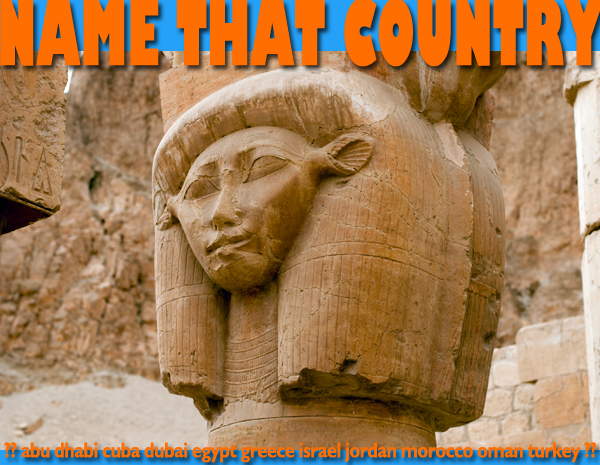
For thousands of years, Hathor was one of the most beloved goddesses of our mystery country. Her attributes and powers broadened over the centuries as she mingled with and absorbed a number of other deities. She was “the mother of mothers,” patron of women, fertility, childbirth and children. As the “mistress of life,” she represented joy, love, beauty, art, music and dance. She was a sky goddess, who gave birth to the sun god Ra each morning and conceived the coming day with him each night. In the underworld, she welcomed the souls of the newly dead with motherly reassurance as they made their way to eternal judgement. She was often represented as a cow or as a woman with cow ears, as above in the Chapel of Hathor at the Temple of Hatshepsut near Luxor.
Can you name that country?
See below for answers.

Temple of Hatshepsut, Luxor
Probably the most recognizable Ancient Egyptian symbol, the ankh hieroglyph represents eternal life. Egyptian gods and pharaohs were frequently shown holding the ankh or in close proximity to it. Fundamental life-giving elements, such as water, air and sun were often represented by the ankh. In some tomb paintings ankhs are shown pouring over the resident pharaoh from an upturned vessel or being blown into his mouth.

Kom Ombo Temple

tomb of Nefertari, Valley of the Queens
The origins of the symbol are lost to the mists of time but some suggestions are that it first represented the ever-holy sun sitting on the horizon, with the sun’s path stretching below; male and female reproductive parts, separated by the fruit of their union; or a sandal strap. It’s easy to see a connection between eternal life and the sun or the male, female and offspring, but a sandal strap, not so much. Imagine this – the loop of the ankh fits around your ankle; the arms of the ankh wrap around your foot, and there you have it, a sandal strap. The word for sandal strap ‘nkh’ was very similar to the word for life ‘ankh’ so the symbol was used to represent both words. That’s one theory anyway.
Click to see tours to Egypt, the birthplace of this powerful and enduring symbol.
Just a few shots of ancient painted surfaces in Egypt.
HAGIA SOPHIA, ISTANBUL, TURKEY

Hagia Sophia (Holy Wisdom) rises like a rust-colored mountain near the end of Istanbul’s Historic Peninsula, overlooking the confluence of the Sea of Marmara, the Golden Horn and the Bosphorus Strait. The city originated on this peninsula and Hagia Sophia has been there almost since the beginning. OK, that’s not quite true, but it has been there for a very long time. The city originated, as Byzantium, in the 7th century BCE. In the 4th century, the Roman emperor Constantine claimed Byzantium as his capital and renamed the city Constantinople. Constantine was the first Christian emperor of Rome. The building we know as Hagia Sophia was built in 537 CE by the Byzantine Emperor Justinian I, on the ruins of two previous cathedrals. Hagia Sophia stood as the largest cathedral for almost 1,000 years. The dome spans over 100 feet and is 180 feet high. Upon conquering the city in 1453, Sultan Mehmet II was so impressed with the building, he made it his imperial mosque. The design of many subsequent mosques built in the city was influenced by the Hagia Sophia.
It’s very impressive from the outside but, for me, the real WOW experience happens inside. It’s just so big and wide-open, you really feel like a speck of dust in there. Continue reading
Happy Friday. Some random shots of Ya’lla travelers:

at Ernest Hemingway’s house in Cuba, Finca Vigia

at Ernest Hemingway’s house in Cuba, Finca Vigia

in the Bastakiya district of old Dubai

at Karnak Temple in Luxor, Egypt

at Caesarea, Israel

at Caesarea, Israel

at Masada, Israel

at Bethany Beyond the Jordan in Jordan – likely baptism site of Jesus

a group on the tour bus in Oman

in Oman

at Pergamum, Turkey


 The Ya'lla Blog