The Most Dramatic Monument in Egypt IS… ABU SIMBEL

Way down in the far, far south of Egypt stand the temples of Abu Simbel, my pick for the most dramatic monument in Egypt. That’s saying a lot, because, as you know, Egypt is full of dramatic monuments. I think the impression of Abu Simbel is amplified by its lonely, barren location. It’s really in the middle of nowhere, raised in the 13th century BCE by Ramesses the Great to impress visitors on his southern frontier. Traders and ambassadors knew they entered a rich and powerful nation, potential invaders knew what they were up against if they chose to push forward, like a border sign reading, “Welcome to Egypt, Don’t get on our bad side.”
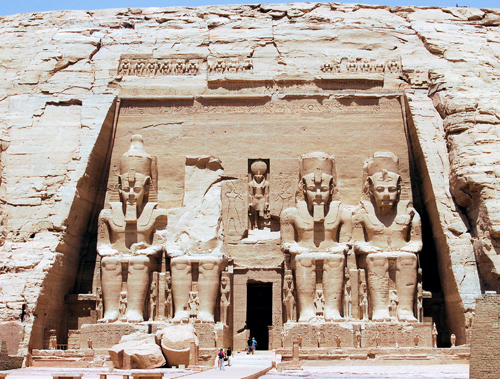
Great Temple, Abu Simbel, Egypt
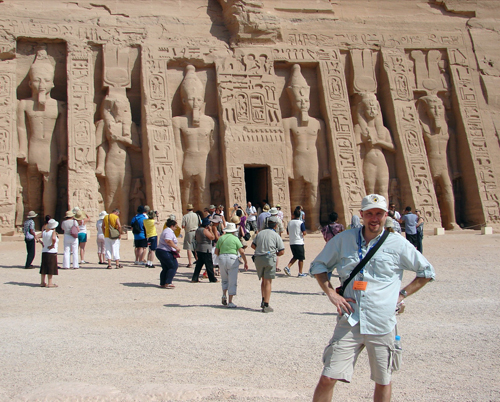
Great Temple, Abu Simbel, Egypt

Small Temple, Abu Simbel, Egypt,

Small Temple, Abu Simbel, Egypt (120 degrees that day!)

The Great Temple is dedicated to Ramesses, as well as the three main gods of the time, Amun, Ra-Horakhty and Ptah, and features four 65-ft. colossal statues of the seated pharaoh on the facade. Inside the temple, two hypostyle halls lead to the spooky inner sanctuary with seated statues of the pharaoh and gods. The halls through the temple are covered in bas-relief and painted scenes of Ramesses doing kingly things, like crushing his enemies and consorting with the gods, and colossal statues of the pharaoh line the walls on either side.
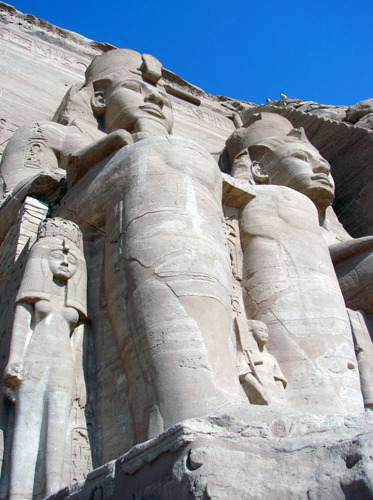
Ramesses II, Abu Simbel, Egypt
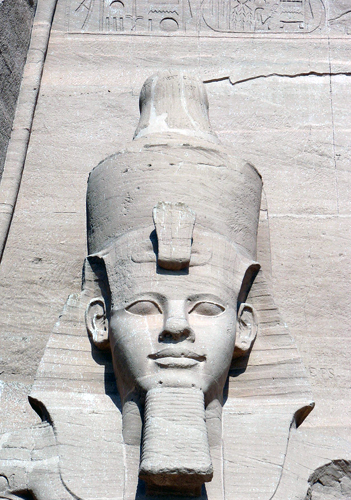
Ramesses II, Abu Simbel, Egypt
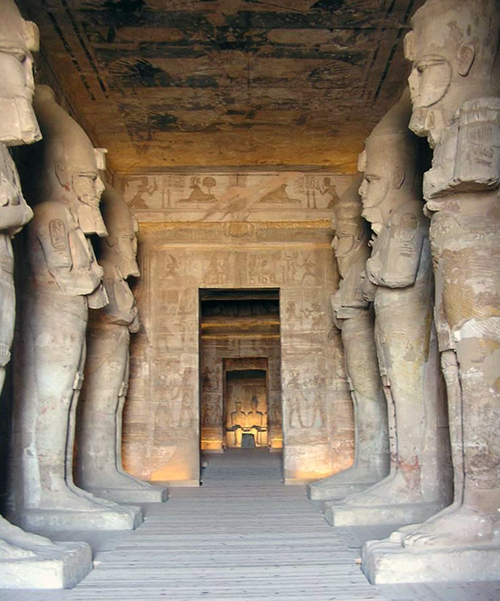
Ramesses II, Abu Simbel, Egypt

Ramesses II, Abu Simbel, Egypt

Grand Temple interior, Abu Simbel, Egypt
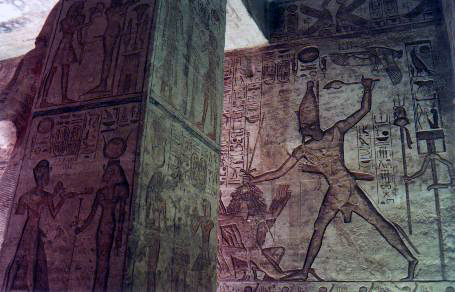
Grand Temple interior, Abu Simbel, Egypt
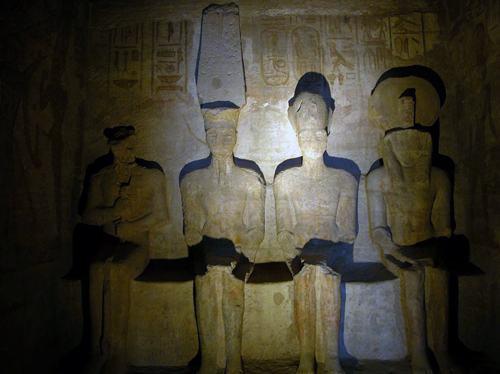
Grand Temple interior, Abu Simbel, Egypt

Grand Temple interior, Abu Simbel, Egypt

Grand Temple inner sanctuary, Abu Simbel, Egypt

Grand Temple inner sanctuary, Abu Simbel, Egypt

The Small Temple is dedicated to the goddess Hathor and Ramesses’ queen, Nefertari.
It’s less grand but more elegant, with six 33-foot standing statues on the facade –  2 of the king and 1 of the queen on either side of the portal. Never before or after was a queen shown the same size as the king in Egyptian art.
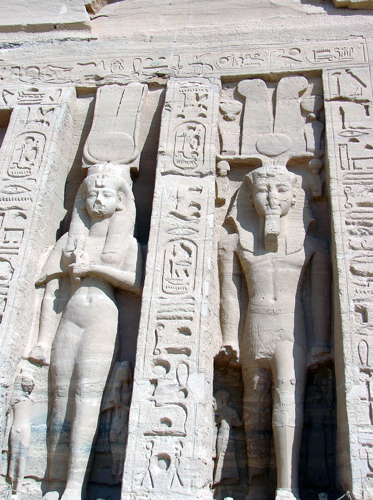
Small Temple, Abu Simbel, Egypt
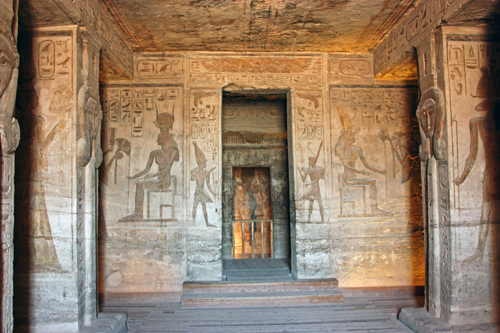
Small Temple, Abu Simbel, Egypt

Small Temple interior, Abu Simbel, Egypt
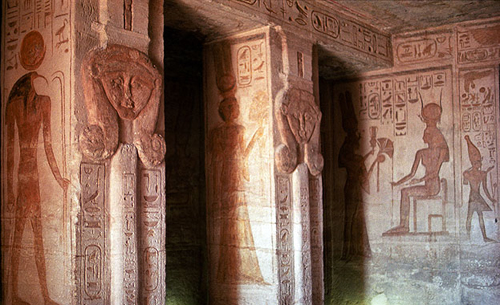
Small Temple interior, Abu Simbel, Egypt

Small Temple interior, Abu Simbel, Egypt

Small Temple interior, Abu Simbel, Egypt

The setting of the temples really enhances their impact. Blue water, blue sky, brown earth is pretty much all you see for hundreds of miles – forlorn, forgotten, untouched and then suddenly the temples are there like a smack in the face, in a good way.

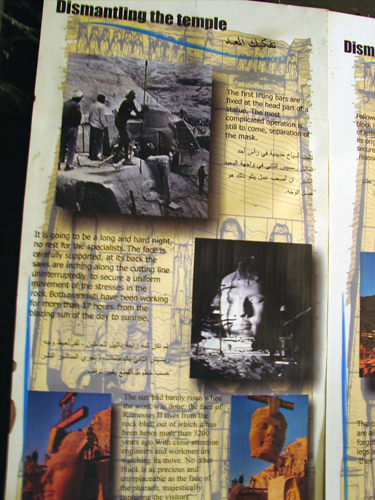
In the 1960s, the temples at Abu Simbel were moved from their original location, which was due to be flooded after the construction of the Aswan High Dam down river.
The temples were cut into 20-ton blocks and moved about 200 feet to higher ground. The temples were originally carved into the face of a mountain, so part of the move included building an artificial mountain. The hollow mountain is open to visitors and contains an exhibit about the temples’ rescue.
abu_simbel_move

Abu Simbel is reached from Aswan by about an hour flight or a 3-4 hour overland convoy of motor coaches and mini vans. It’s also possible to cruise from Aswan across Lake Nasser to Abu Simbel.

www.yallatours.com

NAME THAT COUNTRY


The most famous remains of ancient Thebes is the rambling Karnak Temple. Within the temple, the Hypostyle Hall is a forest of massive columns, some 70-feet tall. The columns are covered in carvings detailing adventures of ancient kings. The columns were originally also covered in brilliant color, traces of which still remain in some areas.


Can you name that country? 
See below for answers.

Continue reading

Alpine Villages of Greece – Dimitsana

Dimitsana village, Greece

Dimitsana village, Greece

In the Arkadia district of Greece’s Peloponnese peninsula, about a 3-hour drive from Athens, the beautiful mountain village of Dimitsana crowns the slopes at one end of the Lousios Gorge at about 1,000 meters above sea level.

This small village has a notable history as a center of resistance during the war of independence from Ottoman rule in the 1820s. The town contributed significantly to the revolution by supplying gun powder milled in more than a dozen water-powered mills along the Lousios River. Some of the monasteries secluded in the Lousios Gorge also harbored resistance thinkers and fighters.

Lousios Gorge, with the Filosofou Monastery on the right and the Prodromou Monastery on the left.

Lousios Gorge, with the Filosofou Monastery on the right and the Prodromou Monastery on the left.

With stone houses and cobbled streets, the village’s medieval atmosphere is balanced by lush natural surroundings and expansive views into the Lousios Gorge. Most visitors to Dimitsana come for the outdoor experiences, which abound year-round – skiing, hiking, rafting, kayaking… As complement to the natural scenery, the town itself is an open-air museum of Byzantine architecture, with many churches and monasteries in the village and surrounding area. Dimitsana is built on the site of the ancient village of Tefthis, and remnants of the ancient city walls can still be seen.

The historical Library of Dimitsana was built as a seminary and home to thousands of volumes from a local monastery. A number of 18th and 19th-century Greek leaders were educated here. During the revolution, the pages of thousands of books were used to make gunpowder cartridges, leaving only about 500 intact. Today the library is a museum, with 14-century manuscripts and artefacts from revolutionary heroes among its treasures.

Filosofou Monastery

Filosofou Monastery

Prodromou Monastery

Prodromou Monastery

The Open-Air Water Power Museum is a fascinating stop for a look at pre-industrial power generation. Among the interesting monasteries in the area are the Prodromou Monastery and the Filosofou Monastery, built on the opposite sides of the gorge. Visiting the monasteries involves some steep walking, but if you’re reasonably fit, the frescos inside and gorge views are well worth the effort. Resident monks are very welcoming. Further down the gorge, just outside the village of Astilochos, on the river bank, are remains of the important ancient city of Gortys.

Dimitsana offers a number of guesthouses, tavernas and cafes and shops selling handmade products, such as the hilopites (Greek egg noodles) and local jam.

NAME THAT COUNTRY


In the south west of the Peloponnese peninsula, Gialova lagoon is one of the most important wetlands in Europe. It’s a nationally protected area and a wildlife refuge. Over 250 species of birds have been documented in the lagoon, including herons, osprey, terns, flamingos and sandpipers. Many thousands of migrating birds stop in the lagoon each year as they travel between Africa and Europe in spring and fall and some 20,000 hang around all year long.

Can you name that country? 
See below for answers.

Continue reading

Bird-watching in Israel

Birds near Eilat, Israel, photo by Dafna Tal, courtesy of Israel Ministry of Tourism

Birds near Eilat, Israel, photo by Dafna Tal, courtesy of Israel Ministry of Tourism

Just as Israel has historically been a thoroughfare for human traffic and a meeting point of diverse cultures, it is a superhighway and home for a vast array of birds. 530 species have been recorded.

As a geographical bridge between Europe, Asia and Africa, Israel hosts 500 million migrating birds each spring and fall. Winters in Israel are mild enough that some European and Asian birds winter there instead of traveling all the way to Africa.

A wide range of habitats makes Israel home to numerous year-round, resident species, including European, African and Asian species living on the fringes of their natural habitats.

Cranes in the Hula Valley of northern Israel, photo by Itamar Grinberg, courtesy of Israel Ministry of Tourism

Cranes in the Hula Valley of northern Israel, photo by Itamar Grinberg, courtesy of Israel Ministry of Tourism

photo by Dafna Tal, courtesy of Israel Ministry of Tourism

photo by Dafna Tal, courtesy of Israel Ministry of Tourism

Any time of year is good for birding but especially November-May, which encompasses both fall and spring migrations and wintering birds. March is best, with spring migration underway, many of the wintering birds still around, and mating season making local birds particularly active and showy.

The prime places to see birds are in the Hula Valley in the north and around Eilat in the far south. Two birding festivals happen each year during migration season, in Eilat in the spring and in the Hula Valley in the fall.

NAME THAT COUNTRY


The Grand Bazaar is one of the world’s oldest and largest traditional covered markets, with more than 4,000 shops on over 60 streets. Just about everything you can think of is for sale here, but leather, gold and silver jewelry, ceramics, textiles and carpets are good buys. The bazaar is located in the country’s largest city, near such famous sites as Topkapi Palace, the Blue Mosque, Hagia Sophia and the Basilica Cistern on the  city’s historical peninsula (surrounded on three sides by the Sea of Marmara, the Bosphorus Strait and the Golden Horn). The bazaar’s first shops were built in the 15th century, on order of the Ottoman sultan Mehmet II soon after he conquered the city.

.

Can you name that country? 
See below for answers.

Continue reading

Rock the Kasbah at Ait Ben Haddou, Morocco

Ksar Ait Ben Haddou, near Ouarzazate, Morocco

Ksar Ait Ben Haddou, near Ouarzazate, Morocco

Click to see tours that include visits to Ait Ben Haddou.

About a 30-minute drive from Ouarzazate, Morocco, or a long day-trip from Marrakech, Ait Ben Haddou is a fortified village (ksar) in south-central Morocco. It’s only one of many ksars built by the indigenous Amazighen (Berbers) in the area, but, thanks to its status as a UNESCO World Heritage Site and a setting for a long list of Hollywood films, this ksar, unlike its fellows, is well preserved. It sits in the southern foothills of the High Atlas Mountains on the old trade route between the Sahara desert and Marrakech. Continue reading