The Coptic Church: a Brief History

6th-century icon, one of the oldest known in existence, of Jesus and the Egyptian St. Menas. Image is from Wikipedia.

6th-century icon, one of the oldest known in existence, of Jesus and the Egyptian St. Menas. The image is from the Wikipedia page on Coptic Art.

The name Copt derives from the Greek word for Egyptian. One of the first Christian churches, the Coptic Church was established in Alexandria, Egypt in the middle 1st century, only a decade or so after the death of Jesus. According to tradition the apostle Mark, author of the Gospel of Mark, founded the church.

Most Egyptians were Christian until the 10th century, when Islam became dominant. Today, about 10% of Egyptians are Coptic Christian.

As one of the oldest Christian churches, the Coptic Church laid a foundation for the development of all Christian denominations. The first Christian theological school was founded in Alexandria in 190 and it was in Egypt that the Christian monastic tradition first developed. The Egyptian desert was the place to be for early Christian monks and contemplatives. Patriarchs of Alexandria, heads of the Coptic Church beginning with St. Mark, were very influential in the development of Christianity in general, presiding over the first three ecumenical councils in the 4th and 5th centuries.

At the 4th Ecumenical Council in 451 at Chalcedon (modern Kadıköy, a district of Asian Istanbul), the Egyptian Church split away from the larger Church over the nature of Jesus. The Roman Church held that Jesus was of two natures, human and divine, and that these two natures were complete and distinct within the one person of Jesus. Based on the writings of Patriarch Cyril of Alexandria, the Coptic Church understood Jesus to be of one unique nature, both human and divine. The disagreement was largely semantic but was the basis of the first division in the Christian Church.

The modern St. Mark’s Coptic Orthodox Cathedral in Alexandria is the most recent in a series of previous churches built on the site, according to tradition, of the original church founded by St. Mark in the 1st century.

Click to see tours to Egypt.

NAME THAT COUNTRY Episode 54

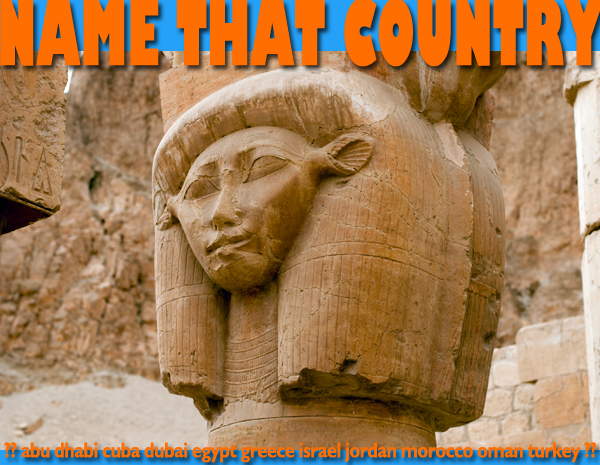
For thousands of years, Hathor was one of the most beloved goddesses of our mystery country. Her attributes and powers broadened over the centuries as she mingled with and absorbed a number of other deities. She was “the mother of mothers,” patron of women, fertility, childbirth and children. As the “mistress of life,” she represented joy, love, beauty, art, music and dance. She was a sky goddess, who gave birth to the sun god Ra each morning and conceived the coming day with him each night. In the underworld, she welcomed the souls of the newly dead with motherly reassurance as they made their way to eternal judgement. She was often represented as a cow or as a woman with cow ears, as above in the Chapel of Hathor at the Temple of Hatshepsut near Luxor.

Can you name that country? 
See below for answers.

Continue reading

The Ankh: What Does it Mean?

Temple of Hatshepsut, Luxor

Temple of Hatshepsut, Luxor

Probably the most recognizable Ancient Egyptian symbol, the ankh hieroglyph represents eternal life. Egyptian gods and pharaohs were frequently shown holding the ankh or in close proximity to it. Fundamental life-giving elements, such as water, air and sun were often represented by the ankh. In some tomb paintings ankhs are shown pouring over the resident pharaoh from an upturned vessel or being blown into his mouth.

Kom Ombo Temple

Kom Ombo Temple

tomb of Nefertari, Valley of the Queens

tomb of Nefertari, Valley of the Queens

The origins of the symbol are lost to the mists of time but some suggestions are that it first represented the ever-holy sun sitting on the horizon, with the sun’s path stretching below; male and female reproductive parts, separated by the fruit of their union; or a sandal strap. It’s easy to see a connection between eternal life and the sun or the male, female and offspring, but a sandal strap, not so much. Imagine this – the loop of the ankh fits around your ankle; the arms of the ankh wrap around your foot, and there you have it, a sandal strap. The word for sandal strap ‘nkh’ was very similar to the word for life ‘ankh’ so the symbol was used to represent both words. That’s one theory anyway.

Click to see tours to Egypt, the birthplace of this powerful and enduring symbol.

How to Visit a Mosque

Sheikh Zayed Grand Mosque, Abu Dhabi

Sheikh Zayed Grand Mosque, Abu Dhabi

Most Ya’lla Tours itineraries include visits to one or more mosques. These are some of the most exquisite buildings anywhere, must-see sites for their artistry as well as their cultural importance. Like all sacred places, mosques have certain expectations around attire and behavior. Here are some things to know: Continue reading

NAME THAT COUNTRY Episode 42

The White Desert National Park pictured above is in the geographic center of our mystery country. Except for a green ribbon of river valley, this country is all desert.
The park features bizarre white chalk formations sculpted by blowing sand.

Can you name that country? 
See below for answers.

Continue reading