NAME THAT COUNTRY Episode 105

Falconry is a centuries-old tradition in our mystery country, and in the wider region. Trained falcons are used to hunt small animals for their keepers. Today it’s a popular sport but some Bedouins still use falcons to put food on the table. Above, a pampered falcon visits the renowned falcon hospital in Abu Dhabi for a check-up and a bit of grooming. Tourists are welcome to visit the falcon hospital, where they can learn about falconry, observe routine procedures and meet some falcons.

Can you name that county? 
See below for answers.

Continue reading

NAME THAT COUNTRY Episode 97

The leaning tower pictured above is known as Capital Gate. It is located in the capital city of the United Arab Emirates, aka UAE, and is the center piece of the National Exposition Center. With an 18-degree lean to the west (more than 4 times the lean of the tower at Pisa), Capital Gate holds the current record as the leaningest of leaning towers. Unlike the Pisa tower, this one leans on purpose.

A number of innovative engineering measures assure that the building will not topple, among which is its pre-cambered core, which means the concrete core was built to lean in the opposite direction of the completed building. The tension between the core and the outer structure provides stability.

The building’s design is meant to evoke the surrounding natural environment of desert and sea, with the tower representing swirling sand and the wave-like canopy, known as the “splash.”

The tower’s 35 levels are occupied by offices on the lower floors and the Hyatt hotel in the upper floors. The asymmetry of the building means every room has a unique shape. The exterior of the building is covered in 12,500 panes of glass, each of which is a different size.

Can you name that city? 
See below for answers.

Continue reading

NAME THAT COUNTRY Episode 95

The Museum of Islamic Civilization pictured above is in Sharjah, about a 30 minute drive from fellow emirate, Dubai. Housed in the historical Souq Al Majarrah building, the museum’s extensive permanent collection is exhibited in sections on religion, science and technology, and 4 galleries of Islamic art.

Can you name that country? 
See below for answers.

Continue reading

NAME THAT COUNTRY Episode 86

This manmade island complex in the Arabian Gulf, Palm Jumeirah, is one of many extraordinary feats of engineering in a city known for pushing boundaries. Palm Jumeirah is home to luxury residences and hotels and the luxury establishments that serve them. The iconic Atlantis Hotel sits at top, center on the crescent.

Can you name that country? What about the city?
See below for answers.

Continue reading

NAME THAT COUNTRY Episode 78

Falconry is a centuries-old tradition in our mystery city, and in the wider region. Trained falcons are used to hunt small animals for their keepers. Today it’s a popular sport but some Bedouins still use falcons to put food on the table. Pampered falcons visit the renowned falcon hospital in our mystery city for a check-up and a bit of grooming. Tourists are welcome to visit the falcon hospital.

Can you name that city? 
See below for answers.

Continue reading

NAME THAT COUNTRY Episode 76

In the 19th century, the first settlements of our mystery city were located along the banks of the saltwater creek pictured above. The only natural harbor around, the creek served as a port for small trading vessels and supported the traditional economies of fishing and pearling. In the mid-20th century, the creek was dredged to accommodate larger ships. Today, major shipping traffic uses the city’s two man-made ports, which are the largest man-made ports in the world.

Crossing the creek by water taxi between the city’s historic districts is a popular tourist activity. The creek reaches about 8 miles inland from the Arabian Gulf and ends in the Ras Al Khor Wildlife Sanctuary.

Can you name that city? 
See below for answers.

Continue reading

NAME THAT COUNTRY Episode 73

photo by Sallie Volotzky

photo by Sallie Volotzky

Our mystery country’s super-modern cities rest proudly on a foundation of Bedouin culture. Most Bedouins in the country have given up their traditional nomadic life to live in the urban fringes, making their living as agricultural workers, but a few maintain the old ways, at least part of the year, living in tents and moving around the desert with their herds of camels, sheep and goats. The picture above was taken from a highway en route from Abu Dhabi to Dubai.

Cultural heritage museums in the cities offer a glimpse of Bedouin life. Visits to Bedouin camps can also be arranged. Hospitality is central to Bedouin culture and strangers are welcomed like family.

Can you name that country? 
See below for answers.

Continue reading

NAME THAT COUNTRY Episode 67

If you’re up for the hair-raising drive in, through the craggy Al Hajar Mountains, the  village of Bilad Sayt is an enchanting, timeless corner of our mystery country. There are many such places in the country, which wisely balanced modernization and traditional culture as it climbed out of the Middle Ages and turned toward the outside world in recent decades. Far less flashy than some of its neighbors, Dubai and Abu Dhabi, the easy authenticity of this country is one of its most appealing traits.

Can you name that country? 
See below for answers.

Continue reading

NAME THAT COUNTRY Episode 66

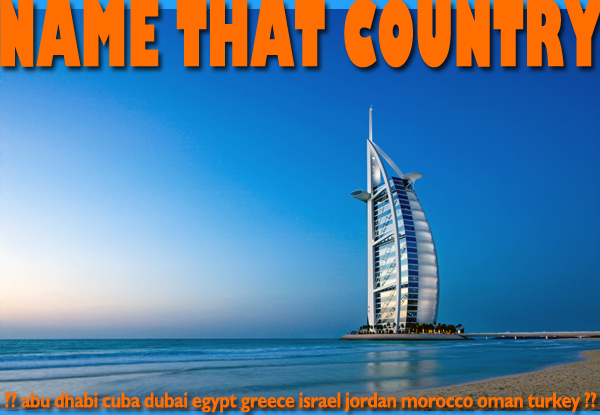
The iconic, sail-shaped Burj Al Arab has been called the only 7-star hotel in the world. Built on an artificial island just off Jumeirah Beach, the only access is by a private bridge (or helipad). Although it’s the world’s 4th tallest hotel, it has only 202 guest suites on 28 double floors. Suites range in size from 1,820 to 8,400 square feet.

Each double floor has its own reception and check-in is done inside the guest suites. Personal butlers attend every guest throughout their stay. For every suite, there are 8 hotel staffers ready to serve.

Can you name that country? 
See below for answers.

Continue reading