NAME THAT COUNTRY Episode 82

In the early 1960s the artist Marc Chagall did a series of 12 stained glass windows for the synagogue at Hadassah Medical Center. The 12 sons of Jacob were each represented by a gem stone and other symbols according to the blessings of Jacob and Moses. Chagall’s windows are brilliant expressions of these foundations of our mystery country.

Can you name that country? 
See below for answers.

Continue reading

NAME THAT COUNTRY Episode 72

This beautiful mosaic is from the floor of the so-called Villa of Dionysus among the ruins of Tzipori (aka Sepphoris). Tizpori was a wealthy, cosmopolitan center of trade in the northern region of our mystery country. The local Roman client king Herod Antipas invested heavily in the city in the early decades of the Common Era. The population of prosperous, Hellenized Jews refused to participate in revolts against Roman occupation, thereby avoiding the destruction suffered by many other Jewish cities and towns. The city attracted Jewish scholars from devastated towns and became a center of Jewish study. Its most notable resident was the Rabbi Yehuda Hanasi, the editor of the Mishna, a collection of commentaries on the Torah and the 2nd most important book in Judaism after the Torah. Remains at the site include a Roman theater, early Christian churches, a Crusader fort and a huge collection of 3rd-6th-century mosaics.

Can you name that country? 
See below for answers.

Continue reading

Jaffa: the Old City of Tel Aviv

Thoroughly modern Tel Aviv is at heart a pioneer city, progressive on many fronts, socially and culturally vital, with cutting-edge arts and food; a mecca for start-ups of all kinds and ranked #2 in the world for high-tech innovation in 2013. Go to Tel Aviv for the beaches, the food, the modern architecture, the museums and galleries, but while there, don’t miss ancient Jaffa (Yafo), the seed of this shimmery metropolis.

Built on an elevated, blunt headland, Jaffa’s long views and natural harbor offered security and industry at least back to the Bronze Age. It’s one of the world’s oldest ports. A short list of landlords includes Canaanites, Egyptians, Philistines, Israelites, Assyrians, Greeks, Romans, Arabs, Crusaders, and Ottomans.

Christians know Jaffa as the site of Peter’s vision on the roof of Simon the Tanner’s house which compelled him to preach to Gentiles, as well as Jews (Acts 10:5-23).
It was also in Jaffa that Peter raised Tabitha from the dead (Acts 9:36-42). These events are commemorated in Jaffa at Simon the Tanner’s House, the Russian Orthodox Church of Tabitha and the Church of St. Peter.

Jaffa is also the place from which Jonah set out on his fishy adventure told in the Biblical Book of Jonah and in the Koran.

Visit Jaffa for its history but also for galleries, shops, restaurants and bars. The flea market, just east of the clock tower at the entrance of Old Jaffa is jammed with everything from trendy clothes to antiques to unapologetic junk. Spend a few daytime hours taking in the romantic, old-world ambience. Follow the narrow, cobbled streets which weave up and around, from the port to the top of the hill, opening periodically onto intimate little squares. At Jaffa’s main plaza, Kikar Kedumim, you’ll find St. Peter’s Church and the visitor’s center/museum, which is built around Roman-era excavations and also exhibits artifacts from other digs in the area.

Above Kedumim Square is Summit Park, the highest point in Tel Aviv-Jaffa, with great views of Tel Aviv and the sea. Within the park, Ra’amses Gate Garden encompasses remains of an Egyptian fortress.

Jaffa is at the southern end of Tel Aviv, easily reached on foot or bike along the waterfront promenade.

If you’re in Tel Aviv to party, don’t miss Jaffa after dark.

Safed

the view from Safed, looking out over the Sea of Galilee, photo courtesy of the Israel Ministry of Tourism

the view from Safed, looking out over the Sea of Galilee, photo courtesy of the Israel Ministry of Tourism

Safed (also spelled Tsfat, Tzfat, and a number of other ways) is a town in the Upper Galilee region in the far north of Israel. It’s one of the few cities in Israel that has been continuously inhabited by a Jewish community for over 2,000 years. At an elevation of 3,000 feet, it’s the highest town in the country, with views out across the Galilee, the Golan Heights and Mt. Meron.

Safed is one of the 4 holy cities in Judaism (along with Jerusalem, Hebron, and Tiberias). According to legend, the Messiah will come through Safed on the way to Jerusalem and the great Kabbalist Yitzhak Luria taught that the divine presence of the Lord will reside in Safed until the building of the 3rd Temple. Legend also tells that the sons of Noah settled in Safed and established a religious school, where Jacob later studied.

In the 16th century, after the Jews were expelled from Spain, Safed became a center of Kabbalah (mystical Judaism) and Jewish learning. Yitzhak Luria, known as Ha ARI (the Lion) studied with renowned rabbis there and went on to develop his own interpretations of sacred texts and pass them on to his own students. His mostly oral teachings were written down by students and went on to have immense influence on the practice of Medieval Judaism and are the basis for the study and practice of most Kabbalah still today.

Safed, Israel

Safed, Israel

Safed, Israel

Safed, Israel

In Safed you’ll find a charming, labyrinthine old town to stroll about, Medieval synagogues, lots and lots of art galleries and artists’ workshops, and stellar views in all directions. In particular, look for the beautiful Abuhav Synagogue and the Sephardic Ha ARI Synagogue, where the Lion himself spent many hours studying and teaching.

Abuhav Synagogue, Safed, Israel, photo by Itamar Grinberg, courtesy of IMOT

Abuhav Synagogue, Safed, Israel, photo by Itamar Grinberg, courtesy of IMOT

art gallery, Safed, Israel, photo by Itamar Grinberg, courtesy of IMOT

art gallery, Safed, Israel, photo by Itamar Grinberg, courtesy of IMOT

kabbalist artist, Safed, Israel

kabbalist artist, Safed, Israel

The annual Safed Klezmer Festival is held in August. Performers from all over Israel and the world play venues around town, many open-air, galleries set up shop in the streets and the whole place parties for three days. Klezmer music is a genre of celebratory, secular music, which originated with Eastern European Jews. Check it out below.

Driving time from Jerusalem or Tel Aviv to Safed is about 2-2.5 hours, from Tiberias it’s about 40 minutes.

See tours that include Safed here.

NAME THAT COUNTRY Episode 62

The architecture around Bialik Square is a small representation of thousands of Bauhaus buildings built in the 1920s and 30s in the largest and first modern city of our mystery country. Because of the large collection of Bauhaus buildings, many of which were whitewashed to keep them cooler in the Mediterranean heat, this original area of the city is known as the White City and is a UNESCO World Heritage Site. Bialik Square is named for the national poet, Chaim Nachman Bialik, whose home, now a museum, is just off the square, on a street which also carries his name. The white building pictured is the recently restored former Town Hall, now a museum and civic center.

Can you name that country? 
See below for answers.

Continue reading

City of David

The king and his men marched to Jerusalem to attack the Jebusites, who lived there. The Jebusites said to David, “You will not get in here; even the blind and the lame can ward you off.” They thought, “David cannot get in here.”  Nevertheless, David captured the fortress of Zion—which is the City of David. (2 Samuel 5:6-7)

Today, the City of David referred to in the biblical text is an archaeological site and national park that is a must-see for any visitor to Jerusalem. It lies along the spine of a narrow ridge just south of the Temple Mount, a short walk from the Western Wall through the Dung Gate.

The City of David (circled) in a scale model of ancient Jerusalem. It stood alone on that ridge during David's time. His palace, yet to be excavated, is at the north end of the city. Solomon extended the walls north of the palace and built the First Temple atop Mount Moriah, known since as the Temple Mount.

The City of David (circled) in a scale model of ancient Jerusalem. It stood alone on that ridge during David’s time. His palace, yet to be excavated, is at the north end of the city. Solomon extended the walls north of the palace and built the First Temple atop Mount Moriah, known since as the Temple Mount.

The site appears to have been permanently settled by Canaanites as early as the 3rd millennium BCE. The 3,800 year old Spring Citadel is a Canaanite fortress built outside the eastern wall to protect the Gihon Spring, the city’s main source of water. This is the largest known Canaanite fortress in Israel, with walls 23 feet thick surrounding the spring. It is believed to be the “fortress of Zion” taken by David to conquer the city in 1004 BCE. It was only discovered in 1995 and opened to the public in 2014 after 17 years of excavation.

King David made the city his capital and proceeded to unite the people of Israel for the first time. David’s son King Solomon extended the city to include the Temple Mount and built the First Temple there.

City of David archaeological park, Jerusalem - This is how it looks today, more or less, excavations are on-going.

City of David archaeological park, Jerusalem – This is how it looks today, more or less, excavations are on-going.

Begin the tour of the City of David at the visitor center, where you can view a 16-minute, 3-D film showing the city as it looked in its prime. Then, if you’re not claustrophobic, explore the tunnels of the city.

There’s the Canaanite tunnel, which most archaeologists date to the 18th century BCE, around the same time the Spring Fortress and other fortifications were built.

Warren’s Shaft, discovered in the 19th century by Sir Charles Warren, is a 40-foot vertical piece of the Canaanite water system that may have been used by David’s army to enter the city.

Hezekiah’s tunnel, also known as the Tunnel of Siloam or Shiloh, is a later addition
built in the early 8th century BCE on the orders of King Hezekiah. Its purpose was to join the Gihon Spring to the city, so it would have an internal water source during the Assyrian siege.

Water still runs through this tunnel today, about 2 feet deep. If you don’t mind wading, it’s a fascinating walk. So sophisticated were their calculations, diggers started on either end and met within millimeters of each other in the middle. You can still see in the tunnel where they marked the meeting point. The tunnel connects the Gihon Spring, which lies outside the city walls, to the Siloam Pool inside the walls. In the winter, we usually bypass this tunnel because the water is quite cold and can be too deep.

wading through Hezekiah's Tunnel - cityofdavid.org.il

wading through Hezekiah’s Tunnel – cityofdavid.org.il

Yet another tunnel, newly opened, the Pilgrim’s Tunnel leads from the City of David to the Davidson Center, which is just south of the Western Wall Plaza. This tunnel was dug during the Herodian Period in the 1st century BCE as a drainage channel to capture water flowing off the surrounding mountains. Water was directed away from the grand Herodian Road, which formed the ceiling of the tunnel, and into the Siloam Pool. Pilgrims from all over Israel would stop at the pool to cleanse themselves before walking the Herodian Road up to the Temple (by now, the 2nd Temple). The Herodian Road is under excavation but visitors today can walk the same route under ground through the tunnel.

The City of David is not a large area but touring the site involves quite a lot of stairs up and down and tunnels require some ducking in places.

There is a parking lot on-site.
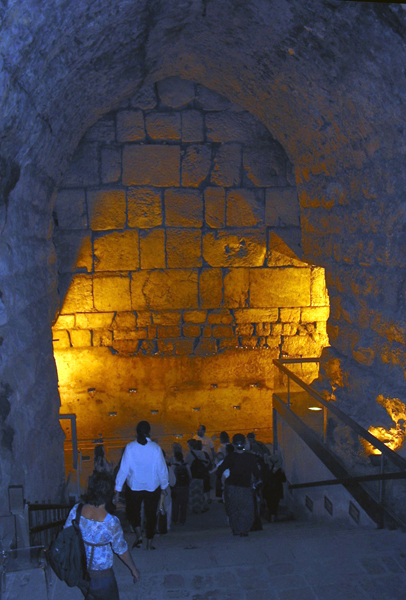
Jerusalem Underground – Western Wall Tunnels

Western Wall Prayer Plaza, Jerusalem

As the ancient remains closest in proximity to the last temple, the Western Wall in Jerusalem is the most important holy site for Jews. It’s the western retaining wall to the Temple Mount, upon which the Temple once stood. The temple itself was destroyed by the Romans in 70 CE.

The Western Wall is generally known as the 200-foot long expanse presiding over the open-air Prayer Plaza. But another 1050 feet of wall extends to the north of the plaza beneath streets and buildings in the Muslim Quarter. Excavation of the area began in the mid-19th century but was limited by Ottoman rulers. Excavation started up again in earnest after Israel took control of the Old City in 1967 and continues still today.

Tunnel tours explore the buried section of the Wall, as well as original steps that lead from the city level up to the Temple Mount, Roman streets, 2nd-Temple era dwellings and ancient cisterns. A section of wall within the tunnels known as Opposite Foundation Stone is especially sacred. It is traditionally held to be the point closest to the heart of the Temple, the Holy of Holies. 

In this illustration of the Temple Mount before the Temple was destroyed, the modern prayer plaza lies between the two arches and the tunnel follows the buried section of the wall to the north of the far arch.

Tunnel tours begin on the north side of the Western Wall Plaza and end near the 1st Station of the Cross on the Via Dolorosa.

NAME THAT COUNTRY Episode 51

Rosh Hanikra is a white chalk cliff on the northern Mediterranean coast of our mystery country. The sea has carved away the soft rock into deep grottos, which are accessed from 200 feet above by a very steep 2-minute cable car ride. About 200 meters of manmade tunnels connect the grottos. The clear blue-green water framed by the white rock is a lovely sight. When the sea is rough, waves crash into the grottos and swirl and froth, putting on quite a show. The whole area is a nature reserve and endangered Loggerhead sea turtles nest on the on Rosh Hanikra Beach. They can be seen riding the surf in the grottos and around the base of the cliff and, at night, laying eggs on the beach. Cute, pudgy Hyrax live in cracks in the cliff face and sun themselves on the rocks in cuddly cohorts.

Can you name that country? 
See below for answers.

Continue reading