Orpheus & Eurydice

Orpheus and the Animals, by Jan Brueghel the Elder

Orpheus was the son of one of the Muses and the king of Thrace. From a very early age, his musical talents were clear. He was singing before he could speak and dancing before he could walk. Every night he would sing himself to sleep and each morning, the singing from his crib woke the household. It was a sweet start to each day and no one complained. Continue reading

Places That Make You Go WOW – Pyramids, Petra & Meteora

the Giza Pyramids, Egypt

the Giza Pyramids, Egypt

Too obvious? Maybe so, but there’s no denying the wow-factor of the pyramids at Giza. The largest, known as the Great Pyramid, was built for the pharaoh Khufu (Cheops in Greek). It stands almost 500 feet tall and is constructed of 2.3 million limestone and granite blocks, some of which weigh 80 tons. Some of the materials were locally sourced but the granite, 8,000 tons of it, came from the quarries at Aswan, 500 miles up river. The Giza pyramids were all built about 4,500 years ago, which makes their immense size all the more incredible. We know they were built as tombs and archaeologists have come up with some very plausible explanations for how they were built; still, few places on earth inspire such wonder.


The Treasury as seen from the siq, Petra, Jordan

The Treasury as seen from the siq, Petra, Jordan

The whole of the ancient city of Petra is astonishing, but, for a couple of reasons, the Treasury is the unequivocal star. In a city full of tombs, dwellings and temples, most of which are carved right into the canyon walls, the Treasury is the best-preserved and grandest of all. Then there’s its alluring position. Surely it’s no accident that the city’s best building is the first thing you see upon entering, if you come though the siq (canyon), which most visitors do. After walking for about a mile, you come around a bend and there it is, magnificently filling the seam of light that opens onto the city. It says “Be impressed.” And you are. The likelihood that you have been anticipating the sight with every step does not diminish the effect. CLICK to read more about Petra.


Meteora, Greece

Meteora, Greece

At Meteora in central Greece, six Orthodox monasteries cling to the tops of soaring sandstone pillars and look out over the stunning Peneas Valley. The monasteries were built in the 14th-16th centuries by hauling materials in nets 1,000 feet straight up the sheer pillar walls. CLICK to read more about Meteora.

GREEK ISLAND CRUISE DIARY – DAY 3

On day 3 of our Greek Islands cruise, we woke up in Rhodes. This was our longest port stop, 7am-6pm.

Rhodes Town, Grand Master's Palace and Medieval walls

Rhodes Town, Grand Master’s Palace and Medieval walls

Continue reading

Greek Island Cruise Diary – Day 1

We boarded our Greek Island cruise at around 10am at Athens’ Piraeus port. We’re traveling on a four-day cruise on the Louis Cruise Lines on the Olympia ship. Ports of call will be Mykonos, Kusadasi (Turkey), Patmos, Rhodes, Crete and Santorini. Continue reading

Santorini Hotels – 2 of our favs

Santorini is expensive. It just is. There’s no point denying it. It’s expensive because it’s rare. We think it may be the most romantic place on the planet. The only reason we don’t declare it so emphatically is because we have not seen every place on the planet. Such beauty and serenity comes at a premium.

#1. ASTRA SUITES – IMEROVIGLI
Our number one favorite hotel on Santorini is lovely in every way but certainly not extravagant. Still, you’ll pay from over $400 to almost $600 a night for the studio rooms we recommend, depending on the season. For Santorini, that’s a fair price.

We loooooooooove this place. Clinging to the side of the caldera, you get jaw-dropping views from most every corner. Every inch of the place is immaculate. Guest rooms are large. The pool is large, relative to most on the island. Service is outstanding and delivered with genuine warmth. Breakfast is served each morning on your private terrace, perhaps the best feature of the overall superb accommodation package. And the food is excellent.

One thing to keep in mind about this or any property on the rim – lots of stairs.

Imerovigli is quieter than Fira or Oia but still offers plenty of restaurants. It sits higher up than Oia or Fira, in a particularly view-friendly position. Walk about 10 minutes to bustling Firastefani and another 10 minutes to Fira.

dining on the edge of the caldera, Astra Suites, Santorini, Greece

dining on the edge of the caldera, Astra Suites, Santorini, Greece

Astra Suites, studio room, Santorini, Greece

Astra Suites, studio room, Santorini, Greece

Astra Suites, studio room, Santorini, Greece

Astra Suites, studio room, Santorini, Greece

Astra Suites, studio room terrace, Santorini, Greece

Astra Suites, studio room terrace, Santorini, Greece

#2. ARESSANA SPA HOTEL & SUITES – FIRA
For a slightly more budget property (approximately $200-$400 per night, depending on the season) this is our number one pick. Plus, it’s one of the few Santorini hotels that accepts children under 13.

Aressana is just across the road from the caldera rim, so, although the views are not as immediate as they are at rim-side properties, they are within easy reach. Right next door is the cable car that travels from the rim to the beach, 1,000 feet below. The location just on the edge of Fira’s town core makes it a bit quieter than it would be right in the center but still just a few minutes walk from all Fira has to offer, including a bus stop for easy access to the whole island.

The contemporary interior design is chic but the atmosphere is very laid back. Guests are greeted like old friends and served with sincere warmth and pleasure. Guest rooms are on the small side but spotless and comfortable, as are all public areas (we wish they’d cool it with the muzak though).

The food is very good and the pool area is enchanting.

Aressana is a member of Small Luxury Hotels of the World, a group with very high standards.

Aressana Spa Hotel & Suites, lobby, Santorini, Greece

Aressana Spa Hotel & Suites, lobby, Santorini, Greece

Aressana Spa Hotel & Suites, Santorini, Greece

Aressana Spa Hotel & Suites, Santorini, Greece

Aressana Spa Hotel & Suites, Santorini, Greece

Aressana Spa Hotel & Suites, Santorini, Greece

To read more about Santorini island, click here.
3 Day Trips from Athens


Temple of Octavia, Corinth, Greece

Temple of Octavia, Corinth, Greece

The ancient site of Corinth is about an hour drive west of Athens on the isthmus that connects mainland Greece to the Peloponnese. There has been significant development there since the 8th century BCE. With ports on the Corinthian Gulf and the Saronic Gulf, Corinth controlled a great deal of trade and was very wealthy and powerful, especially in the Classical period, when the city was known for decadence. The flamboyant Corinthian Order (column) originated in Corinth and is a good reflection of the city’s character at its peak.

Ancient attempts to dig a canal through the isthmus failed but after the first try in the 7th-century BCE, a paved ramp was built so ships could be moved overland, to avoid sailing around the Peloponnese. In the late 19th century the canal was finally built, 4 miles long and only 70 feet across, too narrow for most modern seafaring traffic.

Many visitors to Corinth are interested in its biblical significance. Paul the Evangelist established a church there and visited several times. Two of his letters to the congregation in Corinth are part of the Christian Bible – 1st & 2nd Corinthians. Among the ruins are a 6th-century BCE Temple of Apollo, one of the oldest surviving Greek temples, a Roman Temple of Octavia, the Roman agora, and the Bema, a public square where Paul was judged after some of the locals complained about his preaching.

Cape Sounion, Greece

Cape Sounion, Greece

Less than an hour drive southeast of Athens is Cape Sounion, a windswept promontory jutting out into the Aegean Sea. A magnificent 5th-century BCE Temple of Poseidon commands the end of the cape. It’s a dramatic and evocative place, well worth the pretty drive from Athens along the Saronic Gulf.

Hydra island, Greece

Hydra island, Greece

With Saronic Islands day trips from Athens you visit three islands – Hydra, Poros and Aegina. If you’re short on time and really want to see more than one island in an organized, semi-escorted way, this is a good way to do it. On the other hand, you spend a lot more time traveling between islands and boarding and disembarking than you do on the islands. Personally, I’d rather have time to linger and soak up one place, and Hydra would be that place. Hydrofoils depart several times a day from Athens’ Pireaus port during the tourist season (March/April-October). The one-way trip takes about 1 ½ hours. The island is idyllic, with the pretty, whitewashed town tucked between amphitheater hills and the harbor, cobbled roads and no motorized traffic – the perfect recipe for lazy poking around and a long harbor-view lunch.

Santorini

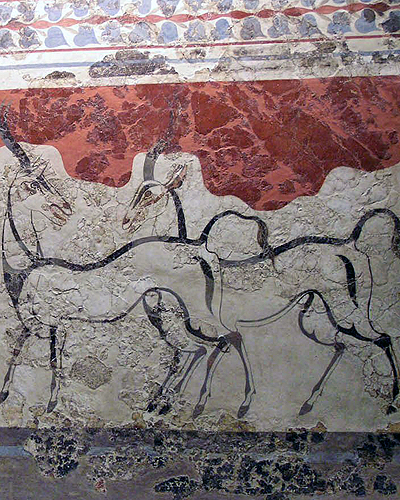
Akrotiri Museum, Santorini

So many Greek islands, so little time… Cyclades, Dodecanese, Sporades, Ionian…literally hundreds of islands, thousands if you count the uninhabited ones, and why not count them? They’re there, they’re islands, they deserve to be recognized. However, in order to stay relevant, we’ll stick to the inhabited ones, and then narrow it way down to a few that possess just the right combination of scenery, personality, infrastructure and accessibility.

We’ll take one in this post – Santorini

While I’m sure most islands have some drama in their past; on that front, I venture none can compete with Santorini. The island as we know it is the caldera of a volcano which erupted in one of the largest explosions ever known on this planet around 1600 BCE. Ash and debris shot 25 miles into the stratosphere and the massive tsunami that followed brought immediate destruction, as well as prolonged environmental devastation that lead to the extinction of the powerful Minoan civilization.

The Minoans were centered in Crete but their influence was widespread and they had colonies on a number of Aegean islands. Akrotiri on Santorini was a Minoan settlement that was preserved in volcanic ash, much like Pompeii. No human remains have been found, so it would seem the inhabitants got out in time. What remains is evidence of a very wealthy, sophisticated city. A powerful city that sank into the ocean in a single day, hmmm, does that sound familiar? Could it be Atlantis? Some think so, scholars even. Visit Akrotiri and decide for yourself.

Despite an explosive history, Santorini is a very peaceful place, and thanks to its explosive history, Santorini is extraordinary to look at. Santorini is all about the views. You sit on your hotel terrace and look at the view, you eat your meals looking at the view. When walking around, you really must try to stop looking at the view and watch where you’re going because there are some pretty steep drops.

Most habitation is perched on the caldera rim, a sheer 1,000 feet over the sea. Fira is the main town, with the most happening. Oia is a little out of the way, quieter and more romantic. Imerovigli is closer to Fira but quiet and sits higher than either Fira or Oia, so claims superior views. Really, the views are good everywhere, as long as there’s nothing in the way.

Most (if not all) Greek island cruises stop in Santorini for a few hours. In season (April/May-October) there are frequent flights and ferries from Athens.