NAME THAT COUNTRY

This is the Lions Gate at Mycenae on the Peloponnese peninsula. Mycenae was a major center of power and cultural influence in the eastern Mediterranean from about 1600-1100BCE. Mycenean civilization was the first advanced civilization on the mainland of our mystery country. In Homer’s Iliad, Mycenae was among the city states that fought in the Trojan War over the abduction of Helen, wife of the King of Sparta (Menelaus) , who was the brother of the King of Mycenae (Agamemnon).


Can you name that country? 
See below for answers.

Continue reading

NAME THAT COUNTRY Episode 127

In the central north of or mystery country, a collection of  monasteries perch 1,000 feet above the Plain of Thessaly at the top of titanic natural pillars. This is Meteora, first inhabited by Christian hermits seeking solitude and security in the 11th century.
These first settlers scaled the towers and lived in caves and cracks in the stone.
In the 13th century, groups of monks came to the area and began to build. Over the next several hundred years over 20 monasteries were built. Today, six of the surviving monasteries are open to visitors.

Can you name that country? 
See below for answers.

Continue reading

Pilgrimage

As long as humans have found transcendent meaning in earthly places, they have made special journeys to those places. Traditionally, a pilgrimage is an act of religious devotion, but lately the word is used to describe a trip to any place that is especially inspiring to the traveler. Continue reading

NAME THAT COUNTRY Episode 117

With its elegant design and amazing acoustics, the theater at Epidaurus is widely considered to be the pinnacle of ancient performance venues. The theater was built as a compliment to the nearby Asclepeion health center. Asclepius, the god of medicine and healing, was born at Epidaurus, and his sanctuary there drew health-seekers from around the known world for almost a millennium, from the 6th-century BCE to the 5th-century CE, well into the Christian era. Dramatic performance was considered therapeutic and Asclepeion patients were often prescribed an evening at the theater.
The theater is still in regular use, especially during the annual, summer Epidaurus Festival.

Can you name that country? 
See below for answers.

Continue reading

Faster, Higher, Stronger in Ancient Olympia

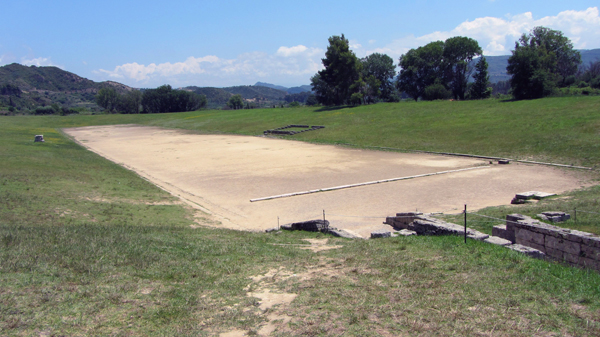
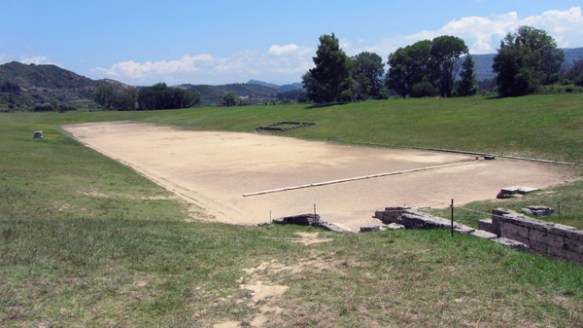
the ancient stadium at Olympia, Greece

the ancient stadium at Olympia, Greece

As we enter week two of our 2016 Olympic Games, here’s a piece about the original Olympic Games and their home, Olympia, Greece.

The ancient games began in 776 BCE and went on every four years until they were banned as a pagan festival by the Christian Roman Emperor Theodosius in 393 CE.

The Olympian Games was one of four Panhellenic festivals held every two or four years, scheduled to alternate so that at least one or another happened each year. Besides the Olympian Games, there were the Pythian Games, the Nemean Games and the Ithsmian Games. They were all primarily religious festivals, with the Olympic Games dedicated to Zeus. They were also designed to promote friendly interaction between sometimes combatant city states. The main political entity of Ancient Greece was the city-state and conflict over resources was constant. More than competition, the games brought everyday rivals together to celebrate those things they had in common, namely religion and the great honor of being Greek.

Only free Greek men were allowed to compete in the games. Women could not compete and could only watch the games if they were unmarried. One source I read explained that the ban on married women was due to the nakedness of the athletes and, while I think that’s only speculative, there is logic to it. Whatever the reason for the ban, it was on penalty of death. It’s true that the athletes competed in the nude, which seems dangerous to me, and not very aerodynamic. Nevertheless, Ancient Greeks celebrated the fit male form and regularly put it on display. They generally exercised in the nude and had naked drinking parties called symposia.

Originally the games only lasted one day but over the years grew to five days, part of that time taken up by religious rituals. The competitive events included running, jumping, discus throwing, javelin throwing, wrestling, boxing, horse racing and chariot racing. Winners received an olive branch and red ribbons after their event and an olive wreath crown at the closing ceremony. More prizes awaited from their home towns, where they were treated as local heroes.

The site of the ancient Olympian Games was the sanctuary of Olympia on the western Peloponnese peninsula. The setting is idyllic in a lush river valley, with rolling green hills all around. The temples of Zeus and Hera were the main religious attractions. They were accompanied by treasuries and administrative buildings. A colossal ivory and gold statue of Zeus stood in his temple and was one of the Seven Wonders of the Ancient World. The main structures for athletic events were a stadium and a hippodrome for the horse and chariot races. Today, the site consists of a lot of foundations and broken columns. The most complete remains are the partially reconstructed Temple of Hera and the Philippeion, built to honor a battle victory by Philip of Macedon (father of Alexander the Great). It’s an exceptionally lovely place, do visit if you have the chance.

Olympia is about 4 hours from Athens but is best seen on a several-days tour of the Peloponnese.

Click to see tours that include Olympia on our web site.
Poetry Corner – Pindar, 4th Olympian Ode

Chariot racing on a black-figure hydria from Attica, ca. 510 BC

Chariot racing on a black-figure hydria from Attica, ca. 510 BC photo by Marie-Lan Nguyen (Wikipedia)

The 5th-century BCE Greek poet Pindar is best known for his victory odes, written for champions of the Olympic and Pythian Games. As we are in the thick of our 2016 Olympic Games, I submit Pindar’s 4th Olympian victory ode, written for Psaumis of Camarina, chariot race winner in 452 BCE.

For Psaumis of Camarina
Charioteer of the thundercloud with untiring feet, highest Zeus!
Your Seasons, whirling to the embroidered notes of the lyre’s song,
sent me as a witness of the most lofty games.

When friends are successful, the noble immediately smile on the sweet announcement. Son of Cronus, you who hold Aetna, the wind-swept weight on terrible hundred-headed Typhon, receive, for the sake of the Graces, this Olympic victory-procession, this most enduring light of widely powerful excellence.

For the procession comes in honor of Psaumis’ chariot; Psaumis, who, crowned with the olive of Pisa, hurries to rouse glory for Camarina. May the god be gracious to his future prayers, since I praise a man who is most eager in the raising of horses, who rejoices in being hospitable to all guests, and whose pure thoughts are turned towards city-loving peace.

I will not stain my words with lies. Perseverance is what puts men to the test, and what saved the son of Clymenus from the contempt of the Lemnian women. He won the foot race in bronze armor, and said to Hypsipyle as he went to take the garland: “Such is my swiftness; and I have hands and heart to match. Even on young men gray hair often grows, even before the expected age.”

NAME THAT COUNTRY Episode 108

On the island of Milos, Kleftiko, also known as “Meteora of the Sea,” is a popular excursion for swimming, snorkeling, diving and kayaking. Shapely gray-white rock formations make a striking contrast to the clear turquoise water and harbor caves and little coves for exploring. Kleftiko is in a remote part of the island and predominantly reached by sea, although there is a hiking trail. Group tour boats and private yachts depart regularly from Adamas and Pollonia.

Can you name that county? 
See below for answers.

Continue reading

Hotel Favs – Petasos Beach Resort & Spa, Mykonos, Greece

Le Club Restaurant, Petasos Beach Resort & Spa, Mykonos

Le Club Restaurant, Petasos Beach Resort & Spa, Mykonos

Located about 5km from Mykonos Town and its famous nightlife, Petasos Beach Resort & Spa is an oasis of relative peace and quiet. With a bus stop right outside the front door, the bustle of town is an easy 10-15 minutes away. In season, the bus runs every 30 minutes and tickets are sold at the hotel desk, for 1.80 euros.

The hotel is positioned at the end of a rocky outcropping, with its own small private beach. The large public beach Platys Gialos is right next door and Psarou beach is a five-minute walk away. Other beaches can be reached by water taxis from Gialos. (American travelers should know that, in terms of pillowy sand, most Mediterranean/Aegean beaches do not compare with those of Hawaii, Mexico and the Caribbean. Don’t go to Greece for the beaches; go to Greece for culture, both past and present, great food and rugged natural beauty, all with a side of beach.)

Pristine, multi-level patios around the pool have gorgeous views of the little bay and sea beyond. Guest rooms are spacious and some deluxe rooms and suites have their own pool. The two on-site restaurants are excellent and plenty of dining options are within an easy walk. Behind all the crisp beauty and comfort of Petasos Beach is an outstanding staff – sincerely friendly and eager to serve. We get nothing but raves from Ya’lla travelers about this hotel.

private pool suite

private pool suite

Classic Room

Classic Room

All photos courtesy of Petasos Beach Resort & Spa