Unknown's avatar

About yalla2013

Ya'lla Tours USA is a boutique tour operator offering top quality travel services in 10 exciting countries: Bahrain, Cuba, Egypt, Greece, Israel, Jordan, Morocco, Oman, Turkey and the United Arab Emirates. Ya'lla Tours communications director, Kyna Perry, writes this blog based on personal experience and the deep well of experience and knowledge of Ya'lla colleagues near and far.

NAME THAT COUNTRY

The Sheikh Zayed Grand Mosque pictured above is named for the founder and first president of our mystery country. The country, composed of seven united principalities boarding the Arabian Gulf, is known for its oil wealth and shiny modern cities. Sheikh Zayed, who died in 2004, is locally revered and widely respected for wise stewardship of the considerable natural resources within his borders.

Can you name that country? 
See below for answers.

Continue reading

Abu Dhabi: from Sandy Village to Manhattan-Skyline in 40 Years

Only forty years ago, the gleaming metropolis of Abu Dhabi that we know today was a hungry, mud-brick speck on the edge of the desert. Most people lived as their ancestors had done, scrapping a meager living from the sea and inland oases.

In 1761, a hunting party of Bedouins followed a gazelle out of the desert to a pool of fresh water near the coast, a miraculous find in that place. (Abu Dhabi means “a place with lots of gazelles.”) They built a well and a watch tower out of coral, sea stone and crushed sea shells to protect and control the water, at that time the greatest form of wealth they knew. The ruling sheikh moved into the fort and Qasr al-Hosn (which means “palace fort”)  remained the residence of the local rulers for 200 years there after. Today, Qasr al-Hosn still stands, the cornerstone of Abu Dhabi, now in the shadow of glass and steel skyscrapers, watch towers of another kind built by liquid wealth of another kind.

A settlement grew up around the fort and pearling, fishing and trading industries developed. Piracy also developed and the coast around Abu Dhabi became known as the Pirate Coast by the British, who were passing by regularly on their way to and from India. In the 19th century, the pirate problem led to a series of treaties or truces between the British and area sheikhs. Hence the next British name for the area – Trucial Coast. British influence lasted until 1971. Some contend that the British used piracy as a pretext to get a foothold in the Arabian Gulf ahead of other European powers.

The pearl harvest and trade made Abu Dhabi economically vital through the 19th century and into the 20th. The development of cultured pearls in the 1920s and the global depression of the 1930s all but ended the natural pearl industry, leaving Abu Dhabi pretty much destitute. They fished, grew dates and herded camels and got by, barely. Then came oil.

Oil was discovered in Abu Dhabi in 1958 and exports began in 1962. In 1966, Sheikh Zayed bin Sultan Al Nahyan sent his older brother Shakhbut into exile and took control. Shakhbut was stuck in the past and making no real effort to put his new wealth to good use. It was a bloodless coup. Sheikh Zayed began right away to invest the new oil wealth in Abu Dhabi and to share it with his neighbors. He built roads, an airport, schools, hospitals, all the infrastructure that a society needs to prosper and progress.

In December 1971, Abu Dhabi joined with five other emirates – Ajman, Dubai, Fujairah, Sharjah, Umm al-Quwain – to form the United Arab Emirates. The seventh emirate, Ras al-Khaimah, joined in February of 1972. Abu Dhabi became the capital of the UAE and Sheikh Zayed bin Sultan Al Nahyan its first president.

Since independence, and oil, Abu Dhabi has become an economic powerhouse, with a per capita GDP in line with countries like Germany, France and the UK. Besides crude oil, natural gas contributes significantly to Abu Dhabi’s wealth and the emirate is actively working to diversify its economy, with steady growth in real estate, banking, tourism and manufacturing. The UAE as a whole is listed in the Very High category of the Human Development Index, which tracks life expectancy, literacy, education, standards of living and quality of life.

Click to see tours of Abu Dhabi on our web site.
NAME THAT COUNTRY

When Jesus was 30 years old, he left Nazareth and settled in the village of Capernaum, about 30 miles away. The village sits on the northern shore of the Sea of Galilee, which is actually a fresh water lake, known locally as Lake Kinneret. Several of Jesus’ disciples lived in Capernaum and fished in the lake for a living. The synagogue pictured above post-dates Jesus but is built on remains of a synagogue where he certainly preached.

Can you name that country? 
See below for answers.

Continue reading

The Dead Sea: Grab a Natural High at the Lowest Place on Earth

salty shores

the Dead Sea forms part of the border between Israel and Jordan

the Dead Sea forms part of the border between Israel and Jordan

The Dead Sea shore is 1400 feet below sea level, the lowest land spot on earth. There is no outlet for the water, which flows into the Dead Sea, technically a lake, from the Sea of Galilee (also technically a lake) via the Jordan River. Water leaves the Dead Sea only by evaporation, leaving minerals behind in high concentration. Because of the extremely low elevation, the barometric pressure is higher than anywhere else on earth, there’s a greater concentration of oxygen in the air, greater filtration of ultraviolet sun rays, and the air is practically free of pollen and other allergens.

The Dead Sea has been known for its healing properties for thousands of years, and even today, the unique climactic and mineral properties are used in therapies for conditions such as psoriasis, arthritis and cystic fibrosis.
Continue reading

NAME THAT CAPITAL

Plaza San Francisco de Assis (St. Francis of Assisi Square) is one of  several colonial era city squares in the old city heart of our mystery capital. The square is cooled by sea breezes sweeping in from the harbor, just behind the pictured port terminal. This port is just one of three in the city’s large natural harbor, which opens onto the Gulf of Mexico. The square was named by the Franciscan community, whose 16th-century church and monastery still stands on the south side of the square.

Can you name that capital? 
See below for answers.

Continue reading

Ancient Egypt’s First Family

Isis and Osiris were a happy couple. They had everything going for them. (I’ll tell you now, because you’ll find out sooner or later, they were brother and sister.
I know, that’s creepy, but in the primordial world of gods and goddesses, it was perfectly normal for brothers and sisters to marry.) Isis and Osiris were the children of the sky god Geb and the earth goddess Nut; and Set and Nepthys were their brother and sister, who also grew up to marry each other.

Osiris was the oldest sibling and the golden child. He was bright and steady and destined for greatness. Set, on the other hand, was turbulent and brooding, one could never tell what was going on behind his shifty eyes. He always knew that his inscrutable presence was unsettling to those around him and he grew into a bitter and vengeful god. Nepthys was the only one who even tried to love him. A classic villain, Set was fated to cast the shadow that made Osiris shine all the brighter.

The brothers grew into their assigned roles, Osiris becoming the god-king of Egypt, Set, his skulking nemesis. Driven by defiance and a lifetime of jealousy, Set mounted a coup. He killed Osiris, cut him into pieces, scattered his body across Egypt and took the throne.

Fearing for her husband’s soul, Isis combed the deserts and waded through marshes, reassembling Osiris’ body piece by piece, so that he could pass on to the afterlife. Before letting him go, Isis used her magic to conceive a child with Osiris.

Osiris became lord of the afterlife and Isis gave birth to their son, Horus. As the son of Osiris, Horus was his natural avenger and the rightful heir to the throne. From his first breath, his life was in danger. Isis kept him hidden in a papyrus thicket, and, thanks to her devotion and special magic, he survived.

When Horus was old enough, he set out to take the throne from his evil uncle. They engaged in physical battles and also pled their cases before a panel of gods. In the end, the other gods favored Horus because his claim was righteous and he became the eternal ruler of Egypt.

This story reflects the belief that Egyptian pharaohs were living gods, the incarnation of Horus. After death, pharaohs lived on as Osiris in the afterlife. With Isis as the magical force connecting the two gods, they formed a trinity that was at the heart of ancient Egyptian religion.

Horus is most often portrayed as a falcon, or a falcon-headed man. Osiris is portrayed wearing the crown of unified Egypt, wrapped like a mummy and holding a crook and flail. Isis, the great mother, is variously portrayed with a throne on her head, nursing the infant Horus, crowned with cow horns and the sun disk, and sometimes with the head of a cow.

Isis and Horus

Isis and Horus

Horus

Horus

Osiris

Osiris

Frankincense, from Oman to the World

Frankincense

Frankincense, the wealth of ancient Oman, flowed from the scared trunks of scrappy little trees on the wadi flats and mountain sides of misty Dhofar. The prized scent intensified as the resin dried and hardened.Then it was sent out by land and sea across the known world.

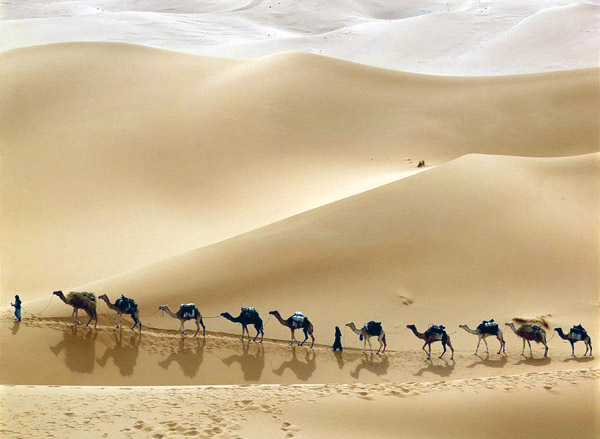
Dhows, the traditional sailing vessels of the region, carried frankincense to ports in Africa, Mesopotamia and India. While great caravans of 1,000 or more camels walked 2,000 miles north across the unforgiving Arabian Desert to ports on the Mediterranean Sea.

Camels can survive weeks without food or water, drawing on the fat stored in their humps. When necessary, they ate grains they carried or whatever they could find to graze on. Caravan drivers ate food packed by the camels, hunted, and shopped where they could on the way.

Tribal territories around the routes carved their share of the trade by charging tolls for passage and selling supplies.

Overnight camps were set up in the open desert or at caravanserai, the truck stops of the ancient trade routes. Song and dance around the fire recapped the highlights of each day’s journey, celebrated a step closer to completion and energized the company for the next leg.

The frankincense trade goes back at least 5,000 years. Egyptians and Mesopotamians were crazy for it, and the Greeks and Romans after them. It was used in religious ritual, in cosmetics, in medicine, even to embalm the dead. Today it’s used in pretty much the same ways and Dhofar still produces some of the highest quality frankincense in the world.

In Dhofar, you can visit remains of the ancient frankincense trade at Sumhuram and Al Baleed, both UNESCO World Heritage Sites near Salalah in southwestern Oman.

Check out our Oman tours at www.yallatours.com/oman.