Coffee the Turkish (Greek, Arabic, Bosnian, Cypriot…) Way

Coffee came to Turkey in the 16th century, discovered in Yemen by an Ottoman official and introduced to the sultan Suleiman the Magnificent. Its popularity quickly spread but in the following century, it was deemed a drug and outlawed, upon pain of death, likely because the coffee house culture encouraged political discourse and potential dissent. Despite the harshest of penalties, the prohibition could not hold against the demand.

The name Turkish coffee refers to a method of preparation, the oldest there is, rather than a particular set of ingredients. The same or very similar drink is popular across the Middle East and eastern Europe, sometimes called Turkish coffee but often named for the country in which it is served.

So, here goes. It’s very simple. You need a special pot called an ibrik or cezve, usually copper with a wooden handle (I bought mine for well under $10), and a teaspoon.
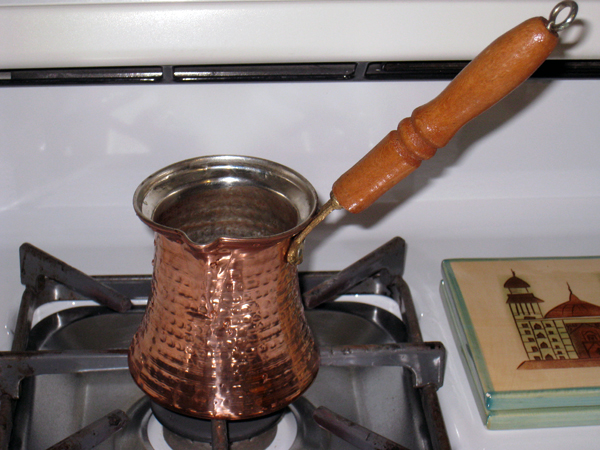
turkish-coffed-ibrik

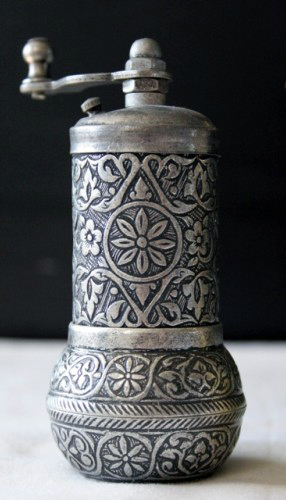
You can use any coffee but fresh ground beans are the best. The grind must be extremely fine, like powder. Few standard electric coffee grinders will do the job. A hand-crank pepper mill works great.
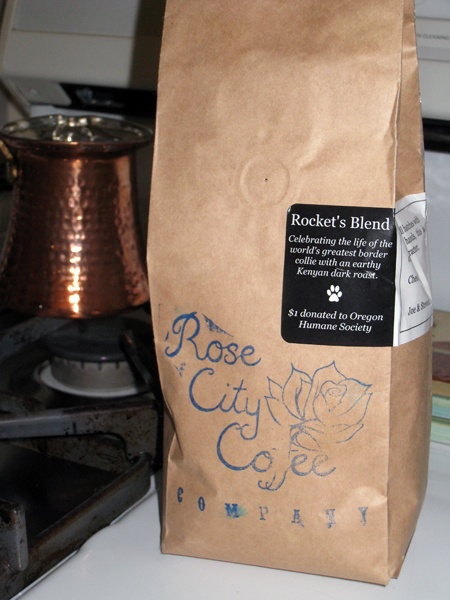
gurkish-coffee-beans

grinder

Measure cold water into the cezve with a demitasse cup and add 1-2 heaping teaspoons of coffee per cup of water. If you like it sweet, add sugar now. Stir until the coffee is mixed well into the water and the sugar is dissolved. Heat on medium until the coffee bubbles up to the rim of the pot, then remove from heat. (You have to watch this coffee while it brews, once it starts bubbling, things move fast. Look away for a second and you might have a very messy stove.)
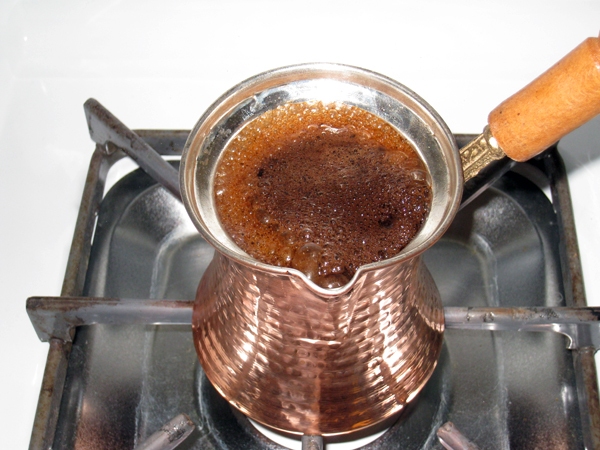
turkish-coffee-foaming

Once the coffee returns to a nonfoamy state, put it back on the heat and repeat. Let it foam up on the heat to near overflowing three times. Then serve. Don’t stir.
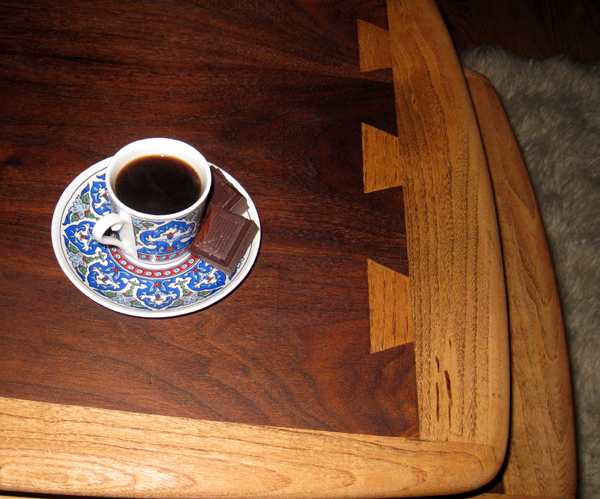
turkish-coffee-finished

If you’d like to have Turkish coffee in Turkey or Morocco or Greece or Oman…we can help you with that. Visit our web site at www.yallatours.com.

NAME THAT COUNTRY


This spice bazaar, just steps from the Bosphorus shore, is one of the best known and largest covered markets in our mystery country’s most populous city. It has been the center of the city’s spice trade for over 350 years. The market is called the Egyptian Bazaar because its construction was financed by income from Egypt, which was an Ottoman province at the time.

.

Can you name that country? 
See below for answers.

Continue reading

Go East Young Man! The Via Egnatia to Byzantium

Via Egnatia route map, Wikipedia

Via Egnatia route map, Wikipedia

The Roman Via Enatia was built in the 2nd century BCE running west-east through Roman occupied lands from the Adriatic Sea to Byzantium (which became Constantinople a few centuries later, then Istanbul… https://youtu.be/Wcze7EGorOk). The road begins on the eastern coast of the Adriatic Sea at the Albanian town of Durres (ancient Dyrrachium) and heads eastward for about 700 miles through some very rugged terrain, including multiple mountain passes. The modern countries on the route are Albania, the Republic of Macedonia, Greece and European Turkey. All roads lead to Rome, as they say, but the Via Egnatia required a transfer to the Via Appia, which picked up on the other side of the Adriatic and continued to Rome.

the Via Egnatia at Philippi in Greece

the Via Egnatia at Philippi in Greece

The apostle Paul used the Via Egnatia to travel between Philippi and Thessalonica in northern Greece on his 2nd missionary journey. In the waning years of the Roman Empire, travel along the Via Egnatia, or any road in the Roman provinces for that matter, was dangerous and by the 5th century CE, the road was in serious disrepair. With the Byzantine Empire, centered in Constantinople, the road was restored and became an important trade route to western Europe. The Via Egnatia made up one leg of the crusader march from Europe to the Holy Land.

Like many highways through once-Roman territories, the modern Egnatia Odos runs parallel to its ancient namesake from Thessaloniki, Greece to the Turkish border.


Istanbul Highlights #1

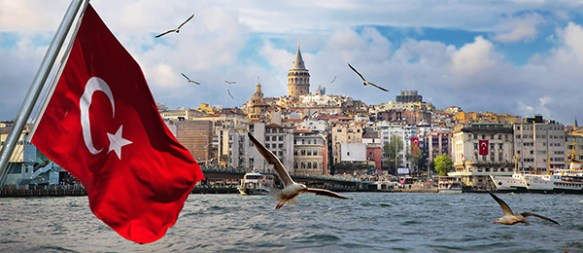
view-from-bosphorus-dreamstime

The highlights of Istanbul for a first-time visitor are:

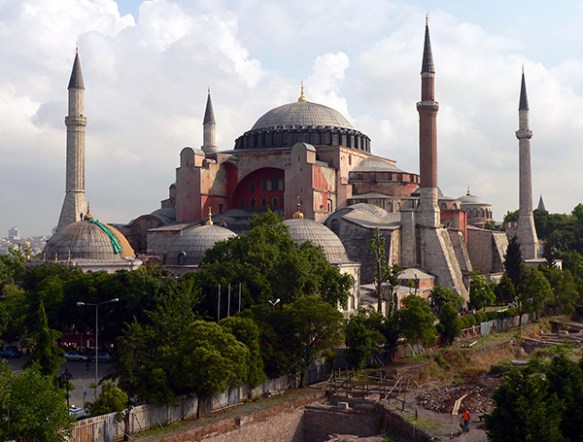
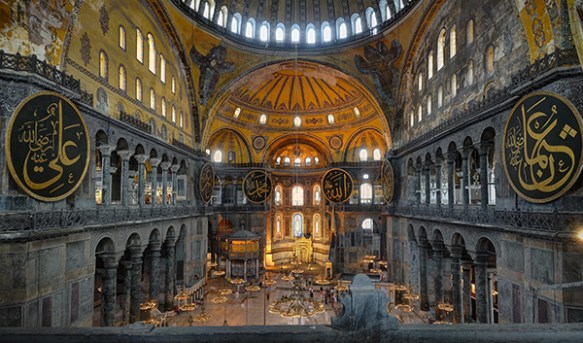
The Hagia Sophia is a 6th-century Christian basilica, converted to a mosque by the Ottomans. After 85 years as a museum, Hagia Sophia became a working mosque again in 2020. If the word awesome still had meaning, I would use it to describe the Hagia Sophia, temple of Holy Wisdom. It set the standard for Byzantine architecture, though it was 1,000 years before another cathedral surpassed its size. From the outside, it’s a red-orange mountain that seems to anchor the city to the Bosphorus shore. It’s not particularly beautiful but the air of greatness can’t be missed. On the inside, it’s vast and filled with the light of heaven. The massive, superlative dome practically floats above the wide-open enormity below. Interior surfaces are decorated with frescos, mosaics, calligraphy and marble.

Hagia_Sophia_Cathedral

hagia-sophia-interior

Continue reading

NAME THAT COUNTRY

This gorgeous tile work is inside the Topkapi Palace, the residence and governing hub of the Ottoman Empire from the middle 15th century until the Empire’s demise in the early 19th century. The palace sprawls along the waterfront of a peninsula in the heart of the city once known as Constantinople.1924, Topkapi Palace became a museum open to the public and is among the most visited sites in our mystery country.

.

Can you name that country? 
See below for answers.

Continue reading

NAME THAT COUNTRY Episode 40


The world’s steepest ancient theater appears to be sliding right off the acropolis of Pergamum. Don’t worry, it has been there for 2,000 years. Just out of the picture, dazzling marble remains are scattered across the mountain top and the Temple of Dionysus, the foundations of the great Alter of Zeus and the agora are terraced into the slope.

Pergamum was an important Greco-Roman city, home to 200,000 people at its peak. The 3rd largest library of antiquity was here and people from all across the Roman world came for health and wellness treatments at the Sanctuary of Asclepius. One of the Seven Churches of Revelation was in Pergamum and it’s a common stop on Christian pilgrimage tours of our mystery country. 

Can you name that country? 
See below for answers.

Continue reading