
Royal Palace, Rabat

Fez medina

Fez medina

Madrasa Bou Inania

foothills of the Atlas Mountains
Royal Palace, Rabat
Fez medina
Fez medina
Madrasa Bou Inania
foothills of the Atlas Mountains

The former Imperial City of Meknes is in the north of our mystery country. Meknes was the seat of the ruling Alaouite Dynasty from the late 17th century to the early 19th century. The dynasty’s founder Sultan Moulay Ismail vowed to make his city rival Versailles and by most accounts succeeded. Some of that grandeur remains, including the glorious Bab el-Mansour gate pictured above. One of the country’s top tourist attractions, the Roman site of Volubilis, is about 30 minutes away from Meknes.
Can you name that country?
See below for answers.

In the Marrakech medina, near the Mellah (Jewish quarter), the Bahia Palace sprawls across 8 hectares in an incoherent series of reception halls, living quarters, courtyards and gardens. It was built in two phases by father and son Grand Viziers, first 1859-1873 and then 1894-1900. Today, the palace is home to the Moroccan Ministry of Cultural Affairs and is still used by the king to host the occasional visiting dignitary.
The sedate façade reveals nothing of the splendid interiors, with elaborately carved, painted and inlaid cedar ceilings, vivid tile and marble floors and walls, stained glass windows and serene courtyards that seem a world away from the chaotic medina just outside. Some of the palace is closed to the general public, but those areas that are open do a good job representing the various moods of the palace as a whole.


The “blue city” of Chefchaouen is a meditation on the divine, often represented by the color blue in Jewish tradition.The village was founded in 1471 by Jews and Muslims fleeing the Spanish Reconquest. Jews also fled here prior to World War II, but most left upon the founding of Israel in 1948.
Chefchaouen is tucked into the Rif Mountains in the northwest of our mystery country, a compact maze of narrow lanes framed by crisp blue and white Andalusian architecture. Although it’s several hours from the population centers and tourist hubs of the country, more and more visitors are making the trek to experience the crisp air and relatively low-key charms of this mountain jewel.
Can you name that country?
See below for answers.

Wandering through the Medina in Fez, you see craftsmen of all sorts at work, their workshops often open right onto the narrow alleyways. The leather tanneries are slightly less accessible; you’ll smell them long before you see them. The tannery works can only be seen from upper floors of the leather shops that surround them. Continue reading
As we cross the threshold from the work week to the weekend here in North America, I offer a feast of Moroccan portals for your viewing pleasure. Thanks to our friend Kathy Moroney for sharing her photos.


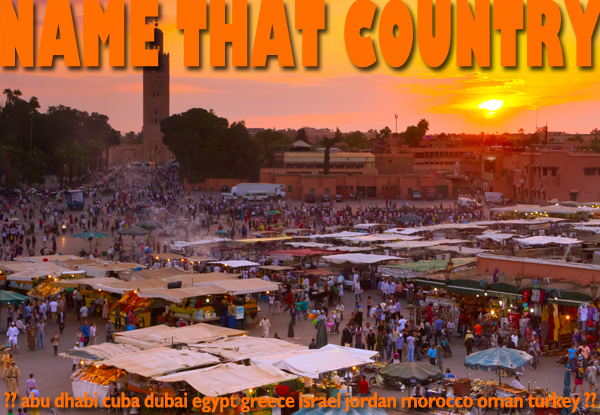
The cultural hub of one of our mystery country’s most famous cities is pictured above. Jemaa el Fna square is known for its manic atmosphere, especially after the sun sets. Locals and visitors come here to see traditional musicians, dancers and story tellers and enjoy fresh squeezed juice and a hot meal from the many food stalls.
Can you name that county?
See below for answers.

Bou Inania Madrasa, Fez

Fez medina

storks somewhere in Morocco

Fez medina

Hassan II Mosque, Casablanca

The village of Imlil is tucked into the High Atlas Mountains. Trekkers use Imlil as a base for climbing Mt. Toubkal, the highest peak in North Africa. However, you needn’t be a mountain climber to enjoy the crisp air, soaring views and traditional charms of this Berber village. It makes a great day trip from Marrakech, only 90 minutes away.
Can you name that county?
See below for answers.


 The Ya'lla Blog