
Dead Sea mud

boys and their donkeys at Petra

the iconic shot of Petra – the “Treasury”

mountains around Petra

Madaba market
Dead Sea mud
boys and their donkeys at Petra
the iconic shot of Petra – the “Treasury”
mountains around Petra
Madaba market

In the north of our mystery country, the Greco-Roman Decapolis city of Pella was built on a site that had already been inhabited for thousands of years. (Hellenistic Greeks named the city after the Macedonian birthplace of Alexander the Great.) Archaeologists have discovered a substantial fortification wall from the early Bronze Age and a Canaanite temple, as well as remains from Greek, Roman, Byzantine and Umayyad periods; and there’s still a great deal to be excavated. Pella does not attract as many visitors as the better known and more flashy Decapolis city of Jerash, but most who do visit are impressed by its subtle, evocative quality and beautiful setting.
Can you name that country?
See below for answers.

Jerash theater

6th-century mosaic on display at the Museum of Popular Traditions in Amman’s Roman theater

Mt. Nebo

Petra

Petra

salty shores

the Dead Sea forms part of the border between Israel and Jordan
The Dead Sea shore is 1400 feet below sea level, the lowest land spot on earth. There is no outlet for the water, which flows into the Dead Sea, technically a lake, from the Sea of Galilee (also technically a lake) via the Jordan River. Water leaves the Dead Sea only by evaporation, leaving minerals behind in high concentration. Because of the extremely low elevation, the barometric pressure is higher than anywhere else on earth, there’s a greater concentration of oxygen in the air, greater filtration of ultraviolet sun rays, and the air is practically free of pollen and other allergens.
The Dead Sea has been known for its healing properties for thousands of years, and even today, the unique climactic and mineral properties are used in therapies for conditions such as psoriasis, arthritis and cystic fibrosis.
Continue reading
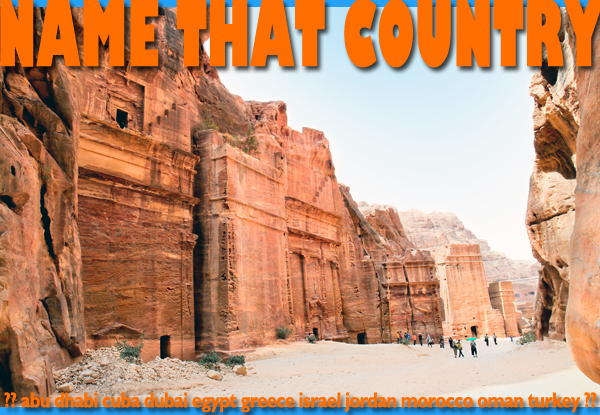
The Street of Facades is a main thoroughfare in the most famous tourist destination of our mystery country. Rock-cut tombs of some of the rich and powerful of this ancient Nabatean city line the section of the street pictured, with more modest tombs further down the way. In this sprawling site, beyond the Street of Facades, are temples, theaters and more tombs, some even more grandiose than those pictured.
Can you name that country?
See below for answers.
As we wait for Winter Storm Caly to march across much of the USA, our thoughts turn to gentle, summer beaches…

Paradise Beach, Corfu island, Greece

the Dead Sea, Jordan

Fins Beach, Oman

Oludeniz Beach, Turkey

Varadaro Beach, Cuba
These images were taken by Ya’lla traveler Dori Russell:

Petra

the Dead Sea

syrupy sweets, mmmmm
mountains near Petra

The Greco-Roman city of Pella (named for the birthplace of Alexander the Great) was a Decapolis city, one of 10 centers of Greek culture established on the eastern fringes of the Hellenistic Greek world. Pella is located about 80 miles north of our mystery country’s capital city Amman (built on the site of another Decapolis city, Philadelphia).
Can you name that country?
See below for answers.

Even in its ruined state, the Roman Temple of Hercules, including the evocative, disembodied Hand of Hercules, commands the high ground in the city of Amman.
Amman’s central hill, Jabal al-Qala’a or the Citadel, was among the earliest parts of the city to be settled, with archaeological evidence of habitation going back to the Neolithic period. A list of occupiers includes many of the usual suspects, as well as a few relatively small, regional powers – Assyrians, Babylonians, Persians, biblical Ammonites, Greeks, Romans, Byzantines and the early Islamic Umayyad and Ayyubid dynasties. The Umayyad Palace is another prominent historical remnant on the Citadel.
Can you name that county?
See below for answers.

Dana Biosphere Reserve, Jordan
At around 120 square miles, the Dana Biosphere Reserve is the largest nature reserve in Jordan. It’s located just off the King’s Highway (or the Dead Sea-Aqaba Highway, depending on where you enter) between the Dead Sea and Petra.
On the eastern edge, the 15th-century village of Dana commands the reserve’s high point at almost 5000 feet. The low point is more than 160 ft below sea level, at Wadi Araba.

Dana Village
The reserve is cut through with deep sheltered canyons and trails for all levels of hikers. The convergence of 4 biogeographical zones means a range of environments, from lush highlands and scrubby slopes to parched wadi beds, supporting a rich biodiversity, with some 800 plant and 450 animal species endemic to Europe, Asia and Africa.

Dana Biosphere Reserve, Jordan

Dana Biosphere Reserve, Jordan
In its management of the reserve, the NGO Royal Society for the Conservation of Nature (RSCN) strives to balance environmental conservation with the economic needs of the local Bedouin tribes. In 2005, the RSCN built the Feynan Ecolodge in Feynan Wadi, where copper mining had been the main industry for over 3 thousand years.
The remaining copper is deep and would require environmentally devastating blasting to reach. The lodge, and tourism in general, provides a sustainable economic alternative to copper mining.

Rummana campground, Dana Biosphere Reserve
The Rummana campground at the other end of the reserve near Dana Village offers tent camping with jaw-dropping views.
 The Ya'lla Blog