Poetry Corner – I Didn’t Win Light in a Windfall, Hayim Nahman Bialik

National Poet of Israel Hayim Nahman Bialik, 1873-1934

National Poet of Israel Hayim Nahman Bialik, 1873-1934
By writing in Hebrew, Bialik was influential in reviving the ancient language, now an official language of modern Israel, along with Arabic.

I didn’t win light in a windfall,
nor by deed of a father’s will.
I hewed my light from granite.
I quarried my heart.

In the mine of my heart a spark hides –
not large, but wholly my own.
Neither hired, nor borrowed, nor stolen –
my very own.

Sorrow wields huge hammer blows,
the rock of endurance cracks
blinding my eye with flashes
I catch in verse.

They fly from my lines to your breast
to vanish in kindled flame.
While I, with heart’s blood and marrow
pay the price of the blaze.

NAME THAT COUNTRY Episode 123

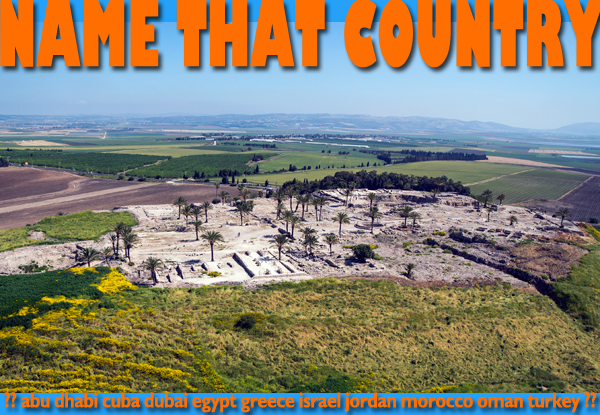
Over 20 layers of habitation, one atop the other, make up Tel Megiddo in the north of our mystery country. An important Egypt-Mesopotamia trade route crossed the Carmel Mountain ridge at a pass near the settlement. This is Armageddon (Greek for Megiddo) of the Book of Revelation, where the final battle between the forces of good and evil is prophesied to take place.

Can you name that country? 
See below for answers.

Continue reading

Gazelle Valley Park, Jerusalem

My beloved is like a gazelle or a young stag. Look! There he stands behind our wall, gazing through the windows, peering through the lattice. Song of Solomon 2:9

My beloved is like a gazelle or a young stag. Look! There he stands behind our wall, gazing through the windows, peering through the lattice. Song of Solomon 2:9

photo: Israel Ministry of Environmental Protection

Gazelle Valley, in the middle of urban Jerusalem, has been home to the native Israeli mountain gazelle for millennia, but, in recent decades, the encroaching city severely suppressed their numbers and real estate developers threatened to wipe them out permanently.

photo: Israel21c

photo: Israel21c

The Society for the Protection of Nature in Israel (SPNI), along with area residents, fought for 15 years to maintain the wild patch, and they won! Then the city of Jerusalem, community groups, and NGOs worked together to clean up the neglected plot and turn it into a nature reserve and community gathering place. The park opened in the spring of 2015, with enhancements planned for years to come.

photo: Haaretz

photo: Haaretz

Within the 64-acre park, the replenished (and growing!) gazelle population has 22 acres to roam freely without being disturbed by human visitors. In addition to glimpses of gazelles, birds and other wildlife, humans enjoy walking and bike paths, picnic tables and benches, guided tours, educational programs for all ages, chamber music concerts, and weekly Friday evening Shabbat celebrations.

Gazelle Valley Park is open daily. Entrance is free of charge.


Banias / Caesarea Philippi, Israel

waters of the Banias Spring (one source of the Jordan River), with Pan's Cave, aka the Gates of Hades, in the background - For Greco-Roman pilgrims to the sanctuary, the large cave, with its seemingly bottomless pool and flowing stream, marked an entrance to the underworld or “gates of Hades.” The spring no longer flows out of the cave but rises from the ground below.

waters of the Banias Spring (one source of the Jordan River), with Pan’s Cave, aka the Gates of Hades, in the background – For Greco-Roman pilgrims to the sanctuary, the gaping cave, with its seemingly bottomless pool and flowing stream, marked an entrance to the underworld or “Gates of Hades.” The spring no longer flows out of the cave but rises from the ground below.

In or around the last decade before the Common Era, the city of Caesarea Philippi was commissioned by Philip the Tetrarch, a son of Herod the Great. The site already had a long history as a religious sanctuary. For over two centuries it had been known as Paneas, a major sanctuary for the Greek god Pan. The modern Arabic name Banias derives from the Greek Paneas. Before the Hellenistic period, the area was sacred to the Canaanite god Baal. Sheltered in the foothills of Mt. Hermon, the region’s highest mountain, with abundant  water and a lush, garden setting, it does feel like hallowed ground. Continue reading

NAME THAT COUNTRY Episode 119

In 1947, local Bedouins found the first cache of what came to be known as the Dead Sea Scrolls in a Judean Desert cave. Eventually, eleven caves would yield pieces of some 800 ancient manuscripts, the last found in 1956. It’s generally accepted that the scrolls were collected by the Essenes, or a similar Jewish sect, which had a community living at Qumran, in the shadow of the caves.

Can you name that country? 
See below for answers.

Continue reading

Pilgrimage

As long as humans have found transcendent meaning in earthly places, they have made special journeys to those places. Traditionally, a pilgrimage is an act of religious devotion, but lately the word is used to describe a trip to any place that is especially inspiring to the traveler. Continue reading

NAME THAT COUNTRY Episode 110

This 1:50 scale model depicts the capital city of our mystery country as it was 2,000 years ago. In the 1960s, archaeologists, historians and architects used ancient texts and archaeological records to recreate a mini version of the city as it may have looked just prior to its destruction by the Romans in 70CE. In the foreground is the oldest part of the city, founded by David, the country’s 2nd king. The model is on display at the national museum.

Can you name that county? 
See below for answers.

Continue reading

Visit Israel – Caesarea Maritima

Roman theater at Caesarea Maritima

Roman theater at Caesarea Maritima

One highlight of a visit to Israel is a stop at Caesarea Maritima, on the northern coast between Haifa and Tel Aviv. It’s a picturesque and evocative place, with sprawling ruins lazing in the Mediterranean sun and sea air.

Construction began around 25 BCE at site of a Phoenician port on the orders of Herod the Great, who named his new city for the current (and first) Roman emperor Caesar Augustus. From about 6 BCE, it was the capital of the Roman province of Judea and the seat of provincial prefects (Pontius Pilate, for one) and other Roman officials.
The city gathered in a tidy Roman grid around the largest harbor in the eastern Mediterranean and boasted all the cultural institutions and infrastructure that Roman officials would have expected – a hippodrome, theaters, baths, temples, an aqueduct…

Roman aqueduct at Caesarea Maritima

Roman aqueduct at Caesarea Maritima

part of Herod's palace at Caesarea Maritima

part of Herod’s palace at Caesarea Maritima

It was in Caesarea that the first gentile converted to Christianity, the Roman centurion Cornelius. Paul the apostle also spent time there, including two years in prison before being shipped to Rome for trial. During the Byzantine period, Caesarea Maritima became an important center of Christian learning, with a large library and at least two influential early church fathers (Origen and Eusebius) living and working there. 

entrance to the Crusader city at Caesarea Maritima

entrance to the Crusader city at Caesarea Maritima

The city declined after Persian and Arab invasions in the 7th and 8th centuries. In the early 12th century, Crusaders occupied the site and, inspired in part by the legend that the Holy Grail was found there, held it as a Crusader stronghold until the middle 13th century, when it was sacked by Mamluk invaders. 

Today the site is an archaeological park with extensive remains from the Roman, Byzantine and Crusade periods.

Click to see Israel programs that include a visit to Caesarea Maritima.
NAME THAT COUNTRY Episode 101

About seventeen miles south of the Sea of Galilee is one of the world’s most extensively excavated Greco-Roman sites – Beit She’an (aka Scythopolis). Blessed with fertile land and abundant water, this strategic location at the convergence of the Jordan and Jezreel Valleys has been occupied at least since the 5th millennium BCE and holds remains from Canaanites, Egyptians, Philistines, Israelites, Greeks, Romans and Byzantines in 18 distinct layers. At its peak, as the main Roman Decapolis city, Beit She’an had a population of 40,000.

Can you name that county? 
See below for answers.

Continue reading