
In the ancient Greek world, pre-Socratic philosopher Heraclitus was among the very first “natural philosophers,” those who sought understanding of the physical world through observation. Before these thinkers, the mechanics of nature were attributed to the actions of the gods.
Heraclitus was a citizen of Ephesus, a Greek city on the Ionian coast, today western Anatolia in Turkey. He was part of a wave of revolutionary thought that rose up out of western Anatolia in the 5th and 6th centuries BCE. Other important thinkers from that time and place include Thales, Anaximander, Anaxagoras and Anaximenes.
All that we know of Heraclitus comes down through later philosophers, including Plato and Aristotle, who referenced and quoted him extensively in their writings. Collections of his ideas are published as “Fragments,” presumably of a more complete body of work, now lost.
Heraclitus believed that the universe and everything in it is in an eternal state of becoming and that change is the only constant. His most famous and emblematic aphorism is that a person can never step into the same river twice, meaning that the person and the river will be different each time they meet.
You cannot step twice into the same rivers; for fresh waters are flowing in upon you. (12)
We step and do not step into the same rivers; we are and are not. (49a)
He understood the universe to be composed of the union of opposites striving for harmony, each reliant on the other for its existence. The interaction of united opposites provides the primary universal order, which Heraclitus called logos and symbolized with fire. In this world, conflict is a natural and essential process to all being and exists on a continuum with reconciliation.
The way up and the way down is one and the same. (60)
In the circumference of a circle the beginning and the end are common. (103)
Men do not know how what is at variance agrees with itself. It is an attunement of opposite tension, like that of the bow and the lyre. (51)
Couples are things whole and not whole, what is drawn together and what is drawn asunder, the harmonious and discordant. The one is made up of all things, and all things issue from the one. (10)
God is day and night, winter and summer, war and peace, surfeit and hunger; but he takes various shapes, just as fire, when it is mingled with spices, is named according to the savour of each. (67)
We must know that war is common to all and strife is justice, and that all things come into being and pass away through strife. (80)
It is sickness that makes health pleasant and good; hunger, satiety; weariness, rest. (111)
Heraclitus expressed little confidence in either the perceptive powers or the intelligence of his fellow humans. While acknowledging that the truth of things was hidden, he despaired that most people were unable to comprehend the truth even when pointed out to them. He is sometimes referred to as the Weeping Philosopher, partly due to his intellectual isolation. As an arrogant misanthrope, he probably didn’t have many friends, which also may have led to some tears.
Nature loves to hide. (123)
Eyes and ears are bad witnesses to men, if they have souls that understand not their language. (107)
The many do not take heed of such things as those they meet with, nor do they mark them when they are taught, though they think they do. (17)
Fools when they do hear are like the deaf; of them, does the saying bear witness that they are absent when present. (34)
##
The fragments used in this post are all from the John Burnet translation.


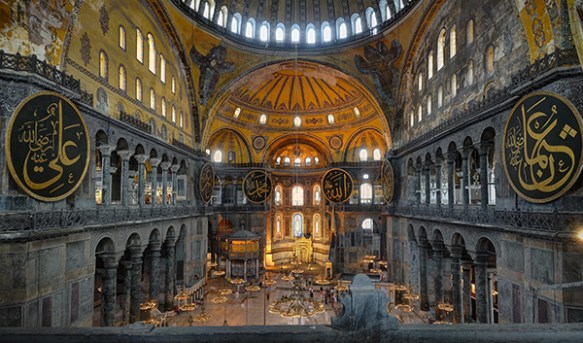


 This gorgeous tile work is inside the Topkapi Palace, the residence and governing hub of the Ottoman Empire from the middle 15th century until the Empire’s demise in the early 19th century. The palace sprawls along the waterfront of a peninsula in the heart of the city once known as


 The Ya'lla Blog