NAME THAT COUNTRY Episode 71

This Bent Pyramid at Dahshur is a precursor to its famous cousins just up the road. Construction began with an incline of 52 degrees and then changed about midway up to a more cautious 43-degree incline. The reason for the change is not known for sure.
To continue at the original angle would have required a taller, heavier structure. Perhaps materials and manpower were running short. Perhaps the architect decided the lower levels would not support the height needed to maintain the sharper incline. Another theory is that the decision to reduce the angle was influenced by the collapse of the pyramid at Meidum, a slightly earlier attempt at a smooth-sided pyramid. In any case, the Bent Pyramid gives an intriguing glimpse into the development of architecture and engineering in our mystery country over 4,500 years ago.

Can you name that country? 
See below for answers.

Continue reading

NAME THAT COUNTRY Episode 70

The Temple of Hephaestus is located within the area of the agora, the ancient cultural and political center of the city that is today the capital of our mystery country. Hephaestus was the god of fire, metal working, the art of sculpture and other crafts. Archaeological evidence places a number of blacksmith and pottery workshops in the near vicinity of his temple. The temple was built in the mid-5th-century BCE, a golden age of social and cultural innovation and productivity, and today is one of the most complete Doric temples standing anywhere.

Can you name that country? 
See below for answers.

Continue reading

NAME THAT COUNTRY Episode 69

For ancient Greeks and Romans, Hieropolis, in the Anatolian southwest of our mystery country, was a luxury spa  destination. Visitors today probably know it best for the travertine-terrace pools, which inspired the modern name, Pamukkale or Cotton Castle in the local tongue. Formed by millions of years of mineral deposits from the thermal waters, the white terraces rise abruptly from the valley floor to over 500 feet high and can be seen from 10 miles away.

Can you name that country? 
See below for answers.

Continue reading

NAME THAT COUNTRY Episode 68

Tagine is the national food of our mystery country. The name refers both to the clay pot and the dish cooked inside it. The pot consists of a round base with low sides and a conical top. During cooking, condensation is trapped in the conical top and flows back into the base to stew the ingredients there. Cooking can be done over coals, in an oven or on the stove top; the key is low heat for long, slow cooking. There are countless recipes for Tagine, which is really more about the pot and slow-cook method than the ingredients. The Tagine pot acts as a serving dish, as well as a cooker, and traditionally all diners would eat right out of the one dish, using bread to scoop their bites rather than utensils.

Can you name that country? 
See below for answers.

Continue reading

NAME THAT COUNTRY Episode 67

If you’re up for the hair-raising drive in, through the craggy Al Hajar Mountains, the  village of Bilad Sayt is an enchanting, timeless corner of our mystery country. There are many such places in the country, which wisely balanced modernization and traditional culture as it climbed out of the Middle Ages and turned toward the outside world in recent decades. Far less flashy than some of its neighbors, Dubai and Abu Dhabi, the easy authenticity of this country is one of its most appealing traits.

Can you name that country? 
See below for answers.
Continue reading

NAME THAT COUNTRY Episode 66

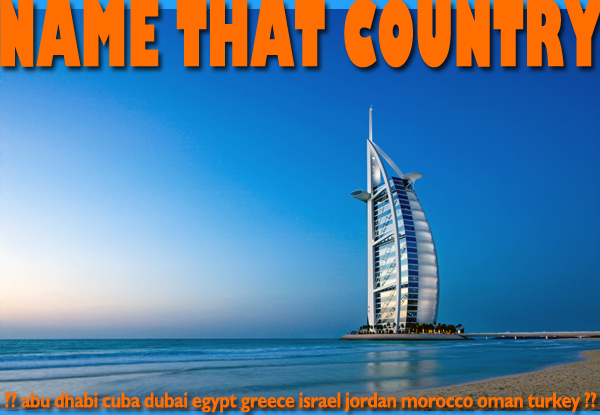
The iconic, sail-shaped Burj Al Arab has been called the only 7-star hotel in the world. Built on an artificial island just off Jumeirah Beach, the only access is by a private bridge (or helipad). Although it’s the world’s 4th tallest hotel, it has only 202 guest suites on 28 double floors. Suites range in size from 1,820 to 8,400 square feet.

Each double floor has its own reception and check-in is done inside the guest suites. Personal butlers attend every guest throughout their stay. For every suite, there are 8 hotel staffers ready to serve.

Can you name that country? 
See below for answers.

Continue reading

NAME THAT COUNTRY Episode 65

Arte Corte is a hair salon and museum of hairdressing founded by Gilberto Valladares, known as Papito, the most recognized hair stylist in our mystery country.

Papito’s cultural project brings together barbers, hairdressers, models, artists and historians to preserve the history of hairdressing in Cuba and also to improve conditions for residents of the neighborhood. The group operates a school of hairdressing free for youth of the area and a cooperative to help other businesses get a start, improve the facilities for senior citizens and beautify the neighborhood.


Can you name that country? 
See below for answers.

Continue reading

NAME THAT COUNTRY Episode 64

Known as the “Citadel,” the site pictured above is located on the highest of seven hills that make up Amman, the capital city of our mystery country. The area has been continuously inhabited at least since the Bronze Age and excavations have only scratched the surface. Roman, Byzantine and Umayyad remains have been uncovered to date, including the Roman Hercules Temple above, a water cistern and palace from the Umayyad period and a Byzantine church. The national archaeological museum is also located at the Citadel.

Can you name that country? 
See below for answers.

Continue reading

NAME THAT COUNTRY Episode 63

Qasr Al Sarab is a luxury desert resort near Abu Dhabi, the capital of our mystery country. Located in the world’s largest uninterrupted sand desert, the Rub’ Al Khali, the resort is an oasis base for exploring the surrounding dunes. Camel trekking, dune bashing, desert sailing (yes, desert sailing),  and fat-tire biking are just some of the activities available. Desert animals like oryx and gazelles freely wander the grounds and sometimes drink from the swimming pools.

Can you name that country? 
See below for answers.

Continue reading

NAME THAT COUNTRY Episode 62

The architecture around Bialik Square is a small representation of thousands of Bauhaus buildings built in the 1920s and 30s in the largest and first modern city of our mystery country. Because of the large collection of Bauhaus buildings, many of which were whitewashed to keep them cooler in the Mediterranean heat, this original area of the city is known as the White City and is a UNESCO World Heritage Site. Bialik Square is named for the national poet, Chaim Nachman Bialik, whose home, now a museum, is just off the square, on a street which also carries his name. The white building pictured is the recently restored former Town Hall, now a museum and civic center.

Can you name that country? 
See below for answers.

Continue reading