


Foto Friday – Church of the Nativity, Bethlehem
Reply

Vassilopita, photo from Greek Reporter
On New Year’s, Greeks will be partying and enjoying fireworks, along with the rest of the world. But, also like the rest of the world, they will partake in some local, age-old traditions as well.
In some Christian denominations, including the Greek Orthodox, January 1st is the Feast of the Circumcision of Jesus. According to Jewish tradition, male babies are circumcised 8 days after birth. The day is honored as Jesus’ first sacrifice for human kind.
January 1st is also celebrated as the anniversary of the death of St. Vasilios (Basil), an early church father remembered for his generosity, especially to the poor. Holiday gifts are traditionally exchanged on New Year’s Eve or New Year’s Day, rather than the 24th or 25th of December and it’s St. Vasilios who brings gifts for children instead of St. Nicolas.
St. Nick does get a nod though. His feast day on December 6 opens the Christmas season, which ends with the Feast of Epiphany on January 6. The 12 days of Christmas begin with the birth of Jesus on December 25 and end with the visit of the Magi on January 6th. So, while many Americans close the holiday season on January 2nd, Greece remains in the thick of it for a few more days.
On New Year’s Eve, it’s traditional for family and friends to gather for a big meal and stay up waiting for the New Year and St. Vasilios to arrive. They might pass the time playing games of chance, this being a particularly lucky day.
An onion is hung on the door overnight as a symbol of renewal. Once the New Year rings in, a pomegranate, symbol of prosperity, is smashed on the doorstep before entering the house the 1st time.
The Vasilopita is a traditional cake baked with a coin inside. On New Year’s Day, the cake is served and whoever finds the coin in their cake can look forward to a lucky year.
Cheers to all and best wishes for a healthy, prosperous and peaceful 2015!
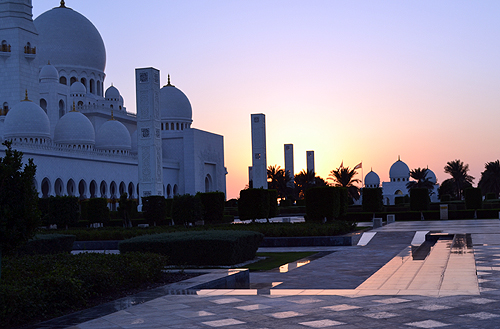
Grand Mosque, Abu Dhabi, United Arab Emirates
2013 was an eventful year at Ya’lla Tours USA.
To begin with, it was our 20th anniversary. In 1993 Ronen Paldi, Israeli native, landed in Portland, Oregon and opened Ya’lla Tours USA. He based the company philosophy and operations on the practical experience he gained as a tour guide for over 10 years in Israel and Egypt, on the ground day-to-day with travelers.
Our really big news in 2013 was the introduction of not 1 but 4 new countries to our repertoire – the UAE, Oman, Qatar and Bahrain. Our tag line “specialists to the exotic Mediterranean” no longer covers it. These were our first new destinations in over 10 years. Clients often nudged us to cover Italy, Spain and France because they combine nicely with our existing countries (Israel, Jordan, Egypt, Morocco, Greece,Turkey). However, there are already many well-established, quality tour operators to Italy, Spain and France and the world really doesn’t need another one. Ronen’s excellent business sense told him that there was not room in that market for us and chose to stay focused on our product line in the Middle East/Eastern Mediterranean (plus Cuba, which is another thing altogether). The Arabian Peninsula, on the other hand, is a relatively untapped market for American travelers and it fits well culturally and geographically with our other countries, while also bringing something new.
Perhaps what sealed the deal was that our dear Jordanian friends Gaby and Reem operate a travel services company in Dubai. They were our ground operator in Jordan back in the 1990s. So, although the destinations are new, we have friends we trust advising us and taking care of our clients. They know us, how we operate, what we expect and we know they will deliver. I think it was meant to be. In addition to Gaby and Reem, the director of our office in Egypt is very familiar with the area, having visited there many times. His input was essential as we began to select hotels and compose itineraries.
Ronen and Tania went to the Arabian Peninsula for the first time in June. When they returned we had a meeting in Portland with all of our sales reps from around the country, something we hadn’t done in three years. It was fun to have everyone in the same room together and exciting to be learning about new places.
In early December Ronen returned to the Arabian Peninsula with our entire sales team, Teri McCulloh, our general manager, our videographer and 18 travel agency owners and managers. Some of us stayed behind to hold down the fort… My colleagues went to the Arabian Peninsula and all they brought me was 1,000+ pictures… (and that’s enough!)
Speaking of colleagues, we got a new one, just as the year was drawing to a close – Michael Walsh, our new sales manager in California and Colorado. Welcome Michael!
Finally, my 2013 babies, our pretty new web site and this blog, both of which will benefit from those 1,000+ photos mentioned above.
In 2014 we’ll continue to deepen our knowledge of the Arabian Peninsula; Egypt, Greece, Israel, Jordan, Morocco, Turkey and Cuba too, and share what we know with you. Thanks for reading.
We wish you a healthy, peaceful and prosperous 2014.
In honor of the longest night of the year in the Northern Hemisphere and the promise of light that is at the heart of most of the holidays and festivals this season:
BULBS
LAMP
CANDLES

Nefertiti
Is there a reader on your Christmas list who is fascinated with ancient Egypt?
How about you? Here are three page-turners, full of real, historical intrigue and well-drawn, relatable characters – Michelle Moran’s historical fiction novels about three of ancient Egypt’s most famous women:
Nerfertiti
Nerfertiti was the wife of the iconoclastic pharaoh Akhenaten, best known for his monotheism. He worshiped the sun god Aten, to the exclusion of the many other Egyptian gods. Nefertiti is popularly known for her great beauty, based on the bust pictured above. There is no question she was at the center of one of ancient Egypt’s most interesting periods.
The Heretic Queen
This is the story of Nefertari, queen of Ramesses II (the Great), who reigned for 66 years and is widely considered Egypt’s most powerful pharaoh and possibly the pharaoh, Moses’ adopted brother, who refused to set the Hebrew slaves free in the Exodus story. Ramesses II’s love and respect for Nefertari is exemplified in the temple he built for her at Abu Simbel. Not only is it one of the few temples built in the name of a queen but it’s the only known instance in ancient Egyptian art where a queen is portrayed equal in size to the pharaoh. Nefertari’s tomb is spectacular, the most beautiful of all the royal tombs discovered in Egypt.
Cleopatra’s Daughter
Cleopatra was the last pharaoh of Egypt, although she was actually Greek and didn’t even speak Egyptian. She was a member of the Ptolemaic Dynasty that ruled Egypt from the conquest of Alexander the Great to that of Rome. Cleopatra’s daughter, Cleopatra Selene II and her twin brother Alexander Helios were the products of Cleopatra’s affair with the Roman officer Mark Antony. This book tells the story of Cleopatra Selena II after the death of her parents, when she was taken to Rome by her parents’ rival, Octavian, the future Roman Emperor Augustus.
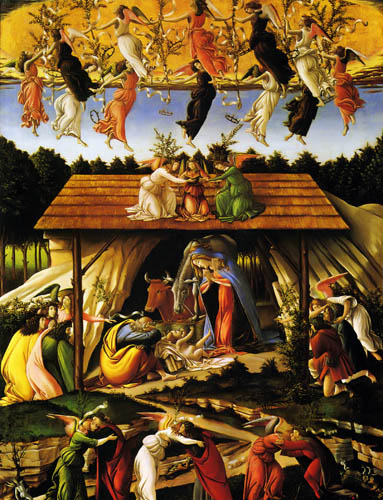
Mystical Nativity
Sandro Botticelli, c.1500
Last night, as I was preparing a post about travel related stocking-stuffers, I experienced what can only be described as spiritual ecstasy while listening to Bach’s Christmas Oratorio. I was moved near to tears by the joy and beauty of it.
I’m sorry to say that I can be a bit of a humbug at Christmas and rarely get in the spirit this early. Usually, sometime after the middle of the month, my Grinchy heart bursts its chains and swells all out of proportion. Obsessive baking, shopping and decorating ensues. It’s the lights and music that get me and especially the 3-hour Christmas Oratorio by JS Bach. I’m sure the opening chorus of the 1st cantata is the most joyful thing I have ever heard. Please listen and celebrate, whatever your tradition, use headphones for the best effect. For me, it’s about life’s hope and promise.
This is the text of the opening chorus, written to be performed on Christmas day, 1734.
Exult, rejoice, rise up and praise these days,
glorify what the Highest has done today!
Abandon despair, banish laments,
sound forth full of delight and happiness!
Serve the Highest with glorious choruses,
let us honor the name of the Supreme Ruler!
The stocking-stuffers post can wait until next week.
In 167BCE Israel was dominated by the Syrian Greek Seleucids and their king Antiochus IV. Antiochus IV referred to himself as Epiphanes, God Manifest. Behind his back he was known as the Madman.
Determined to Hellenize the Jews, Antiochus IV outlawed Jewish religious ritual and custom and defiled the Temple by sacrificing to Greek gods there. In the village of Modi’in, just outside Jerusalem, the priest, Mattathias, refused an order to sacrifice to the Greek gods. When a Hellenized Jew in the village agreed to make the sacrifice, Mattathias killed him, as well as the Greek officer and then fled into the mountains with his five sons and other supporters. From there they launched an insurgency against the Seleucids, led by Mattathias’ son Judah. Because Judah was a crusher-of-enemies he was called Maccabee, which roughly translates as the Hammer, and the whole rebellion is known as the Maccabean Revolt. Despite being vastly outnumbered, the Maccabees prevailed. Now, the first order of business was to cleanse the Temple by burning the ritual menorah for eight days, but there was only enough oil for one day. Miraculously, the oil burned for the full eight days giving us the eight-day festival of Hanukkah, in which we eat fried foods without regret to celebrate the miracle of the oil and the Maccabean victory against religious oppression.
THANKSGIVING
Thanksgiving was declared a national holiday by President Abraham Lincoln in 1863. The Thanksgiving story, well-known by most American school children, of Pilgrims and Natives sharing a feast in 1621, is based on accounts by William Bradford and Edward Winslow, leaders of Plymouth Colony in Massachusetts. This is from Winslow’s Mourt’s Relation:
Our harvest being gotten in, our governor sent four men on fowling, that so we might after a special manner rejoice together after we had gathered the fruits of our labor. They four in one day killed as much fowl as, with a little help beside, served the company almost a week. At which time, amongst other recreations, we exercised our arms, many of the Indians coming amongst us, and among the rest their greatest king Massasoit, with some ninety men, whom for three days we entertained and feasted, and they went out and killed five deer, which we brought to the plantation and bestowed on our governor, and upon the captain and others. And although it be not always so plentiful as it was at this time with us, yet by the goodness of God, we are so far from want that we often wish you partakers of our plenty.
Whether you’re celebrating Hanukkah or Thanksgiving or both (Thanksgivukkah) on November 28, 2013, we wish you a happy, healthy day.
OK, not a bar, unless you plan to celebrate Hanukkah and Thanksgiving in a bar, which could happen. Anyway, this is not a joke but the actual and exceedingly rare concurrence of two beloved holidays in the USA – Thanksgiving and Hanukkah.
Neither is a fixed date. Thanksgiving falls on the 4th Thursday of November, which according my loose estimation can range from the 22nd to the 28th. In the lunar Jewish calendar, the eight days of Hanukkah begins on the 25th day of Kislev, which can fall anywhere from late November to late December. This year, it’s very early. Next year, the Jewish calendar will reset with a leap month in the Spring, which will put Hanukkah back into December.
According to some calculations Thanksgiving and Hanukkah will not coincide again for almost 80,000 years. So we better party while we can! The internet is flooded with merchandise and recipes to mark this rare event, which has been dubbed Thanksgivukkah. Here are some of my favorites:


9-year-old Asher Weintraub conceived and designed the Turkey/Menorah he calls the Menurkey, http://menurkey.com/.
Two silly Youtube entries:
Turkey vs Dreidel Rap Battle, sponsored by Manischewitz, of course
Pilgrims Story of Thanksgivukkah
And of course food!
Sweet Potato Latkes
from the San Francisco Chronicle’s SFGate.com
1 pound sweet potatoes or yams, peeled (about 2 medium)
1/4 cup grated onion, squeezed dry, about 1 small
1 teaspoon kosher salt, or to taste
2 large eggs
1/2 cup all-purpose flour + more as needed
Vegetable oil, as needed
Shred the sweet potatoes with the shredding disk of the food processor or on the large holes of a box grater. Place in a large bowl. Stir in the onion and salt.
In a small bowl, whisk the eggs and flour to blend. Stir into the potato mixture, mixing well.
Heat 1/4-inch oil in a large skillet over moderately high heat until it registers 365° on a thermometer or sizzles instantly when a small amount of batter is added. Add a little more flour to the batter if the test amount is too wet and doesn’t hold together.
For each latke, fill a 1/4-cup measure half full; invert into the oil and flatten slightly. Repeat, making about 8 latkes at a time, but being careful not to crowd the skillet. Cook until the latkes are golden on the bottom, 3-5 minutes. Carefully turn and brown on the other side, about 3 minutes more. Remove to a tray lined with paper towels. Keep warm while frying remaining latkes.
Serve sweet potato latkes with this:
Cranberry Applesauce
from Buzzfeed.com
2 cups fresh or frozen cranberries
½ teaspoon ground cinnamon
½ teaspoon ground nutmeg
¼ cup sugar
½ cup Manischewitz Concord Grape wine
4 large Granny Smith apples
In a medium sauce pot, combine cranberries, spices, sugar, and Manischewitz. Bring mixture to a boil, then reduce heat and simmer 20 minutes. Peel and core apples, then cut them into large chunks (approximately ½-inch cubes), and add to the cranberry mixture. Cover sauce and continue to simmer for 20 minutes, stirring occasionally. If sauce begins to stick, add water.
Remove from heat and cool to room temperature before serving.

Sweet Potato Latkes Photo: Craig Lee, Special To The Chronicle
Happy Thanksgiving! Happy Hanukkah!
Sukkot is a joyful 7-day Jewish holiday, beginning 5 days after Yom Kippur, in October or September. It’s an annual commemoration of the period immediately after the Exodus from Egypt as well as a harvest festival. In Hebrew, sukkot means “booths” and refers to the temporary shelters, sukkah, that the Israelites built during their 40 years in the desert with Moses. Continue reading
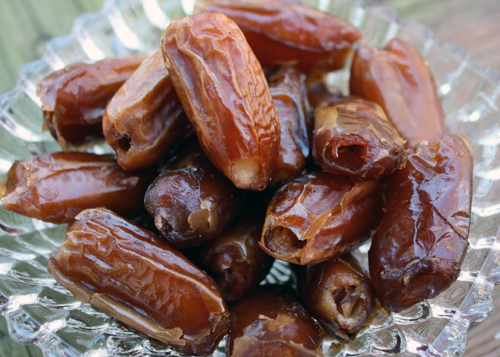
Ramadan is the ninth month of the Islamic lunar calendar. The prophet Muhammad received the first revelation of the Quran during this month and so it is the holiest time in the Muslim faith.
The primary practice of Ramadan is fasting, one of the Five Pillars of Islam. Healthy, observant adults refrain from eating and drinking (also smoking, gum chewing, sex, cursing and any less-than-upstanding behavior) from dawn to sunset. The idea is to enter a more spiritual way of being, to know gratitude, compassion and self-discipline. More prayer and more charity are also part of Ramadan observance. Continue reading
 The Ya'lla Blog