Foto Friday – More Cuban Cars!

Since the US embargo took effect in 1962, no American cars or car parts have been imported to Cuba and Cuban government regulations have restricted the purchase of new cars imported from other countries. For 50 years talented and creative mechanics have kept classic American models (Yank Tanks) rolling down the roads of Cuba. Many are in mint condition but even the clunky ones are lovely to behold. If you’re into classic cars, or beautifully designed objects of any sort, this is paradise.

Click for information on tours to Cuba for Americans.

photo by Steve Sherwood

photo by Steve Sherwood

photo by Steve Sherwood

photo by Steve Sherwood

Continue reading

Foto Friday – Cuban Cars

Since the US embargo took effect in 1962, no American cars or car parts have been imported to Cuba and Cuban government regulations have restricted the purchase of new cars imported from other countries. For 50 years talented and creative mechanics have kept classic American models (Yank Tanks) rolling down the roads of Cuba. Many are in mint condition but even the clunky ones are lovely to behold. If you’re into classic cars, or beautifully designed objects of any sort, this is paradise.

Click for information on tours to Cuba for Americans.

photo by Jason Hedrick

photo by Jason Hedrick

Continue reading

CUBA – a Great Place to Visit

Recently, I was invited to join a group of friends on a legal visit to America’s closest island nation to the South – Cuba. I was very excited about going to a country that had been off limits to me for all of my life. I remember discussions from my high school history class about socialism, and the relationship between Cuba and the Soviet Union after America placed its embargo on Cuba. With the demise of the Soviet Union in 1991, I, like most American’s, lost touch with what was happening in Cuba, until now. I can tell you, that Cuba has survived and is working toward a brighter future for its people. Continue reading

Gay-Friendly Cuba

Is Cuba “gay-friendly?”

That is a question that has been asked of many destinations, and certainly of some Caribbean island destinations in recent years, and the good news is that Cuba is gay-friendly, to a fairly high degree.

According to Ronen Paldi, President of Ya’lla Tours USA, “Today, with Raul being in the closet and his daughter heading the ‘Gay Coalition’ (she is out of the closet), Cuba is gay friendly.” Ya’lla Tours has been a US Treasury Licensed Travel Service Provider to Cuba since 2002, and has sent thousands of people to Cuba.

How are gay visitors and natives treated in Cuba? Paldi goes on to say that gay visitors experience the same Cuba as everybody else. Cuba is a huge attraction for those who are interested in religion, culture, arts and social interaction with the Cuban people. Cubans who are gay are not persecuted like they were under Fidel’s power, according to Paldi.

Further, Cuba does have a gay social scene. “There are clubs that gay people feel more comfortable going to, and we recommend those clubs as a matter of course,” said Paldi.

While same-sex relationships might not be celebrated in Cuba (public displays of affection are not encouraged), they are fairly well tolerated, and people are free to be themselves.

Paldi reminds potential visitors to Cuba that travel to Cuba is restricted, and US Citizens and foreign nationals living in the United States, must comply with the law in any travel to Cuba.

Rich Davis, Ya'lla Tours USA Sales Manager, Midwest Region

Rich Davis, Ya’lla Tours USA Sales Manager, Midwest Region

Guest blogger Rich Davis is the Ya’lla Tours USA sales manager in the Midwest region. He’s based in Chicago.

Growing Up in Cuba, An Interview with Tania Vazquez Paldi, Part 6

To read previous parts of this interview, click below:
Part 1
Part 2
Part 3
Part 4
Part 5

In our last post, Tania was telling us about her work as a tour guide in Cuba in the 1990s. After the fall of the Soviet Union, Cuba had to adjust to the loss of significant economic aid. The development of leisure tourism was one plan to make up for the loss and the country invested in tourist infrastructure and services and allowed foreign hotels to come in.

Tania: After ten years getting to know the tour operators, the ministers etc., Melia decided to create this office in Havana. They were in the beach resort, in Varadero before, but when they moved to Havana because they had so many hotels that they needed to be in the city and they needed a corporate office to do the sales and marketing, rather than the contractors. They needed a team, a bigger team and they decided to hire guides. Why tour guides? Because it’s easy for a tour guide to sell a country because you know your country and its history and everything and you know the industry and the tour operators. You sell first the destination, then the product. So, they called different guides and 2 out of 50 were approved.

Kyna: And you were one.

Tania: I was qualified for the British and English-speaking market and my colleague, Frank, he speaks German and English, so we could share different markets. So, out of 50, 2 were approved. I was lucky. They were so in need of marketing, I started to work in September and in October I was already in Glasgow and all over the UK traveling.
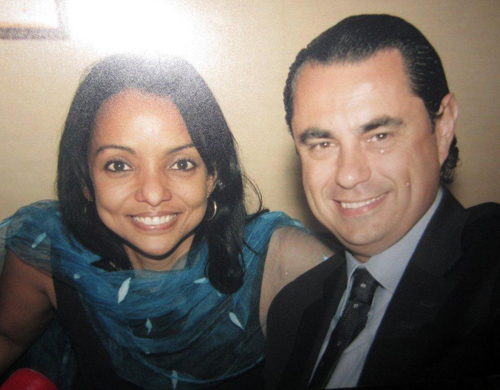
London, 2006 - Tania and a Melia Hotels executive at a gala dinner to announce the novelties of the Melia Hotels in Cuba to UK tour operators and press.

London, 2006 – Tania and a Melia Hotels executive at a gala dinner to announce the novelties of the Melia Hotels in Cuba to UK tour operators and press.

Kyna: Was this the first time you had been out of Cuba?

Tania: No, the first time was in the Bahamas, but it was like being in Cuba, it’s very close. That was 1993, when I was a tour guide.

Kyna: You started traveling to Europe in 2000…

Tania: 2003

Kyna: How was that?

Tania: It was an adventure. Traveling is an adventure every time you go out. But for me it was okay because I developed the skill of traveling when I was a tour guide. Even in traveling your own country, you know, you get a plane, you check into a hotel, you have to find your way, you have to ask and be social, so you get all those skills once you’re a tour guide.

Kyna: Plus you had been working with people from these countries.

Tania: Exactly, it was the best experience. I have no issue, anywhere I go. Even if I don’t speak the language, I always find my way. You cannot imagine how many times I got lost in London, sometimes with the telephone battery dead and people helping me, giving me their phones to call. Everywhere I go, I always get lost and I ask people. People help you. It’s fun. As long as you respect people and they respect you back. In 2003, when I started to travel I realized I always had the dream of being a tourist instead of a tour guide, and now I am a tourist.

Kyna: How does the Cuban government chose people who will be traveling outside of the country. They want to pick people who are a low risk for defection. You had small children at home…

Tania: You go through a background check but there is always a risk. I have friends and colleagues who decided to defect. Most of them did not have kids. I had several opportunities but I didn’t. Not because of my kids because in the end you can file a claim and get them out. I didn’t do it because the company put trust in me. Morally I couldn’t do it. Some people understand that, some do not. I had a good life. Not all the Cubans that live here or abroad defected. Some, like me, they married or came to live with their family. Sometimes, when I speak with Cubans who defected, they are very negative about Cuba and assume I agree. I understand maybe they had bad experiences but my experience was not bad. It’s not black and white. You have to be pragmatic. I know there are bad things about Cuba but there are good things too. I have met a lot of Cubans abroad, some are doing well, some not so well, but most of them would like to be back in Cuba. I’m sure when it changes, many will be back.

This concludes my first interview with Tania. We plan to sit down again over coffee and treats, probably after the holidays, so stay tuned. I have a list of things I want to talk about, including religion and the black-market in Cuba. If there’s anything in particular you’d like me to ask Tania, please let me know.

www.yallatours.com
Growing Up in Cuba, An Interview with Tania Vazquez Paldi, Part 5

To read previous parts of this interview, click below:
Part 1
Part 2
Part 3
Part 4

When we left off, we were discussing how Tania got her start in the tourism industry in Cuba. After studying English at university, she had hoped to work in a hotel but was told she was over qualified. Then she got a call from the Cuban tourism company Cubanacan to work as a tour guide.

Kyna: When was this, what year?

Tania: That was in 1991.

Kyna: So, that was right after Russia was out of there, really hard times.

Tania: Exactly and that was the beginning of real Western tourism. What we had before were political groups, students that came for political or social reasons.

Kyna: You mean from Communist countries?

Tania: And from America too, kind of like People to People.

Kyna: But not vacation tourism?

Tania: No. Socio-politic, they used to call it, socio-politic groups.

They used to meet Communist Party members and stuff like that. That was the type of tourism that we had.The real tourism really broke out after 1991, after the collapse of the Soviet Union. I worked with the first FITs and groups coming from the UK with Thompson Holidays, the first tour operator to do flights directly to Varadero, to the beach resorts.

Kyna: Were they building beach resorts?

Tania: Oh yes. Melia came into the picture in 1990. In 1990 they built Sol Palmeras, in 1991 Melia Las Americas and several other hotels, they were building infrastructure very strategically to develop tourism. Then came Super Clubs, Iberostar and different hotel chains.

Kyna: What about existing hotels, from before the Revolution?

Tania: They were owned and managed by the government. Later they were commercialized. There was a lot of competition.

So, my work as a tour guide gave me the opportunity to get experience in the industry, to deal with the tour operators, to get to know the resorts, the different sites.

www.yallatours.com


Growing Up in Cuba, An Interview with Tania Vazquez Paldi, Part 4

Here’s another installment of my interview with Tania Vazquez Paldi about her life in Cuba. In this part, we’re discussing Tania’s work in the travel industry in Cuba.

Tania moved from Havana, Cuba to Portland, Oregon about two years ago.
For a short bio of Tania and the first part of our conversation click.
For part 2, click.
For part 3, click.

Kyna: How did you get into the position that allowed you to travel outside of Cuba extensively?

Tania: When I started at college, I did a Bachelor of Arts in languages and literature. I was supposed to be, after I graduated, a translator or a teacher of English Literature. But I didn’t want that. I wanted to be in the tourist industry always.

Kyna: Did you chose your degree of study or where you placed?

Tania: You had three choices, it depends on your scripts and your curriculum.

Kyna: Your aptitude… so, they track you and they decide what you’re good at and give you three choices.

Tania: They interview you as well. My choices were journalism, architecture and then translation.

Kyna: Journalism and architecture were very competitive?

Tania: Very competitive, very demanding

Kyna: For journalism, I would think you would have to be really committed to the party, to be a card-carrying Communist.

Tania: Correct, and I was no part of any political organization what-so-ever, though I had to behave.

Kyna: Do you think, because your father was so loyal to the Revolution, that helped you in any way?

Tania: If it did. I don’t know. They always do a background check on you and I’m sure it came out and it was a positive thing in my favor but they never tell you. And, I always behaved. I was not involved in any issues or trouble or social movements. I was a standard student. So I was approved and I was happy it happened. I really liked what I was studying; I really liked all these subjects – history, art, literature, languages. I did attempt to leave the university because I wanted to become a stewardess. My father, smartly, told me, “Don’t; finish what you started and whatever you want to become after that, that’s fine, but you have to finish.” I was so upset but now I understand why he was so right. So I finished and then became a tour guide. That was another accident that happened that was for good. I wanted to work in a hotel but because I was over qualified, they didn’t accept me. I was so disappointed and I was crying one day and my mother came with a telegram and said, “They called you from Cubanacan,” that still exists, “and they are looking for tour guides and they want to interview you.” So I stopped crying and then I went to this agency. They were just starting to create this group of guides because that was the beginning of tourism, Western tourism.

Kyna: When was this, what year?

Tania: That was in 1991.

In Wednesday’s post we’ll continue with Tania’s experiences as a tour guide.