Unknown's avatar

About yalla2013

Ya'lla Tours USA is a boutique tour operator offering top quality travel services in 10 exciting countries: Bahrain, Cuba, Egypt, Greece, Israel, Jordan, Morocco, Oman, Turkey and the United Arab Emirates. Ya'lla Tours communications director, Kyna Perry, writes this blog based on personal experience and the deep well of experience and knowledge of Ya'lla colleagues near and far.

NAME THAT COUNTRY Episode 68

Tagine is the national food of our mystery country. The name refers both to the clay pot and the dish cooked inside it. The pot consists of a round base with low sides and a conical top. During cooking, condensation is trapped in the conical top and flows back into the base to stew the ingredients there. Cooking can be done over coals, in an oven or on the stove top; the key is low heat for long, slow cooking. There are countless recipes for Tagine, which is really more about the pot and slow-cook method than the ingredients. The Tagine pot acts as a serving dish, as well as a cooker, and traditionally all diners would eat right out of the one dish, using bread to scoop their bites rather than utensils.

Can you name that country? 
See below for answers.

Continue reading →

NAME THAT COUNTRY Episode 67

If you’re up for the hair-raising drive in, through the craggy Al Hajar Mountains, the  village of Bilad Sayt is an enchanting, timeless corner of our mystery country. There are many such places in the country, which wisely balanced modernization and traditional culture as it climbed out of the Middle Ages and turned toward the outside world in recent decades. Far less flashy than some of its neighbors, Dubai and Abu Dhabi, the easy authenticity of this country is one of its most appealing traits.

Can you name that country? 
See below for answers.

Continue reading →

Safed

the view from Safed, looking out over the Sea of Galilee, photo courtesy of the Israel Ministry of Tourism

the view from Safed, looking out over the Sea of Galilee, photo courtesy of the Israel Ministry of Tourism

Safed (also spelled Tsfat, Tzfat, and a number of other ways) is a town in the Upper Galilee region in the far north of Israel. It’s one of the few cities in Israel that has been continuously inhabited by a Jewish community for over 2,000 years. At an elevation of 3,000 feet, it’s the highest town in the country, with views out across the Galilee, the Golan Heights and Mt. Meron.

Safed is one of the 4 holy cities in Judaism (along with Jerusalem, Hebron, and Tiberias). According to legend, the Messiah will come through Safed on the way to Jerusalem and the great Kabbalist Yitzhak Luria taught that the divine presence of the Lord will reside in Safed until the building of the 3rd Temple. Legend also tells that the sons of Noah settled in Safed and established a religious school, where Jacob later studied.

In the 16th century, after the Jews were expelled from Spain, Safed became a center of Kabbalah (mystical Judaism) and Jewish learning. Yitzhak Luria, known as Ha ARI (the Lion) studied with renowned rabbis there and went on to develop his own interpretations of sacred texts and pass them on to his own students. His mostly oral teachings were written down by students and went on to have immense influence on the practice of Medieval Judaism and are the basis for the study and practice of most Kabbalah still today.

Safed, Israel

Safed, Israel

Safed, Israel

Safed, Israel

In Safed you’ll find a charming, labyrinthine old town to stroll about, Medieval synagogues, lots and lots of art galleries and artists’ workshops, and stellar views in all directions. In particular, look for the beautiful Abuhav Synagogue and the Sephardic Ha ARI Synagogue, where the Lion himself spent many hours studying and teaching.

Abuhav Synagogue, Safed, Israel, photo by Itamar Grinberg, courtesy of IMOT

Abuhav Synagogue, Safed, Israel, photo by Itamar Grinberg, courtesy of IMOT

art gallery, Safed, Israel, photo by Itamar Grinberg, courtesy of IMOT

art gallery, Safed, Israel, photo by Itamar Grinberg, courtesy of IMOT

kabbalist artist, Safed, Israel

kabbalist artist, Safed, Israel

The annual Safed Klezmer Festival is held in August. Performers from all over Israel and the world play venues around town, many open-air, galleries set up shop in the streets and the whole place parties for three days. Klezmer music is a genre of celebratory, secular music, which originated with Eastern European Jews. Check it out below.

Driving time from Jerusalem or Tel Aviv to Safed is about 2-2.5 hours, from Tiberias it’s about 40 minutes.

See tours that include Safed here.

NAME THAT COUNTRY Episode 66

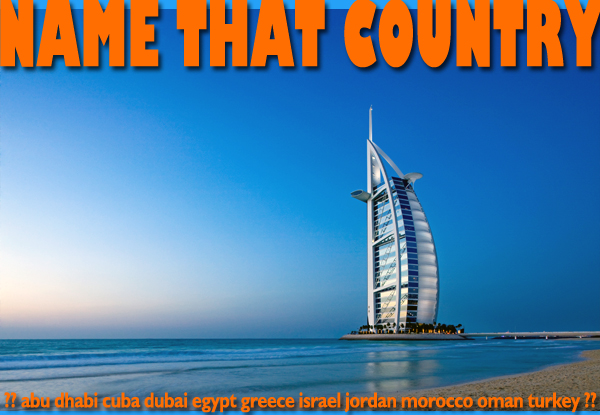
The iconic, sail-shaped Burj Al Arab has been called the only 7-star hotel in the world. Built on an artificial island just off Jumeirah Beach, the only access is by a private bridge (or helipad). Although it’s the world’s 4th tallest hotel, it has only 202 guest suites on 28 double floors. Suites range in size from 1,820 to 8,400 square feet.

Each double floor has its own reception and check-in is done inside the guest suites. Personal butlers attend every guest throughout their stay. For every suite, there are 8 hotel staffers ready to serve.

Can you name that country? 
See below for answers.

Continue reading →

Jerash, Jordan

Roman theater, Jerash, Jordan

Roman theater, Jerash, Jordan

Gerasa (modern Jerash), 30 miles north of Amman, is the second most visited tourist site in Jordan, after Petra, and one of the world’s most extensive Roman sites outside of Italy.

There is evidence that the area has been inhabited since the Neolithic period but serious development began with the Hellenistic Greeks in the 3rd-century BCE. The city grew and prospered under Roman rule and was a member of the Decapolis, ten politically important city-states in the far eastern reaches of the empire. At its height, in the 2nd-century CE, 20,000 people lived in Gerasa.

Temple of Artemis, Jerash, Jordan

Temple of Artemis, Jerash, Jordan

The ancient remains sprawl across an elevated, rolling plain with the modern town and cultivated fields looking on from the surrounding slopes. Much has yet to be uncovered. Demonstrations of gladiator fights and chariot races take place in the hippodrome every day except Tuesday. For three weeks each summer (around late July-early August) the site hosts the Jerash Festival, an acclaimed arts festival with theater, music and dance performances staged among the ruins.

Oval Plaza, Jerash, Jordan

Oval Plaza, Jerash, Jordan

Click to see Jordan tours that include visits to Jerash.

It’s Fig Season in Turkey!

photo by Capucine Fachot-Charbonneau, The Istanbul Guide

photo by Capucine Fachot-Charbonneau, The Istanbul Guide

As you walk down almost any street in Istanbul, save for the main arteries, there’s a distinct perfume of late summer afternoons. The figs have arrived and so has their sweet, heady aroma. Though dried figs are available all year round in Istanbul, there’s nothing like biting into a fresh one, as its perfume hits the back of the throat, and the crunchy seeds heighten the pleasure derived from its sweet chewiness.

Continue reading →

NAME THAT COUNTRY Episode 64

Known as the “Citadel,” the site pictured above is located on the highest of seven hills that make up Amman, the capital city of our mystery country. The area has been continuously inhabited at least since the Bronze Age and excavations have only scratched the surface. Roman, Byzantine and Umayyad remains have been uncovered to date, including the Roman Hercules Temple above, a water cistern and palace from the Umayyad period and a Byzantine church. The national archaeological museum is also located at the Citadel.

Can you name that country? 
See below for answers.

Continue reading →

Madaba, Jordan – City of Mosaics

The modern city of Madaba Jordan sits on top of multiple layers of previous inhabitation, going back some 4,000 years. Walking around town you can see the remains of buried structures poking up through the grass. Among Madaba’s excavated past (and probably the unexcavated as well) is a large collection of mosaic floors, walls and ceilings.

After being mostly abandoned for almost 1,000 years, Madaba began to be resettled in the 1880s by Arab Christians. The first mosaics were discovered as they mined the ancient rubble to build their new town. In 1896, the famous mosaic map of the holy land was found and excavation and preservation of Madaba’s mosaics has continued pretty steadily ever since.

St. George’s Church – This is where you’ll find the mosaic map that put Madaba on the map. A modern-era church stands atop the remains of a 6th-century Byzantine church, the floor of which contained this detailed depiction of the Mediterranean basin. The map was originally over 1,000 square feet but only about 1/4 remains.

the famous Madaba Map

the famous Madaba Map

detail of the famous Madaba Map

detail of the famous Madaba Map

Archaeological Park – This fine open-air museum encompasses the remains of several churches and houses including, of course, some very good mosaics.

Hippolytus Hall mosaic, Madaba Archaeological Park

Hippolytus Hall mosaic, Madaba Archaeological Park

Church of the Virgin mosaic, Madaba Archaeological Park

Church of the Virgin mosaic, Madaba Archaeological Park

Archaeological Museum – Here is a nice little collection of mosaics from Madaba and the vicinity, as well as other artefacts and cultural displays.

Church of St. John the Baptist – Climb the bell tower for sweeping views, then explore the maze of passages that burrow through the hill underneath the church.

Church of the Apostles – If you really can’t get enough mosaics, walk a bit away from the city center to the Church of the Apostles, which houses a beautiful, large mosaic floor.

Church of the Apostles mosaic, Madaba

Church of the Apostles mosaic, Madaba

Um er-Rasas – This is a UNESCO World Heritage Site, although it seems utterly forgotten. Hidden in the expansive field of debris, you’ll find Roman, Byzantine and early Muslim ruins in early stages of excavation. The most spectacular discovery to date is the beautifully preserved mosaic floor of the Church of St. Stephen. The site is about 19 miles south of Madaba.


This photo of Um er-Rasas (Kastrom Mefa’a) is courtesy of TripAdvisor

Wadi Jadid – For a nice juxtaposition to the detailed, micro-artistry of Madaba’s mosaics, travel about 6 miles to the southwest to find a field of megalithic tombs from the 3rd millennium BCE. Most of the dolmens are tumbled down but there are enough standing to give a very satisfying sense of mystery and extreme ancientness.

dolmen at Wadi Jadid, Jordan

dolmen at Wadi Jadid, Jordan

Madaba is located along the famous King’s Highway, about 20 miles south of Amman.
It pairs nicely with visits to Mt. Nebo, Bethany Beyond the Jordan and the Dead Sea.

To see tours to Madaba click here.