Unknown's avatar

About yalla2013

Ya'lla Tours USA is a boutique tour operator offering top quality travel services in 10 exciting countries: Bahrain, Cuba, Egypt, Greece, Israel, Jordan, Morocco, Oman, Turkey and the United Arab Emirates. Ya'lla Tours communications director, Kyna Perry, writes this blog based on personal experience and the deep well of experience and knowledge of Ya'lla colleagues near and far.

NAME THAT COUNTRY Episode 131

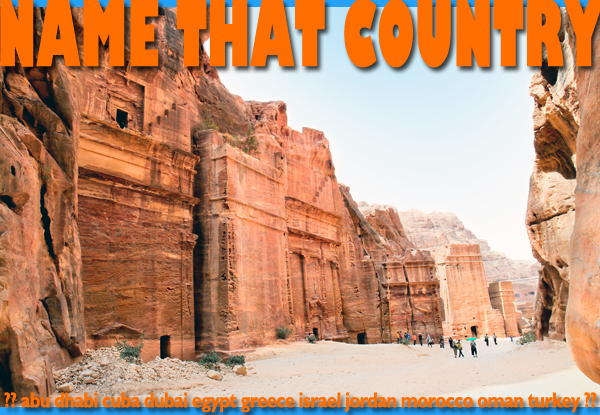
The Street of Facades is a main thoroughfare in the most famous tourist destination of our mystery country. Rock-cut tombs of some of the rich and powerful of this ancient Nabatean city line the section of the street pictured, with more modest tombs further down the way. In this sprawling site, beyond the Street of Facades, are temples, theaters and more tombs, some even more grandiose than those pictured.

Can you name that country? 
See below for answers.

Continue reading

Blessed Are Those

view of the Sea of Galilee from the Church of the Beatitudes, Israel, photo by Itamar Grinberg, courtesy of Israel Ministry of Tourism

view of the Sea of Galilee from the Church of the Beatitudes, Israel, photo by Itamar Grinberg, courtesy of Israel Ministry of Tourism

The Church of the Beatitudes sits on a gentle rise overlooking the Sea of Galilee on the spot traditionally believed to be where Jesus gave his Sermon on the Mount, which opens with the eight Beatitudes. This was one of the earliest sermons of Jesus and is generally believed to present the core values of Christian faith. According to the Gospel of Matthew, the Sermon on the Mount happened just after Jesus began his ministry, traveling around the Galilee region preaching and healing. He was developing a reputation as a wise teacher and miracle worker and people began to seek him out.

Now when he saw the crowds, he went up on a mountainside and sat down.
His disciples came to Him, 2and He began to teach them, saying:

3Blessed are the poor in spirit, for theirs is the kingdom of heaven.

4Blessed are those who mourn, for they will be comforted.

5Blessed are the meek, for they will inherit the earth.

6Blessed are those who hunger and thirst after righteousness,
for they will be filled.

7Blessed are the merciful, for they shall be shown mercy.

8Blessed are the pure in heart, for they will see God.

9Blessed are the peacemakers, for they will be called the sons of God.

10Blessed are those who are persecuted because of righteousness, for theirs is the kingdom of heaven.

11Blessed are you when people insult you, persecute you and falsely say all kinds of evil against you because of me. 12Rejoice and be glad, because great is your reward in heaven, for in the same way they persecuted the prophets who were before you.

Matthew 5:1-12

Foto Friday – Coptic Churches

In honor of Coptic Christmas tomorrow, January 7, 2017, a few images from Coptic churches ~

Monastery of Paul the Anchorite in Egypt's Eastern Desert

Monastery of Paul the Anchorite in Egypt’s Eastern Desert

The Archangel Michael's Coptic Church, Aswan, Egypt

The Archangel Michael’s Coptic Church, Aswan, Egypt

Basilica of the Virgin Mary, Cairo, Egypt

Basilica of the Virgin Mary, Cairo, Egypt

Coptic Chapel in the Holy Sepulchre, Jerusalem

Coptic Chapel in the Holy Sepulchre, Jerusalem

St. Samaan Church, Mokattam Mountain, Cairo

St. Samaan Church, Mokattam Mountain, Cairo

HAPPY CHRISTMAS!

NAME THAT COUNTRY Episode 130

The former Imperial City of Meknes is in the north of our mystery country. Meknes was the seat of the ruling Alaouite Dynasty from the late 17th century to the early 19th century. The dynasty’s founder Sultan Moulay Ismail vowed to make his city rival Versailles and by most accounts succeeded. Some of that grandeur remains, including the glorious Bab el-Mansour gate pictured above. One of the country’s top tourist attractions, the Roman site of Volubilis, is about 30 minutes away from Meknes.

Can you name that country? 
See below for answers.

Continue reading

Wepet Renpet: Ancient Egyptian New Year

In Ancient Egypt, the New Year, Wepet Renpet (literally – the opening of the year), was based on the annual flooding of the Nile River, an earthly cycle which usually coincided with a heavenly cycle as well. In July, priests would watch for the reappearance of the star Sirius after a 70-day absence from view. The star’s return heralded the coming flood and reset the calendar for a new year. Ancients attributed flooding to the gods, but in reality it was due to heavy rains in the Ethiopian highlands.

The New Year was marked with community feasting and a mix of hope and fear. The annual flood left behind rich deposits of silt, which fertilized crops to feed the entire country. Just the right amount of flooding assured a fruitful harvest; too little could mean famine; too much could mean destruction. Flood levels varied from south to north, with higher levels in the south. On average, the river rose about 36 feet. Waters were fully receded in October; then planting began. Since the completion of the Aswan High Dam in 1970, the Nile in Egypt no longer floods.

NAME THAT COUNTRY Episode 129

Biblical wisdom is timeless, but it is often expressed in the activities and settings of very particular times and places. In the northern Galilee region of our mystery country, Nazareth Village provides visitors with living context for some familiar ancient stories.
Visitors observe and participate in daily chores performed in the manner of 1st-century Galilean villagers. Tending animals and crops, pressing olive oil, baking bread… The village buildings and methods of farming and household tasks are based on scholarly research and archaeological evidence.

Can you name that country? 
See below for answers.

Continue reading

Hanukkah is not the Jewish Christmas…

People have plenty of misconceptions about the Jewish holiday of Hanukkah, which this year starts Saturday at sundown. Here, according to a pair of Providence rabbis, are seven places to set the record straight.

It’s not that big a deal
The top myth about Hanukkah has to be its importance, said Rabbi Rachel Zerin of Temple Emanu-El in Providence. About half a dozen other holidays, such as Yom Kippur and Passover, she said, are much more important than Hanukkah for Jews. “In the scheme of Jewish holidays, it’s not a very significant one,” she said. Zerin said she thinks this became a popular idea because the eight-day holiday usually falls around Christmas.

Hanukkah is not the “Jewish Christmas”
Some people think Hanukkah is the Jewish Christmas celebration, especially this year, because it begins on Christmas Eve. But the holiday changes every year, as it does not follow the solar Gregorian calendar used in the United States, but the lunar Jewish calendar. “Very often, Hanukkah can be well over by the time Christmas comes around,” Zerin said.

There are two story lines to Hanukkah, Zerin said. The first celebrates the Maccabean revolt, when the Jews overthrew the Greeks who had taken over the Second Temple in Jerusalem, and outlawed Judaism. The other story is of a miracle, she said. When the Jews entered the Temple after the revolt, it had been destroyed, and the menorah that is always supposed to be burning was no longer lit. Only one jar of purified olive oil was left to light the menorah. It should have only lasted one day, but it burned for eight days, until more oil could be purified, Zerin said. “That’s where we got the tradition of lighting the Hanukkah menorah,” she said, for eight days.

Latkes? Try jelly doughnuts
Potato latkes, or oil-fried potato pancakes, are an important treat on the Jewish holiday. That’s in part to celebrate the importance of oil on Hanukkah. But it’s not the only treat Jews have on the holiday. “In Israel, it’s actually more common to have doughnuts, especially jelly-filled doughnuts,” Zerin said. They’ve started to make their way to the United States, she said, and are sometimes seen here on holiday tables.

Dreidel is just a game after all
The dreidel is a four-sided spinning top with Hebrew letters on each side, and is used to play games on Hanukkah. The letters are taken from the sentence in Hebrew, “Nes gadol hayah sham” — “a great miracle happened there.” The story goes that when the Jews were not allowed to practice their religion, they would meet and read Jewish texts secretly. If soldiers came along, they hid the texts and would take out the spinning tops to play, telling soldiers they were just gambling. “It’s not historically accurate, but that’s the myth,” Zerin said. The game was actually invented later, she said, and taken from a German gambling game that used a spinning top.

Presents aren’t a key to the holiday
On Hanukkah, many children today receive presents over the eight nights of the holiday, said Senior Rabbi Howard Voss-Altman of Temple Beth-El. “Giving presents is just a lovely thing to do,” he said. “It is, in part, so that our children don’t feel deprived of getting presents.” But another big part of the holiday is to give presents or charitable contribution to others, he said. Charity is central to Judaism, and “Hanukkah should be no different,” he added.

It’s not a menorah, it’s a Hanukkiyah
A menorah has seven branches with candles and it symbolizes creation, Voss-Altman said. It is often lit on the Sabbath, he added. But a Hanukkiyah, or Hanukkah menorah, is lit on the eight days of Hanukkah, and has nine branches. One of the candles helps light the others over the eight days, Voss-Altman said.

And finally …; the Hanukkah bush?
“There’s no such thing as a Hanukkah bush,” said Voss-Altman. People with “Christmas-tree envy,” came up with the Hanukkah bush, he said, but there is no religious tradition for a bush to celebrate the holiday. “That’s sort of a comedy thing,” he said, laughing. “There’s no bush for Hanukkah.”

Reprinted from Providence Journal.
Foto Friday – Merry Christmas!

Church of the Visitation, Jerusalem, photo by Noam Chen, courtesy of the Israel Ministry of Tourism

Church of the Visitation, Jerusalem, photo by Noam Chen, courtesy of the Israel Ministry of Tourism

Chora Museum, Istanbul

Chora Museum, Istanbul

Dormition Abbey, Jerusalem, photo by Noam Chen, courtesy of the Israel Ministry of Tourism

Dormition Abbey, Jerusalem, photo by Noam Chen, courtesy of the Israel Ministry of Tourism

Dormition Abbey, Jerusalem, photo by Noam Chen, courtesy of the Israel Ministry of Tourism

Dormition Abbey, Jerusalem, photo by Noam Chen, courtesy of the Israel Ministry of Tourism

Church of the Holy Sepulchre , Jerusalem, photo by Noam Chen, courtesy of the Israel Ministry of Tourism

Church of the Holy Sepulchre , Jerusalem, photo by Noam Chen, courtesy of the Israel Ministry of Tourism

Jerusalem Old City walls, photo by Dafna Tal, courtesy of the Israel Ministry of Tourism

Jerusalem Old City walls, photo by Dafna Tal, courtesy of the Israel Ministry of Tourism

NAME THAT COUNTRY Episode 128

A remote valley on the west of the Nile river shelters the burial grounds of ancient kings and courtiers. To elude robbers, tombs were hidden deep in the folds of the desert mountains. Most were looted anyway, leaving only the exquisite wall paintings for posterity. To date, 63 tombs have been discovered in the Valley of the Kings, ranging in size from a single chamber to sprawling networks of passageways with over 100 chambers.

Can you name that country? 
See below for answers.

Continue reading