
Masada

the Greek Orthodox Church of the Holy Apostles, Capernaum


Akko (Acre)

the ancient synagogue at Capernaum

Masada
the Greek Orthodox Church of the Holy Apostles, Capernaum
Akko (Acre)
the ancient synagogue at Capernaum

This is the Lions Gate at Mycenae on the Peloponnese peninsula. Mycenae was a major center of power and cultural influence in the eastern Mediterranean from about 1600-1100BCE. Mycenean civilization was the first advanced civilization on the mainland of our mystery country. In Homer’s Iliad, Mycenae was among the city states that fought in the Trojan War over the abduction of Helen, wife of the King of Sparta (Menelaus) , who was the brother of the King of Mycenae (Agamemnon).
Can you name that country?
See below for answers.

We get a fair number of requests to see Whirling Dervishes from our travelers to Turkey. If you ever have the opportunity, I highly recommend it. It’s a fascinating and moving thing to witness.
Sufism is a mystical form of Islam and a Dervish is an ascetic follower of Sufism.
A type of Sema, a Sufi ritual, whirling is most associated with the Mevlevi order of Sufis founded in Konya, Turkey. The Mevlevi Dervishes are followers of the 13th-century mystical poet Jalal ad-Din Muhammad Balkhi-Rumi, better known in the West simply as Rumi. In Muslim countries, he’s more often referred to as Mevlana or Mevlevi, which means “our guide.”
Spinning is done to align mind, body and heart with the fundamental movement of the universe and all it contains. Everything is revolving, from subatomic particles to stars, planets and galaxies. Each element of the ceremony in some way symbolizes the submission of the ego to the oneness of God. The camelhair hat worn by the dervishes represents “the tombstone of the ego.” Dervishes remove their black cloak to begin the ritual, symbolizing spiritual rebirth. The white skirt worn while spinning is the ego’s shroud. Dervishes spin with arms wide, right hand open to heaven and left hand pointed down, forming a channel for God’s blessings to flow to the earth. There are four movements to the Sema, each involving submission of different aspects of self to God.
You can witness the Whirling Dervishes in Konya, where they originated, and in Istanbul. Konya is located in south-central Turkey and makes a good stop when traveling between Cappadocia and the coast. It’s perhaps the country’s most conservative city, very religious, and the site of the Mevlana Mausoleum. The Konya Cultural Center has weekly whirling ceremonies that are open to the public. The timing is changeable, so I won’t commit to anything specific here. In Istanbul, Dervishes are whirling daily at various locations. If you’re going, let us know and we’ll get details.
If you’re lucky enough to attend a whirling Sema, please remember that it is worship and should be treated with the proper respect.
Be Lost In The Call
by Mevlana Jalal ad-Din Rumi
Lord, said David, since you do not need us,
why did you create these two worlds?
Reality replied: O prisoner of time,
I was a secret treasure of kindness and generosity,
and I wished this treasure to be known,
so I created a mirror: its shining face, the heart;
its darkened back, the world;
The back would please you if you’ve never seen the face.
Has anyone ever produced a mirror out of mud and straw?
Yet clean away the mud and straw,
and a mirror might be revealed.
Until the juice ferments a while in the cask,
it isn’t wine. If you wish your heart to be bright,
you must do a little work.
My King addressed the soul of my flesh:
You return just as you left.
Where are the traces of my gifts?
We know that alchemy transforms copper into gold.
This Sun doesn’t want a crown or robe from God’s grace.
He is a hat to a hundred bald men,
a covering for ten who were naked.
Jesus sat humbly on the back of an ass, my child!
How could a zephyr ride an ass?
Spirit, find your way, in seeking lowness like a stream.
Reason, tread the path of selflessness into eternity.
Remember God so much that you are forgotten.
Let the caller and the called disappear;
be lost in the Call.

Moulay Ismail Royal Stables, Meknes

Fez Mellah (Jewish Quarter)

Fez Medina (Old City)

Fez Medina (Old City)

Fez Medina (Old City)

For about 400 years, from the mid-15th century, Topkapi Palace was the residence and administrative center of the Ottoman Empire. The sprawling complex occupies the end of a peninsula bordered by 3 bodies of water – the Marmara Sea, the Bosphorus Straight and the Golden Horn. In 1924, the palace became a museum open to the public and is among the most visited sites in our mystery country.
Can you name that country?
See below for answers.
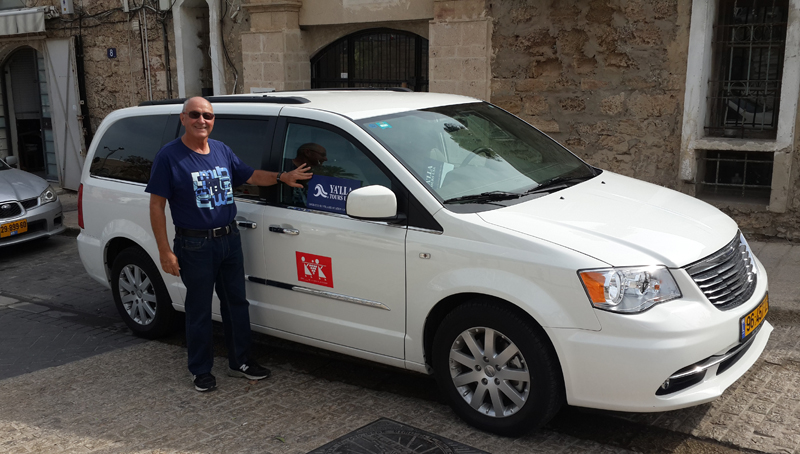
our guide Jacob modeling our touring van
The advantages of a private tour may seem obvious to some, but we get quite a few questions about the distinction between our tours labeled “private” and those labeled “motor coach.” With Ya’lla Tours, and in general, a private tour means that the travel party travels with a guide in a private vehicle. The guide and vehicle are not shared with other travelers. Scheduled motor coach tours in Israel average about 20 passengers in a bus but could have anywhere from 2 to 50 passengers.
The biggest advantage of a private tour is the lower guide to traveler ratio. With a small travel party, there’s the opportunity for much more interaction and conversation between the guide and the travelers. It really becomes like a family unit. Rather than lecturing to a crowd, the guide has the time and proximity to speak directly to and with all of her/his travelers. With large groups at site visits, it can be hard to get close enough to the guide to hear what is being said, much less have a one-on-one discussion. (Don’t get me wrong, even guides of large groups strive to connect with everyone in their flock. I’ve been in groups of over thirty, where every traveler felt personally bonded with the guide. In addition to encyclopedic knowledge about their country, good tour guides possess infinite patience, humor, kindness and energy.)
Moving from place to place is also much easier with a small party. Vans can zip through traffic and maneuver ancient, narrow streets. Despite excellent drivers, motor coaches are far less nimble; it’s just a fact. Also, stops and site visits take considerably less time with a small party, meaning you see more and experience more of the destination. Imagine 2-5 travelers arriving in a van at Capernaum, for example. From the moment they park to the moment they are all gathered around their guide at the site should take five minutes. Now imagine a motor coach group of 20 – 50. Just getting everyone off the bus takes 5 minutes or more, plus another 10-15 minutes before the entire group is standing at attention, ready to learn about the site.
Finally, with a private tour, you have much more flexibility. From the outset, your itinerary is customized to your personal interests and needs. In Israel, this is especially important because, for so many, it is a religious destination. Scheduled motor coach tours are general interest tours designed for broad appeal. While they visit religious sites, the guide’s explanations are academic rather than religious in tone.
With a private tour, you can modify your itinerary as you go to suit your experience on the ground. If you fall in love with Jerusalem’s Old City and want to spend the whole day there, you can do it. Maybe you sacrifice another visit or have a longer day tomorrow to make up what you missed today; but you have options, the private itinerary is fluid. With a motor coach tour, such changes are impossible.
Now, all of this is not to say that we are totally down on motor coach touring. We are not. It’s a good value and can be a fun social experience, meeting and touring with people from all over.
Check out tour private and motor coach tours to Israel at www.yallatours.com/israel/


This is Sur, on the northern coast of our mystery country, about 90 miles northeast of the capital city, Muscat. Sur has been a regional center of ship building for centuries. Visitors can tour the ship yards and observe craftsmen building the traditional vessels in the same way they have done for many generations. The ship pictured is the Fatah Al Khair, a type of Al Ghanjah ship, built in 1951. The semicircular keel is one of the signature features of Sur ship builders.
Can you name that country?
See below for answers.

a cat mummy at Luxor’s Mummification Museum
For those interested in mummies and/or ancient Egyptian religion, the Mummification Museum in Luxor is well worth a visit. Most of the mummies on display are animals (currently there is just one human mummy), which gives insight into the reverence ancient Egyptians held for animals. The museum is dedicated to the process of mummification and the belief system behind it. Exhibits are well organized and include beautiful examples of mummification tools, sarcophagi and canopic jars, which held organs removed from the embalmed body. Thirty to forty minutes is plenty of time to see everything and leave with a good understanding of ancient Egyptian mummification. The museum is right on the Nile Corniche in the center of Luxor, just north of the Luxor Temple.

Royal Palace, Rabat

Fez medina

Fez medina

Madrasa Bou Inania

foothills of the Atlas Mountains
 The Ya'lla Blog