Unknown's avatar

About yalla2013

Ya'lla Tours USA is a boutique tour operator offering top quality travel services in 10 exciting countries: Bahrain, Cuba, Egypt, Greece, Israel, Jordan, Morocco, Oman, Turkey and the United Arab Emirates. Ya'lla Tours communications director, Kyna Perry, writes this blog based on personal experience and the deep well of experience and knowledge of Ya'lla colleagues near and far.

5 Things To Do In Muscat, Oman

Royal Opera House of Muscat
This is a magnificent building, inside and out. If you’re able to catch a performance there, we’re thrilled for you and a bit envious. If not, we highly recommend a taking a tour. The monumental proportions, sublime design and state of the art technology are testament to the high value Sultan Qaboos places on the arts. He’s a big fan of classical music himself but he had the opera house built for the people of Oman and visitors. Besides world-class performances, the opera house offers arts education programs, lectures and workshops.

Al Alam Palace
This is the ceremonial palace of the sultan of Oman. It’s not open to the public but it’s easily accessible for photos and visual consideration from the front and back. It’s a very unique piece of architecture, especially the central building, which I found kind of obnoxious initially, to be honest. But the more I look at it, the more I love it. It was completed in 1972, which explains a lot. The modern, organic Islamic style is whimsical and flamboyant in the most friendly way. I love it even more now than I did when I started writing this paragraph.

Sultan Qaboos Grand Mosque
Another awesome building, outside it’s all cool, serene elegance, with gleaming marble surfaces and pearly arches. Inside, the exposed timber ceilings are warm and earthy, while heavenly multitudes seem to open out to infinity in the massive central dome. Modestly dressed non-Muslims are welcome.

Stroll the Corniche
The Muttrah Corniche pedestrian promenade rambles for about 3km along the sea wall in the Muttrah district of Muscat. If you avoid the midday heat, it’s bustling with locals and visitors and is the perfect vantage from which to take in harbor sights on one side and the pretty sea-front avenue backed by the craggy Hajar mountains and old Portuguese watch towers on the other side. From the corniche you can access the fish market, best in the early morning, and the adjacent fruit and vegetable market and down the way is the Muttrah Souk. You’ll find benches, a park and fountains along the corniche.
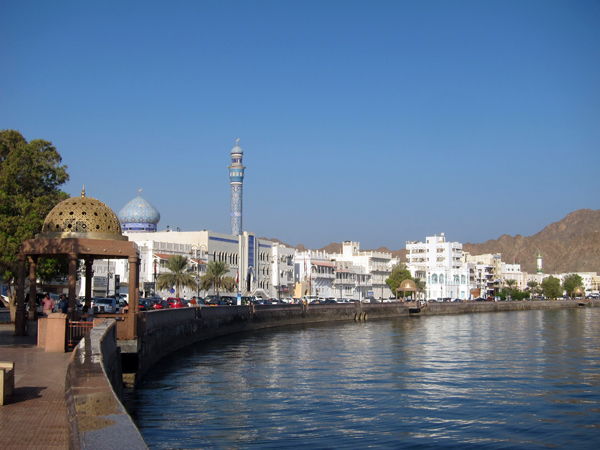
Muttrah Corniche, Old Muscat, Oman

Muttrah Corniche, Old Muscat, Oman

Muttrah Souk
This, the oldest market in Oman, is a must, whether or not you’re a shopper. The streets closest to the corniche are pretty touristy but if you persevere into the maze you’ll find a feast of authentic shops. Some good buys are gold, silver and frankincense. Be sure to bargain. The souk closes from about 1-5pm each day and it especially bustles with locals in the evenings.

Read more about Oman here.
See more pictures of Oman here and here.
See our tours to Oman here.

NAME THAT COUNTRY

Taroudant is an authentic Berber market town, smaller and more low-key than our mystery country’s more popular destinations, Marrakech and Fez. It’s located in the gorgeous Souss Valley in the south of the country, framed by the High Atlas Mountains to the north and the Anti Atlas to the south. Atlantic beaches are just an hour away.The walls around Taroudant are the most intact in the country. You will meet few tourists here, if any.


Can you name that country? 
See below for answers.

Continue reading

Pergamum in Turkey

Temple of Trajan, Pergamum, Turkey

Temple of Trajan, Pergamum, Turkey

Pergamum is an ancient Greco-Roman city in western Turkey, about 15 miles from the Aegean coast, 60 miles from Izmir, the closest airport, 110 miles from Ephesus, and about 320 miles from Istanbul. The modern town on the site is Bergama.

Continue reading

NAME THAT COUNTRY

This stretch of the Kidron Valley lies between Mount Moriah and the Mount of Olives in one of the world’s holiest cities. The valley continues eastward about 20 miles to the Dead Sea. The valley and adjacent slopes have been burial grounds for thousands of years due to their association with End Times in Judaism, Christianity and Islam.


Can you name that country? 
See below for answers.

Continue reading

The Underground Cities of Cappadocia

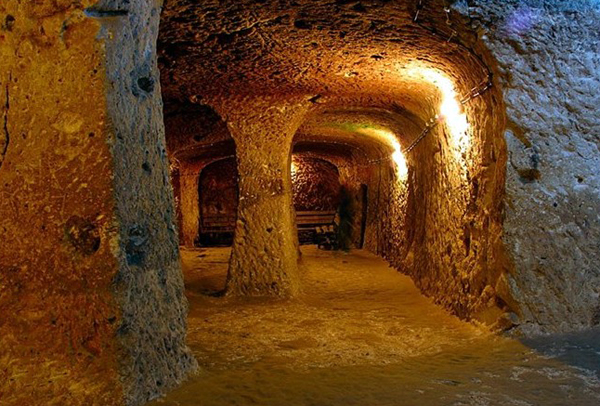
Derinkuyu underground city, Cappadocia, Turkey

Derinkuyu underground city, Cappadocia, Turkey

There are 40 some underground cities in the Nesehir and Kayseri provinces of Cappadocia in central Turkey. Some estimates put the number into the hundreds, while others count around 40. My guess is the discrepancy lies in how one defines “city.”
For our purposes, and those of the average tourist, 40 is more than enough. Most are not open to the public anyway, so we’ll focus on two that are: Derinkuyu and Kaymakli.

Extending down 200 feet with 8 levels, Derinkuyu is the deeper of the two cities but Kaymakli has more sprawl. They are connected to each other by tunnels, as are many of the other underground cities.

The cities possibly originated in Hittite times, around 1200 BCE, but were certainly, significantly expanded over the centuries, especially during Roman persecution of Christians in the 2nd and 3rd centuries and again in the 7th century, with the Arab invasions. Really, this part of the world was a superhighway for invaders, and the inhabitants had reason to hide on a regular basis. They got very good at it.

The underground cities were set up to shelter as many as 20,000 for long-term living and include sleeping quarters, kitchens, storehouses, churches, stables and even a winery. Ventilation shafts doubled as wells. Passageways allowed single file movement only, so intruders could be easily picked off one at a time. Giant boulders served as rolling doors that could only be removed from the inside. The doors had small holes in the center, just the size and height to spear the unwelcome in the gut, or thereabouts. For quick and easy access, most above-ground homes had openings to the underground right inside or very near the houses.

For most visitors, it’s enough to see one of the two cities. Each takes about an hour to tour. There’s very little signage, so a guide is highly recommended. Passageways are narrow but allow people of average height to get through with minimal stooping. Lighting is good, but if you’re claustrophobic, you might want to stick to the plentiful and thoroughly satisfying above-ground attractions of Cappadocia.

To get to Cappadocia, there are daily flights from Istanbul to Kayseri, in the heart of the region. Ankara is about a 3-hour drive. Istanbul is about a 10-hour drive. The more comprehensive tours of the western half of Turkey will do a semi-circle from Ankara, through Cappadocia, down to the coast and on to Istanbul.

See my last post Cappadocia Above and Below for descriptions of other things to see in Cappadocia.

Click to see our tours that include underground visits in Cappadocia.

Foto Friday – Oman

Sultan Qaboos Grand Mosque, Muscat, Oman, photo by Sallie Volotzky

Sultan Qaboos Grand Mosque, Muscat, Oman, photo by Sallie Volotzky

Sultan Qaboos Grand Mosque, Muscat, Oman, photo by Sallie Volotzky

Sultan Qaboos Grand Mosque, Muscat, Oman, photo by Sallie Volotzky

Sultan Qaboos Grand Mosque, Muscat, Oman, photo by Sallie Volotzky

Sultan Qaboos Grand Mosque, Muscat, Oman, photo by Sallie Volotzky

Al Hamra village, Oman, photo by Sallie Volotzky

Al Hamra village, Oman, photo by Sallie Volotzky

local entertainment in the Sharquiya Sands desert of Oman, photo by Sallie Volotzky

local entertainment in the Sharquiya Sands desert of Oman, photo by Sallie Volotzky


NAME THAT COUNTRY

Beautiful boxes inlaid with mother of pearl are a popular souvenir from our mystery country, and just one of countless items to be browsed in the streets of Khan el Khalili Bazaar. We recommend visiting with a guide and exploring beyond the touristy areas (where many products are made in China). A guide will help navigate the maze of small streets for a more authentic experience in this historical market and make sure you get what you pay for.


Can you name that country? 
See below for answers.

Continue reading

Cappadocia Above and Below

Cappadocia is a region in central Turkey known for surreal sights, rich history and laid-back hospitality. Heavy volcanic activity followed by millions of years of erosion of the soft volcanic ash deposits and the harder layers of basaltic lava which covered them left over a hundred square miles of constantly surprising landscapes, sometimes comical, sometimes stunningly beautiful, often just plain weird.

Historical records tell us the Hittites lived in the area around 3,000 years ago, but it was certainly inhabited long before that. Early Christians settled there in the fourth century, perhaps earlier, because of the remoteness from the Roman centers along the coast. Three major figures in Christian history, the Cappadocian Fathers – St. Basil, St. Gregory of Nyssa and St. Gregory of Nazianus – came from Cappadocia and were involved in the establishment of monasteries there. Scores of rock-cut, frescoed, Byzantine churches, chapels and monasteries are tucked into the crazy landscape like precious jewels.

Apple Church, Goreme, Cappadocia

Apple Church, Goreme, Cappadocia

Buckle Church, Goreme, Cappadocia

Buckle Church, Goreme, Cappadocia

St. Barbara Church, Goreme, Cappadocia

St. Barbara Church, Goreme, Cappadocia

Cappadocia contains many different areas of fantastical rock formations, rock-cut and cave dwellings and churches, underground cities and magnificent scenery. Two days is enough time to see the highlights but you could easily spend a week or more, especially if you want to hike or cycle and explore a bit off the beaten path. Here below is a brief overview of the main attractions:

The Goreme Open Air Museum is #1 for quantity and quality of churches in combination with scenic wonders. If you’re short on time, go here first.

About 4 miles to the southwest is the highest point in Cappadocia, the Uchisar Citadel, which is fun to explore, and the Pigeon Valley between Goreme and Uchisar is a beautiful, moderate hike.

About 3.5 miles north of Goreme is Avanos, a pretty town on the Kızılırmak River.
Go there to buy the local pottery, which has been the town’s main industry for thousands of years.

Head east about 3 miles off the road to Avanos to find the Zelve Open Air Museum. Zelve consists of three adjoining valleys, where you’ll find cone formations and fairy chimneys, similar to Goreme, but nowhere near as many churches. Zelve gets far fewer tourists and what it lacks in frescos it makes up for in tranquility and open space.
Very good trails and signage run through the valleys. When you’re exploring Zelve, think about the people who lived in the rock-cut dwellings right up until 1952.

The underground cities of Kaymakli and Derinkuyu are about 18 and 24 miles southwest of Goreme, respectively. I’ll write more about these in my next post.

The Ihlara Valley is a beautiful valley with rock-cut churches and monasteries but none as dramatic or well-preserved as those of Goreme. However, the scenery alone is worth a visit. It’s about 75 miles southwest of Goreme.

Ihlara Valley, Cappadocia

Ihlara Valley, Cappadocia

On the way to Ihlara, stop at the carefully preserved Ottoman Greek town of Guzelyurt. Cappadocia was historically inhabited by Christian Greeks until a population exchange after World War I moved Greek-speaking inhabitants to Greece and Muslims living in Greece to Turkey. Guzelyurt also has a small underground city.

To get to Cappadocia, there are daily flights from Istanbul to Kayseri, in the heart of the region. Ankara is about a 3-hour drive. Istanbul is about a 10-hour drive. The more comprehensive tours of the western half of Turkey will do a semi-circle from Ankara, through Cappadocia, down to the coast and on to Istanbul.

For Cappadocia accommodations, Goreme, Urgup, Uchisar and Avanos are most central. Goreme has the most tourist facilities but we prefer the slightly removed towns of Urgup and Uchisar, which are quieter and tend toward higher quality services.

Click to see our Turkey tours that include Cappadocia.