Unknown's avatar

About yalla2013

Ya'lla Tours USA is a boutique tour operator offering top quality travel services in 10 exciting countries: Bahrain, Cuba, Egypt, Greece, Israel, Jordan, Morocco, Oman, Turkey and the United Arab Emirates. Ya'lla Tours communications director, Kyna Perry, writes this blog based on personal experience and the deep well of experience and knowledge of Ya'lla colleagues near and far.

NAME THAT COUNTRY Episode 38

Between sea and desert, a swath of craggy mountains are rich with exquisite valleys or wadis, where rugged terrain shelters clear, fresh-water pools, lush palm groves and waterfalls. These natural features are treasured by our mystery country and attract the range of visitors, from picnicking local families to adventure-seeking travelers from abroad. Around the edges, wadis can be gentle and easy to access but most often a 4-wheel drive will be required. A hike into the depths of a wadi will likely involve climbing over large rocks and wading or swimming through fresh water pools.

Can you name that country? 
See below for answers.

Continue reading →

L’Chaim! a Brief Look at Wine in Israel

vineyards in the Upper Galilee

vineyards in the Upper Galilee

Jews, in general, have never been big drinkers, but they have been making wine for use in ritual for thousands of years. Most of that wine was pretty awful, maybe purposely so, to discourage recreational imbibing. If you’ve ever tasted Manischewitz wine, you know what I mean. Continue reading →

NAME THAT COUNTRY Episode 37

 You might be surprised to learn that this mystery city is not all about extravagant, record-breaking real estate developments, luxury shopping and fast cars. It has a slower, more traditional side too. In the days before fossil fuel powered air-conditioning, wind tower houses like the one pictured above kept occupants cool in the searing heat and wicked humidity of this desert by the sea. Wind is drawn down into the tower and cooled by water standing at the bottom before circulating through the building.

Can you name that city? Country? What about the site?
See below for answers.

Continue reading →

Prometheus, Pandora & the Cost of Fire

Prometheus Brings Fire to Mankind, Heinrich Friedrich Fuger, 1817

Prometheus Brings Fire to Mankind, Heinrich Friedrich Fuger, 1817

Prometheus was a surviving member of the Titan generation after the cosmic war between Cronus and his Titans and their offspring the Olympian gods, led by Zeus. Prometheus sat out the conflict and escaped the fate of the Titans, who were banished to Tartarus, the deepest, most torturous pit of the underworld, after their defeat by the Olympians. Continue reading →

Foto Friday – Israel

All the images in this post are courtesy of our friends at the Israel Ministry of Tourism.

Church of Mary Magdalene, photo by Noam Chen

Church of Mary Magdalene, photo by Noam Chen

Mona Lisa of the Galilee at Zippori, photo by Itamar Grinberg

Mona Lisa of the Galilee at Zippori, photo by Itamar Grinberg

Continue reading →

NAME THAT COUNTRY Episode 36

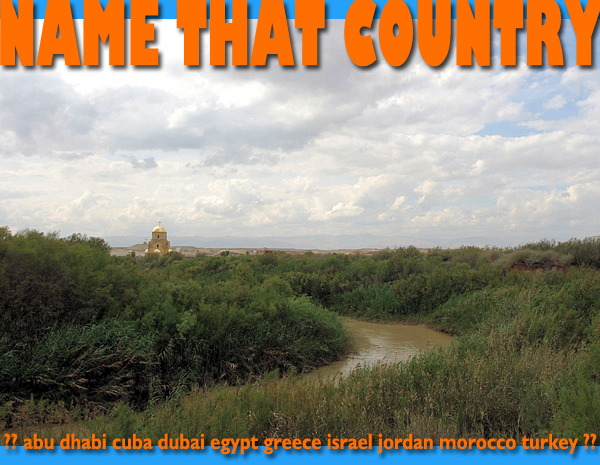
 You might not expect to find such a lush place in our mystery country, which is largely desert. This small green ribbon is in the far west of the country. The river pictured forms part of the western border. This specific place has been a site of Christian pilgrimage since the 4th century, if not before. The Greek Orthodox church in the distance is a modern addition but the remains of ancient churches and lodgings for pilgrims are scattered around the site. Excavations only began 20 years ago, after our mystery country and its neighbor to the west made peace.

Can you name that country? What about the site?
See below for answers.

Continue reading →

The Hamsa: What Does it Mean?

If you’ve traveled in the Middle East no doubt you have seen the hamsa, a talisman in the shape of an open hand. The name is related to the word for ‘five’ in Hebrew (hamesh) and Arabic (khamsa). Five fingers on the hand raised in a “STOP, in the Naaame of Love” or “Talk to the HAND” gesture make a powerful defense against evil-eye generated mischief and also bring good luck.

Beautiful, stylized hands are everywhere in the Middle East and North Africa, especially in Israel, adorning homes and bodies. Hamsas often include extra protective elements in the palm, like an eye, bits of scripture or fish (believed to be immune to the evil eye).

Hamsa origins are deep and murky. Magically protective hands have been found in ancient Egyptian and Mesopotamian artefacts. And what about all those hands in prehistoric cave paintings? In Sephardic Jewish tradition, the symbol may begin in Medieval Kabbalah, where it represented the hand of God.

40,000-year-old hamsas? from a cave in Indonesia

40,000-year-old hamsas? from a cave in Indonesia

The hamsa may also be called the hand of Fatima (daughter of Mohammad), the hand of Miriam (sister of Moses) and the hand of Mary (mother of Jesus) and is sometimes associated with the Five Pillars of Islam and the five books of the Torah. By association with the hand, the number five is considered powerful.

If you have a rabbit foot dangling from your key chain, add a hamsa for good measure. Better yet, convert to hamsa 100% and boycott the rabbit foot industry.

Please don't take my foot.

Please don’t take my foot.

NAME THAT COUNTRY Episode 34

 This site is located on the northern coast of our mystery country. It’s one of the world’s oldest continuously inhabited places. It changed hands as a major port from Phoenicians to Greeks to Romans to various Muslim dynasties to Crusaders to Ottomans, and for a time, was one of the two most populous cities in the country. Today, the 12-century fortress of the Knights Hospitaller, known as the Knights’ Halls, is a popular attraction. The founder of the Baha’i faith spent the last years of his life here and his shrine is the most important place of pilgrimage for the Baha’i faithful. The city is also full of lovely old mosques, churches and synagogues.

Can you name that country? What about the site?
See below for answers.

Continue reading →

Gobekli Tepe – World’s First Temple?

Gobekli Tepe is an archaeological site in southeastern Turkey, about 12km from the city of Sanliurfa. It’s somewhat off the standard tourist track and, frankly, a bit too close to Syria for comfort right now, but it’s such an extraordinary place, it’s worth pondering and perhaps adding to your list of places to visit in a more peaceful future.

When first discovered in 1994 by German archaeologist Klaus Schmidt, Gobekli Tepe rocked the archaeological world, and continues to do so.

The theory has (had?) been that agriculture set civilization in motion. Previously nomadic, hunter-gatherers settled in permanent communities in order to plant crops and domesticate animals. With the settled, communal lifestyle and reliable food sources came more leisure time and division of labor. Art and organized religion were byproducts of this new situation. Religion inspired monumental building, which required the kind of planning, specialized skill and large labor force only available in cities.

Gobekli Tepe turns that theory on its head. The earliest phases of this temple complex were built before the advent of agriculture and there is no sign of a permanent settlement nearby. All evidence suggests that it was exclusively a religious sanctuary. So, perhaps it was a spiritual impulse, rather than a physical need, that set humans on the path toward civilization.

The hilltop complex consists of several layers from different periods between the 10th and 8th millenniums BCE and is only partially excavated to date. (That’s 7,000 years before the Giza Pyramids!) In the oldest layer, pillars are embedded in walls encircling 2 central pillars. There are 20 such spaces. The pillars are limestone, ranging from 10-20 feet tall and weighing up to 16 tons. They were likely brought from a quarry more than a mile distant. The pillars are capped, like a T, perhaps representing the human form. Some of the pillars have human arms carved into them. Many have relief carvings of animals and painted symbols. They would have been carved with flint tools.

Particularly mysterious is the fact that sometime after 8,000 BCE, the whole sanctuary was purposefully buried. Many tons of ancient garbage – flint debris from tool making, and animal bones – was hauled up the hill and dumped into the temples to cover them completely.